Act 1
Scene 1
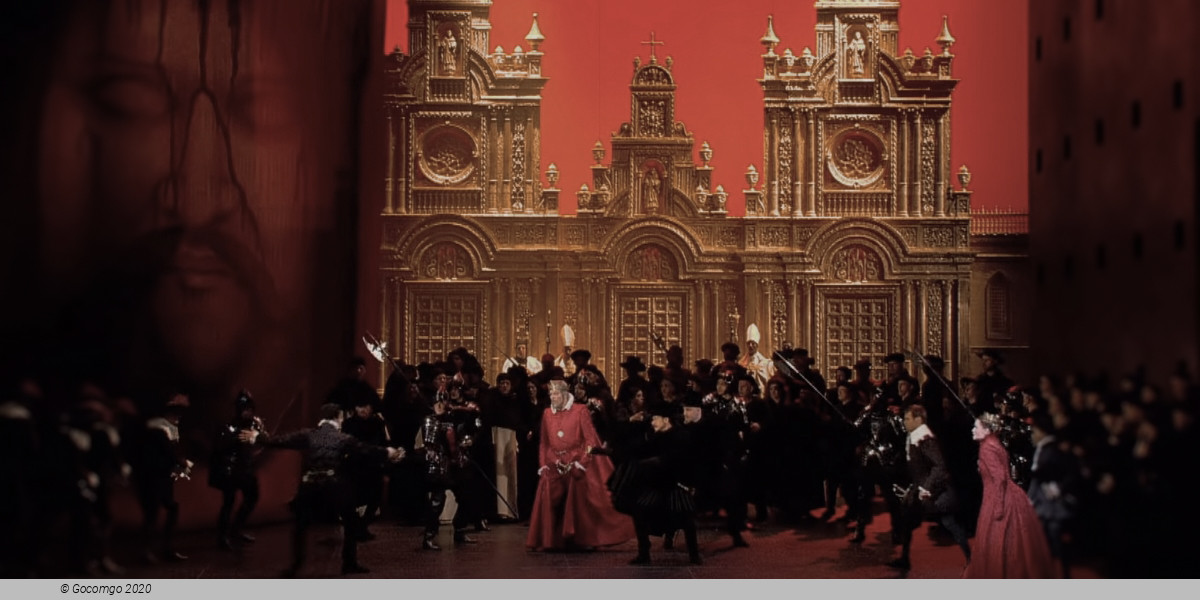
The sudden death of the king and remarriage of his mother Queen Geltrude to his uncle Claudio has depressed Prince Amleto. Still mourning his father and in shock at his mother’s strange remarriage, Amleto refuses to take part in the coronation festivities at Elsinore Castle (Ah, si dissolva quest’abbietta carne). Ofelia reminds him of love’s eternal power (Dubita pur che brillino). Amleto’s friend Orazio and Marcello, a sentry, arrive, having seen the ghost of Amleto’s father walking the castle at night. The three decide to keep watch for the ghost.
Scene 2
Amleto, Orazio, and Marcello keep watch from a castle parapet. The ghost appears, indicating that he wishes to speak to Amleto alone (Tu dêi sapere ch’io son l’anima lesa). Revealing that his brother, Claudio, murdered him and took his crown, he implores Amleto to avenge him. Amleto swears revenge and compels his friends not to reveal what they have seen that night.
Act 2
Scene 1
In the castle, Lord Chamberlain Polonio, Ofelia’s father, tries to convince Claudio and Geltrude that Amleto’s melancholy is a symptom of his love for Ofelia. The three withdraw, and Amleto enters, meditating on suicide (Essere o non essere / "To be or not to be"). Ofelia enters and tries to return some tokens that he had given her. Feigning madness, Amleto demands that she renounce worldly love and enter a convent (Fatti monachella) and decries marriage. A group of travelling singers arrives and Amleto decides to have them stage a play depicting a regicide similar to his father’s, so he can observe Claudio’s reaction.
Scene 2
The court gathers for the play, and Amleto instructs Orazio and Marcello to watch Claudio closely. Amleto calls the play The Trap (la trappola), but assures everyone that there is nothing offensive in it. As the play progresses, Claudio becomes increasingly agitated (Regina nel core), while Geltrude admonishes his foolish behavior. At the play’s climax, Claudio runs from the room, horrified. Amleto revels in the success of his plan (Viva la trappola!)
Act 3
Scene 1
Alone in his chambers, Claudio is overcome by remorse (O nera colpa!). Amleto enters and is about to strike, but realizes that if he kills Claudio in prayer, Claudio will be sent to heaven. Desiring a more opportune moment, he withdraws. Claudio prays (O Padre nostro), but at the conclusion, he recants and exits.
Polonio enters with Geltrude, and urges her to calm Amleto. As Amleto approaches, Polonio hides behind a tapestry. Amleto and his mother argue and Amleto threatens her. Polonio cries for help. Believing Claudio is hiding behind the tapestry, Amleto stabs Polonio, realizing his error too late. In his delirium, Amleto rails against the king’s wickedness (O re ladrone). The ghost enters, ordering Amleto to focus on vengeance. Amleto begs the ghost for forgiveness (Celesti spirti! o lugubre). Geltrude, who does not see the ghost, believes that Amleto has gone mad.
Amleto withdraws, and Geltrude privately admits her guilt (Ah! che alfine all’empio scherno).
Scene 2
Laerte storms the castle, demanding justice for the murder of his father, Polonio. Claudio calms him, and the two watch in horror as Ofelia enters, now insane, imagining her father’s funeral (la bara involta). Claudio informs Laerte that Amleto killed Polonio; Laerte swears revenge, and both exit. Hearing the name "Amleto", Ofelia descends deeper into her madness (Bell’alberel dolente), eventually drowning herself in a brook.
Act 4
Scene 1
Two gravediggers are busy at work, preparing for a funeral (Oggi a me, domani a te). Amleto and Orazio enter and banter with one of the gravediggers. Hearing a crowd approach, they hide. A lengthy funeral procession enters, bearing Ofelia’s body. Laerte curses Amleto (Che Iddio scaraventi l’ardente saetta), who then reveals himself. Amleto and Laerte briefly fight. Amleto claims that he loved Ofelia (Io quella morta amai). Claudio urges Laerte to come away, referencing a secret plan to deal with Amleto.
Scene 2 (only extant in the original 1865 version)
A herald announces to the court that Amleto and Laerte will fence for sport (Illustri cortigiani e cavalieri). Laerte assures Claudio that the tip of his sword is poisoned. Amleto publicly apologizes to Laerte, claiming temporary insanity. Both men begin their duel and when Amleto gains a point, Claudio offers a toast, urging Amleto to drink from his cup (La coppa è colma). Busy with the duel, Amleto declines, while Geltrude murmurs to Claudio that she knows the cup is filled with poison. After Amleto gains another point, Claudio offers Amleto a drink again, but Geltrude seizes the cup, drinks, and faints. While Amleto is distracted, Laerte wounds him with the poisoned sword. Enraged, Amleto disarms his opponent, switches swords with Laerte, and wounds him. Laerte confesses that he is dying, a victim of his own undoing, and that Claudio’s cup was poisoned. Amleto stabs Claudio, before dying himself.




 Via Roma 4