All events take place in Rome, on July 14, 1800, and the next morning.
ACT I
The Church of St. Andrea della Valle, approaching noon. A quick succession of five, rather harsh sounding chords provides a brief introduction to the drama about to unfold. A restless, syncopated tune accompanies the appearance of a nervous looking man in the now completely deserted nave of the church. Upon hearing the sound of footsteps in the distance, he scurries away into the shadowy interior of the Attavanti family chapel. Enters the sacristan, who then busies himself with the preparation of the paintbrushes for one Cavaradossi, an artist working on the picture of Maria Magdalene. The church bells sound off the high noon and the sacristan promptly says his Angelus prayer. And soon enough Cavaradossi himself appears on the scene. Before he actually sets out to continue his work on the picture, he ponders the striking resemblance of the biblical woman on his canvas with the elusive lady often coming in to pray in the church. His loud reflections on the subject (an aria: "Recondita armonia") really shock the sacristan, who rather indignantly comments on the event in clearly audible aside, while slowly taking his leave. The man who had previously hidden himself in a side chapel, now tries to make his exit from church as unobtrusively as possible, but eventually bumps straight into Cavaradossi, who at first fails to recognise in the tattered looking individual his good friend - one Cesare Angelotti, the former consul of the Roman Republic, who - in the wake of its fall and the and the reinstatement of the Ecclesiastical State by the Neapolitan army - had been imprisoned in the Castle of the Holy Angel and just managed to make good his escape. It soon transpires that the elusive lady from Cavaradossi's canvas happens to be his sister, the Marchioness Attavanti, who left behind in the chapel the necessary disguise she would normally use. Their conversation is broken by the arrival of Cavaradossi's beloved, the famous Roman singer - one Floria Tosca. She has been suspecting the artist of having an affair. Her suspicion is further fuelled by the familiar looking features of the woman on the canvas (arioso: "Non la sospiri la nostra casetta"). Cavaradossi somehow manages to alleviate the jelousy of his beloved and convince her of his deep running affection for her (a duet: "Qual occhio al mondo puo sturdi paro"). After she has left, the thundering sound of a cannon shot can be heard, announcing that Angelotti's escape has been finally discovered. Cavaradossi swiftly decides to hide his friend safely away in his nearby villa. A number of people run into the church: the sacristan, followed by the alter-boys and the young clergymen, all of them rejoicing at the news of victory over the army of the consul Bonaparte in the battle of Marengo. Their happy prancing about is stopped by the sudden arrival of the sinister looking and fear inspiring prefect of police, one Baron Scarpia and his henchmen. He has been clearly expecting to find here his much wanted fugitive, although his suspicion also falls upon Cavaradossi, notorious for being articulate with his liberal sentiments. Having accidentally stumbled across a fan apparently lost by Marchioness Attavanti during her hasty retreat, he promptly embarks upon a rather sinister plan: by arousing jelousy in Tosca he might just kill two birds with one stone - make Tosca quite unwittingly help him find Angelotti, the fugitive, and by the same token rid him of his rival in his hitherto most unsuccessful attempts to win her affection ("What a handkerchief was to Yago, a fan would be to me"). The congregation is slowly filling in the empty naves of the church and the thanksgiving service soon begins. The sinister looking Scarpia, with the powerful Te Deum and organ music in the background, starts plotting his conspiracy (grim sounding monologue, rendered in unisono: "Tosca! Nel tuo cuor s'annida Scarpia").
ACT II
Scarpia's office in the Palazzo Farnese the same day in the evening. The orchestra's rhythm is a background for the introduction to the love duet between Tosca and Cavaradossi from the previous Act. Now, lonely Scarpia is tormented by the thought that the happiness of mutual love is not accessible to him (monologue: "Ha più forte sapore"). The tune of the gavotte is heard through an open window. It is played in the Palace reception chambers where the Neapolitan Queen Maria Carolina is staying. Having failed to catch the fugitive, the guards bring in Cavaradossi. Without concealing his convictions, Cavaradossi refuses to give any testimony. The nervous atmosphere of interrogation is contrasted with a distant solemn cantata, with the voices of Tosca and the chorus. That makes Scarpia try again to use a woman in getting information required to apprehend Angelotti out of the current captive. When Tosca arrives called by Cavaradossi, he is subjected to tortures in the adjacent room. Unable to withstand agonizing cries of her lover, desperate Tosca reveals Angelotti's hiding place. Scarpia orders Spoletta with revengeful satisfaction to arrest the fugitive only when the barely conscious painter is removed from the room. He understands that his resistance and suffering were in vain, and he was betrayed by his lover. At the same time, a messenger brings the news that the winners of the Battle of Marengo are Bonaparte and his French Army. Weakened Cavaradossi starts to sing the anthem of freedom ("Vittoria! Vittoria!"), sealing his fate. After he is removed to a death chamber, Tosca and Scarpia negotiate the release of the artist. The Baron equally denies a proposal of bribery (monologue: "Già, mi dicon venal"), and begging for mercy (Tosca's aria: "Vissi d'arte, vissi d'amore"). The only price that may satisfy him is Tosca herself. In return, he promises to carry out a mock execution, and guarantee safe conduct for the lovers to leave Rome. Desperate Tosca accepts that condition, but, once the letter is written, Scarpia advances to embrace Tosca who catches spontaneously a knife and stabs the hated murderer. Seeing the dead corpse, she is unable to refrain from saying symbolic words: "The whole Rome was terrified by him", and, either directed by bad conscience or out of revenge, she places candles around the corpse, takes a crucifix from the wall, puts it on the corpse and quickly leaves the scene of crime.
ACT III
The terrace of the Castel Sant' Angelo the day after, about 3 hours before dawn. First, we can hear a motif played by four French horns in unison. Next, come distant sounds of cattle bells, a song of an unlucky shepherd lover, followed by the Church bells, with St. Peter's Basilica in the background. Cavaradossi is brought to the place of execution, but instead of seeing a confessor, in his last wish, he requests to be able to write a farewell letter to his lover. He looks at the starry sky and the dawning day, and he evokes his memories (four cellos summarize briefly the love duet motif from Act I, turning into the theme that accompanies Tosca's concerns in Act II, followed by the clarinet starting the tune which is continued by a male singer in the aria: E lucevan le stelle. But suddenly, Tosca enters with a joyful news that soon their torments will end, and they will regain long awaited freedom. When Cavaradossi shows concern about the possible way of her gaining mercy for him, she admits committing the crime (aria: "Il tuo sangue o il mio amore volea"). The singer's voice is rising in the climax to c3, and falls down by two octaves. Although originally Puccini contemplated only a passage within a single octave, to increase the effect, a practice developed to prolong it by another octave. Now, the lovers are encouraged by hopes and they plan their future (duet: "O dolce mani"), and Tosca relying on her acting experience instructs Mario how to behave during the execution and pretend to be dead. The execution squad arrives, and the protagonist leaves with it outside the scene. Tosca observes the course of events from a distance, and, once the soldiers are gone and the terrace is empty, she rushes to her lover and encourages him to get up and flee with her. Suddenly, she becomes aware that the execution was real, and the painter is dead. In the meantime, Spoletta arrives with the guards since the murder of Scarpia has been discovered. He orders to arrest Tosca. The lady evades the guards, climbs to a wall and jumps into a precipice.
Lesław Czapliński
Act 1
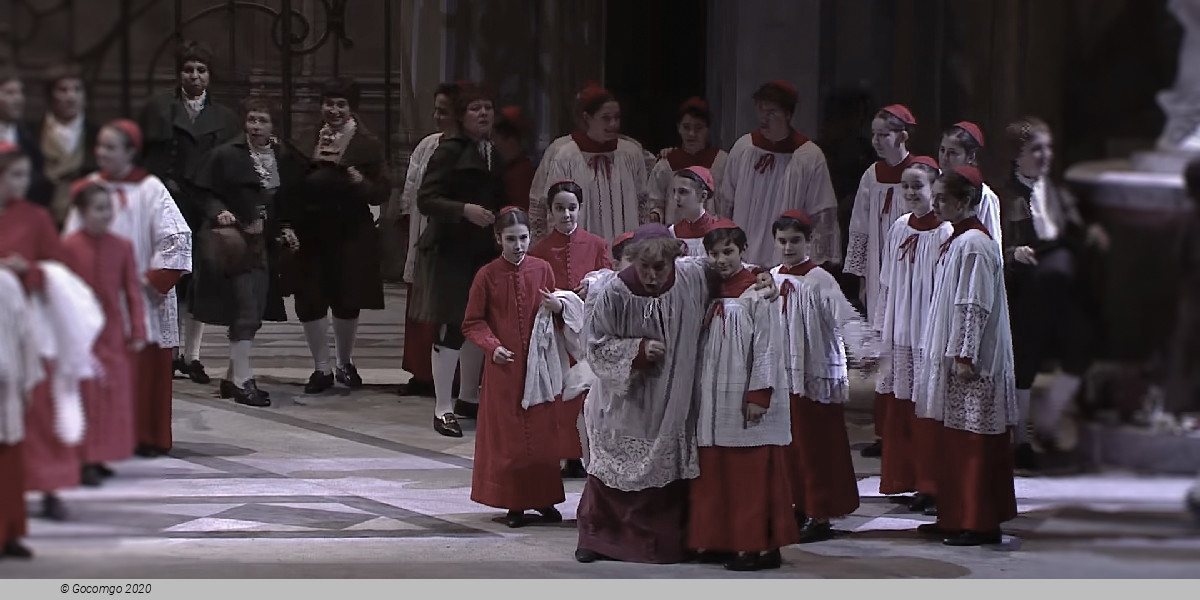
Inside the church of Sant'Andrea della Valle
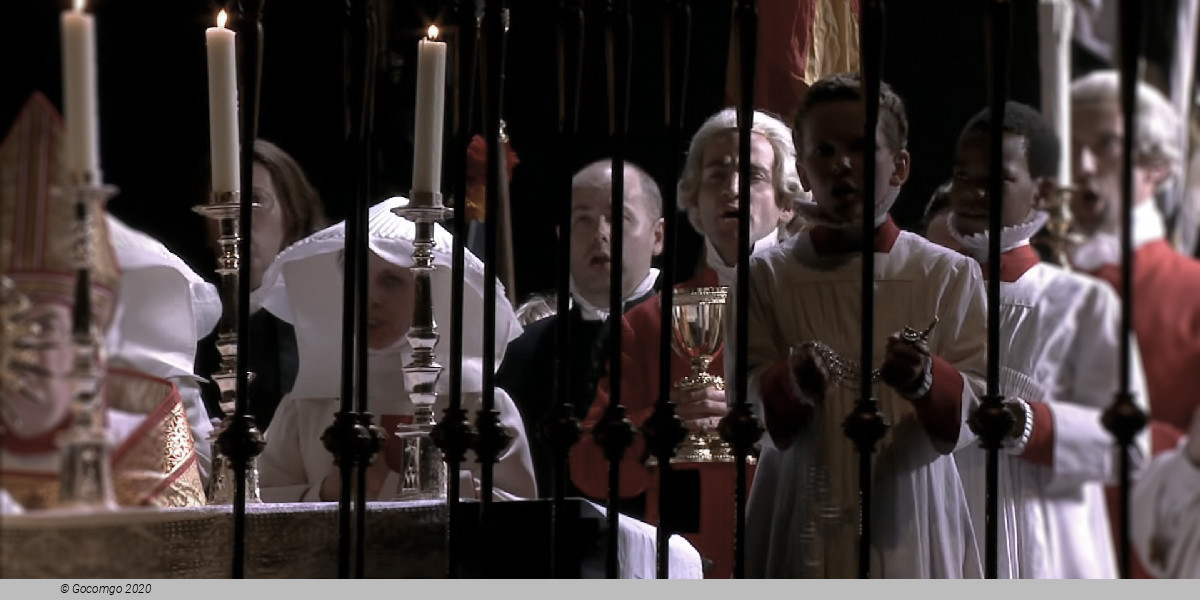
Scene depicting a church interior with high stained-glass windows and heavy ornamental columns. The central figure is a high dignatory around whom several figures are kneeling, while in the background can be seen the tall pikes of the Swiss Guard.
Cesare Angelotti, former consul of the Roman Republic and now an escaped political prisoner, runs into the church and hides in the Attavanti private chapel – his sister, the Marchesa Attavanti, has left a key to the chapel hidden at the feet of the statue of the Madonna. The elderly Sacristan enters and begins cleaning. The Sacristan kneels in prayer as the Angelus sounds.
The painter Mario Cavaradossi arrives to continue work on his picture of Mary Magdalene. The Sacristan identifies a likeness between the portrait and a blonde-haired woman who has been visiting the church recently (unknown to him, it is Angelotti's sister the Marchesa). Cavaradossi describes the "hidden harmony" ("Recondita armonia") in the contrast between the blonde beauty of his painting and his dark-haired lover, the singer Floria Tosca. The Sacristan mumbles his disapproval before leaving.
Angelotti emerges and tells Cavaradossi, an old friend who has republican sympathies, that he is being pursued by the Chief of Police, Baron Scarpia. Cavaradossi promises to assist him after nightfall. Tosca's voice is heard, calling to Cavaradossi. Cavaradossi gives Angelotti his basket of food and Angelotti hurriedly returns to his hiding place.
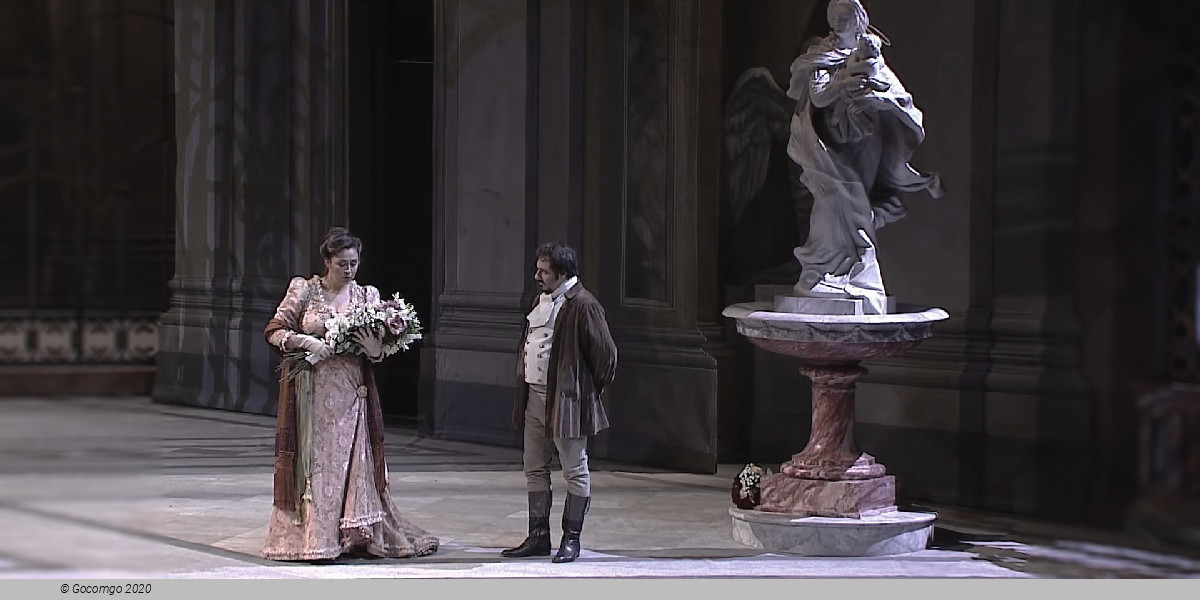
Tosca enters and suspiciously asks Cavaradossi what he has been doing – she thinks that he has been talking to another woman. Cavaradossi reassures her and Tosca tries to persuade him to take her to his villa that evening: "Non la sospiri, la nostra casetta" ("Do you not long for our little cottage"). She then expresses jealousy over the woman in the painting, whom she recognises as the Marchesa Attavanti. Cavaradossi explains the likeness; he has merely observed the Marchesa at prayer in the church. He reassures Tosca of his fidelity and asks her what eyes could be more beautiful than her own: "Qual'occhio al mondo" ("What eyes in the world").
After Tosca has left, Angelotti reappears and discusses with the painter his plan to flee disguised as a woman, using clothes left in the chapel by his sister. Cavaradossi gives Angelotti a key to his villa, suggesting that he hide in a disused well in the garden. The sound of a cannon signals that Angelotti's escape has been discovered. He and Cavaradossi hasten out of the church.
The Sacristan re-enters with choristers, celebrating the news that Napoleon has apparently been defeated at Marengo. The celebrations cease abruptly with the entry of Scarpia, his henchman Spoletta and several police agents. They have heard that Angelotti has sought refuge in the church. Scarpia orders a search, and the empty food basket and a fan bearing the Attavanti coat of arms are found in the chapel. Scarpia questions the Sacristan, and his suspicions are aroused further when he learns that Cavaradossi has been in the church; Scarpia mistrusts the painter, and believes him complicit in Angelotti's escape.
When Tosca arrives looking for her lover, Scarpia artfully arouses her jealous instincts by implying a relationship between the painter and the Marchesa Attavanti. He draws Tosca's attention to the fan and suggests that someone must have surprised the lovers in the chapel. Tosca falls for his deceit; enraged, she rushes off to confront Cavaradossi. Scarpia orders Spoletta and his agents to follow her, assuming she will lead them to Cavaradossi and Angelotti. He privately gloats as he reveals his intentions to possess Tosca and execute Cavaradossi. A procession enters the church singing the Te Deum; exclaiming 'Tosca, you make me forget even God!', Scarpia joins the chorus in the prayer.
Act 2
The body of a man lies supine, with a woman, crucifix in hand, kneeling over him. A candle is placed to each side of his head.
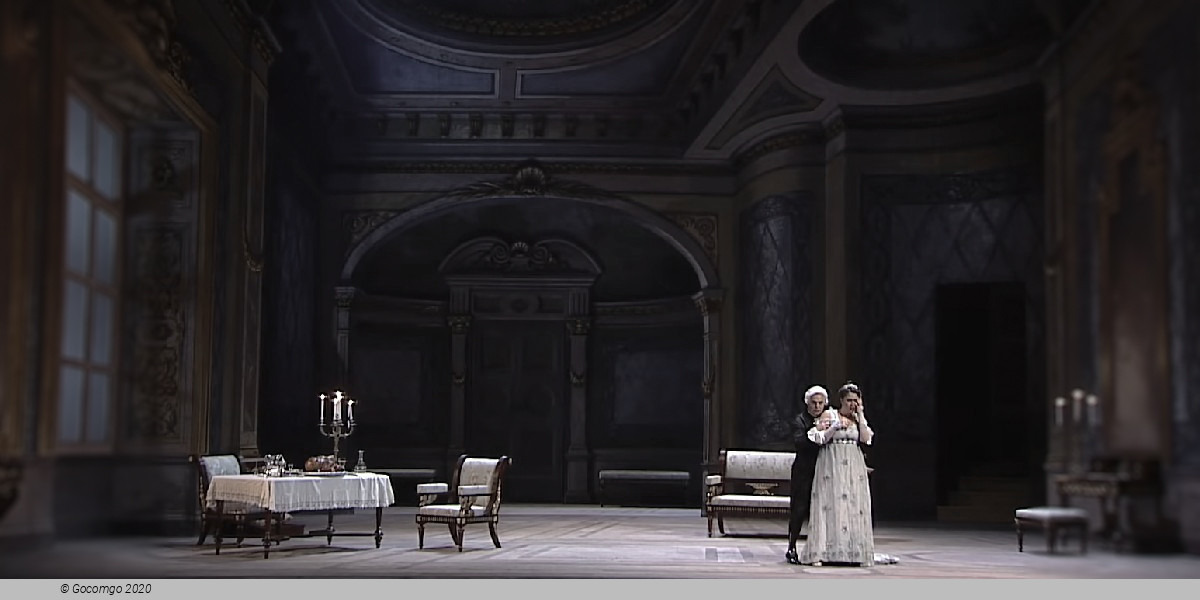
Scarpia's apartment in the Palazzo Farnese, that evening
Scarpia, at supper, sends a note to Tosca asking her to come to his apartment, anticipating that two of his goals will soon be fulfilled at once. His agent, Spoletta, arrives to report that Angelotti remains at large, but Cavaradossi has been arrested for questioning. He is brought in, and an interrogation ensues. As the painter steadfastly denies knowing anything about Angelotti's escape, Tosca's voice is heard singing a celebratory cantata elsewhere in the Palace.
She enters the apartment in time to see Cavaradossi being escorted to an antechamber. All he has time to say is that she mustn't tell them anything. Scarpia then claims she can save her lover from indescribable pain if she reveals Angelotti's hiding place. She resists, but the sound of screams coming through the door eventually breaks her down, and she tells Scarpia to search the well in the garden of Cavaradossi's villa.
Scarpia orders his torturers to cease, and the bloodied painter is dragged back in. He's devastated to discover that Tosca has betrayed his friend. Sciarrone, another agent, then enters with news: there was an upset on the battlefield at Marengo, and the French are marching on Rome. Cavaradossi, unable to contain himself, gloats to Scarpia that his rule of terror will soon be at an end. This is enough for the police to consider him guilty, and they haul him away to be shot.
Scarpia, now alone with Tosca, proposes a bargain: if she gives herself to him, Cavaradossi will be freed. She is revolted, and repeatedly rejects his advances, but she hears the drums outside announcing an execution. As Scarpia awaits her decision, she prays, asking why God has abandoned her in her hour of need: "Vissi d'arte" ("I lived for art"). She tries to offer money, but Scarpia isn't interested in that kind of bribe: he wants Tosca herself.
Spoletta returns with the news that Angelotti has killed himself upon discovery, and that everything is in place for Cavaradossi's execution. Scarpia hesitates to give the order, looking to Tosca, and despairingly she agrees to submit to him. He tells Spoletta to arrange a mock execution, both men repeating that it will be "as we did with Count Palmieri," and Spoletta exits.
Tosca insists that Scarpia must provide safe-conduct out of Rome for herself and Cavaradossi. He easily agrees to this and heads to his desk. While he's drafting the document, she quietly takes a knife from the supper table. Scarpia triumphantly strides toward Tosca. When he begins to embrace her, she stabs him, crying "this is Tosca's kiss!" Once she's certain he's dead, she ruefully says "now I forgive him." She removes the safe-conduct from his pocket, lights candles in a gesture of piety, and places a crucifix on the body before leaving.
Act 3
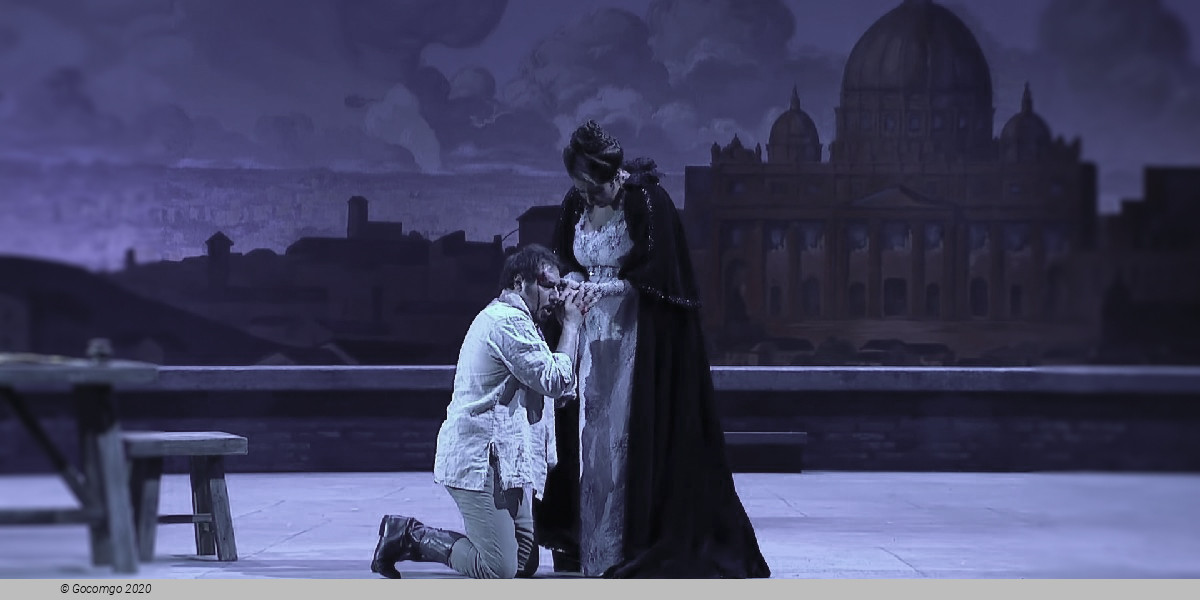
The upper parts of the Castel Sant'Angelo, early the following morning
Roman panorama showing, centre, an arched bridge over a river with a domed building in the distance. To the right of the bridge is a large circular fortress.
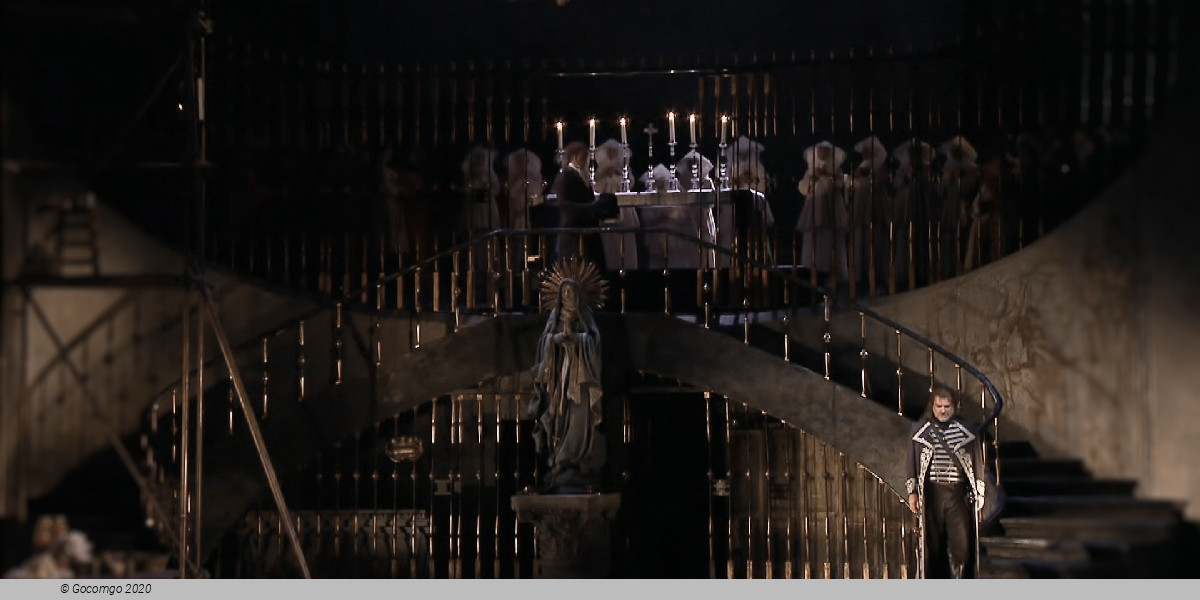
A shepherd boy is heard offstage singing (in Romanesco dialect) "Io de' sospiri" ("I give you sighs") as church bells sound for matins. The guards lead Cavaradossi in and inform him that he has one hour to live. He declines to see a priest, but asks permission to write a letter to Tosca. He begins to write, but is soon overwhelmed by memories: "E lucevan le stelle" ("And the stars shone").
Tosca enters and shows him the safe-conduct pass she's obtained, adding that she has killed Scarpia and that the imminent execution is a sham. Cavaradossi must feign death, after which they can flee together before Scarpia's body is discovered. Cavaradossi is awestruck by his gentle lover's courage: "O dolci mani" ("Oh sweet hands"). The pair ecstatically imagines the life they will share, far from Rome. Tosca then anxiously coaches Cavaradossi on how to play dead when the firing squad shoots at him with blanks. He giddily promises he'll fall "like Tosca in the theatre."
Cavaradossi is led away, and Tosca watches with increasing impatience as the execution is prepared. The men fire, Cavaradossi falls, and Tosca exclaims "Ecco un artista!" ("What an actor!"). When the soldiers have all left, she hurries towards Cavaradossi, only to find that Scarpia betrayed her: the bullets were real. Heartbroken, she clasps her lover's lifeless body and weeps.
The voices of Spoletta, Sciarrone, and the soldiers are heard, shouting that Scarpia is dead and Tosca has killed him. As the men rush in, Tosca rises, evades their clutches, and runs to the parapet. Crying "O Scarpia, Avanti a Dio!" ("O Scarpia, we meet before God!"), she flings herself over the edge to her death.



 Lubicz 48