The theater is the place of mindfulness, presence and liveness. Or A-Liveness. Every event on the stage is permeated with liveliness. The audience can make sure, second by second: These bodies on stage are there for me, this voice speaks to me - now, at this moment. We share this very moment, here, in a room - this reality.
But: what happens to the theater if the human presence for a performance disappears?
What is left then?
Just thoughts and memories? The naked theater machine? The music?
The MH370 was an international scheduled passenger flight operated by Malaysia Airlines.
On March 8, 2014, the Boeing took off with 227 passengers and 12 crew members from Kuala Lumpur to its destination Beijing: unspectacular routine for 39 minutes and 13 seconds. Then the plane disappeared from the radar.
Its disappearance has been dubbed one of the greatest aviation mysteries of all time - because it seems incredible that something as big as a Boeing can be lost in a world where everything and everyone is presumably under surveillance.
And it seems impossible that it will be lost. Although the search was the most expensive in history, at over 150 million euros, and was of imposing proportions.
Shortly after the plane disappeared, the author and director's father wrote his grandson four letters of congratulations on his birthday. The content is almost identical; each envelope is franked with a special stamp. A year later there is no card at all, the birthday was probably forgotten and at some point this forgetfulness gets a name and becomes a disease: dementia. The name of the grandson is forgotten, the fact that there is one and finally the certainty about oneself.
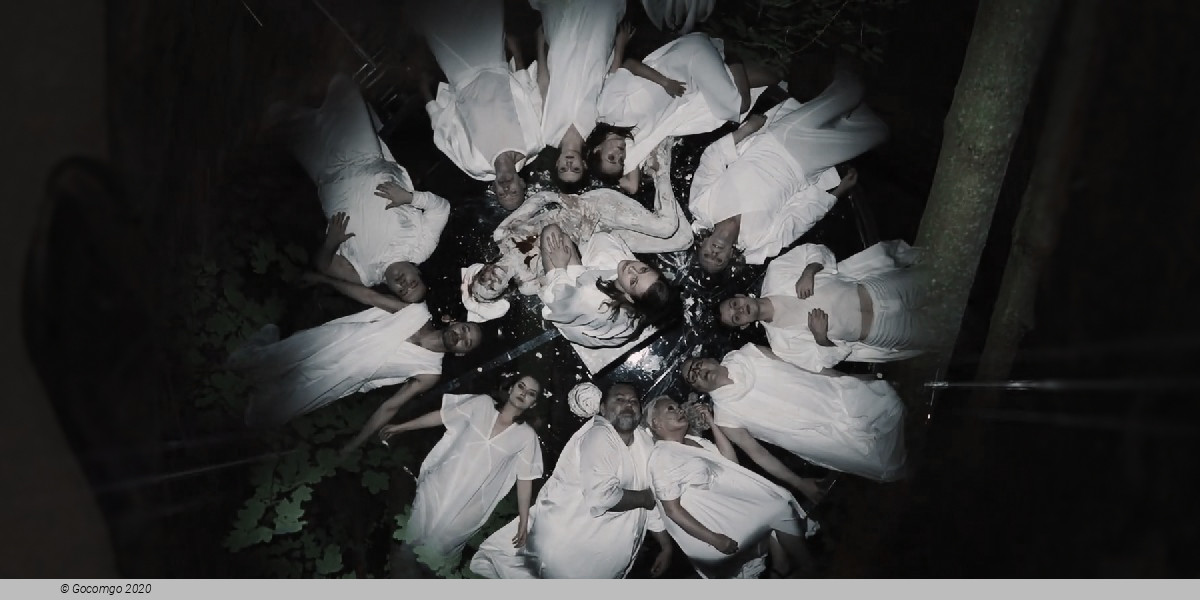
In 'All right. Goodnight.' Helgard Haug traces the disappearance, the search and the struggle with uncertainty - using the example of the missing airplane and the manifesting dementia of his own father. It is the record of an irreversible process.
Music is the artistic medium that has the greatest tradition of making what has disappeared understandable. Be it through a requiem to commemorate the deceased or through a choir that appeared as a chronicler in the ancient theater and reported on hardly imaginable battles and divine destinies. For 'All right. Goodnight.' The electro pop musician Barbara Morgenstern composes in collaboration with the arranger Davor Vincze for the first time for a classical orchestra. Do the 12 musicians of the Zafraan Ensemble succeed in making the gap and the emptiness that followed?
Every disappearance requires narratives. There are sophisticated methods and techniques with which the absence is attested: The flight radar, on which no more green dot can be seen. The call that goes nowhere. The GPS transmitter on the animal's ear that no longer sends any new data. The orbit of the earth is monitored and monitored by satellites floating in space and becomes the place where radio technologies bear witness to on or off, presence or absence, life or death.
In coproduction with HAU Hebbel am Ufer (Berlin), Volkstheater Wien, The Factory Mancheste, Künstlerhaus Mousonturm, PACT Zollverein.
Funded by the Capital Cultural Fund and by the Berlin Senate Department for Culture and Europe.
Performance rights: schaefersphilippen Theater und Medien GbR
Music rights: Barbara Morgenstern © Maobeat Musikverlag / Budde Music Publishing GmbH








 Arthur-Schnitzler-Platz 1