



Metropolitan Opera: On the Dnieper Tickets | Event Dates & Schedule | GoComGo.com

On the Dnieper Tickets

Metropolitan Opera, New York, USA
Important Info
Type: Ballet
City: New York, USA

E-tickets: Print at home or at the box office of the event if so specified. You will find more information in your booking confirmation email.

You can only select the category, and not the exact seats.
If you order 2 or 3 tickets: your seats will be next to each other.
If you order 4 or more tickets: your seats will be next to each other, or, if this is not possible, we will provide a combination of groups of seats (at least in pairs, for example 2+2 or 2+3).

Cast
Performers
Choose the date to see the peformers
Overview

On the Dnieper, Op. 51, also known by its French language title Sur le Borysthène, is Sergei Prokofiev's fourth ballet, written in 1930. Sergei Diaghilev, the impresario who had led Ballets Russes to distinguished success, died suddenly in 1929, hence ending Prokofiev's collaboration with the troupe. (The Prodigal Son was the last such collaboration.) Seeing the success of the work, the Paris Opéra commissioned Prokofiev to write another ballet. Serge Lifar, formerly a close associate with Diaghilev, was responsible for creating the setting and choreography. However, he did not place any significance to the scenario. Rather, the ballet was created as a sequence of dances. On the Dnieper was the result of this collaboration.

Lifar, in his 1965 book La danse, said that he was disappointed with Prokofiev's score. Lifar claimed to have been inspired by Russian folkdance, but acknowledges that critics found his own choreography insufficiently Russian.

Preparations for the ballet were marked the sudden withdrawal of Olga Spessivtseva who was to have had the leading female role. Spessivsteva had had a series of successes with Lifar at the Paris Opera Ballet (Promethee, Giselle) and had unrequited feelings for him. In his book The Three Graces: Anna Pavlova, Tamara Karsavina, Olga Spessivtseva (1959) Lifar describes how their personal situation came to a head during rehearsals. "The two heroines of this ballet were named Natasha and Olga. I have already mentioned the friendship which had sprung up at this time between Natasha P... [Natalie Paley] and myself. It was, therefore, perhaps a little cruel to give these two names, Natasha and Olga, to the heroines. Be that as it may, the role of Olga was allotted to Spessivtseva, while the male part, Serge, was to be interpreted by me. The crisis came when, at one of the rehearsals, Spessivtseva suddenly realized that it was with Natasha ... that in pursuance of the plot, I was to find happiness, whereas the leading, and, from the choreographic point of view, the most important role had been allotted to her, Olga! This crisis, as always with her, developed with the speed of lightning. Just as I had announced at rehearsal, that this was where my pas de deux tendre with Natasha would begin, Spessivtseva all of a sudden made a dash for the window. In one bound I reached her, but, by that time she was already through it. I just managed to clutch her arm. My pianist, Leonide Gontcharov, who was hard on my heels, sprang to my assistance. Olga hung there, suspended from our arms, thirty feet above the Place Charles-Garnier. With great difficulty we managed to drag her back. She fought, bit and scratched in an effort to break free ... Next day she did not turn up at rehearsal, but sent word to me that she had left the Opera forever."

Analysis
Prokofiev continued to develop his lyrical line of composition in On the Dnieper, even more so than in The Prodigal Son. These two lyrical ballets provided much experience for the composer, who was about to start writing his first ballet in the Russian tradition: Romeo and Juliet.

Premiere
The ballet was premiered on 16 December 1932, but it turned out to be a flop, especially when critics had been anticipating a work similar in character to The Prodigal Son. Because Prokofiev left for America the next day, he was unaware of the disappointed reviews. The ballet was withdrawn from stage after a few performances, although Stravinsky and Milhaud warmly praised the music after the premiere. Afterwards, Prokofiev extracted an orchestral suite from the ballet (as he did to his other stage works) as Op. 51a.

Revival
In 2009 Alexei Ratmansky choreographed the Prokofiev score anew for American Ballet Theatre. In his version, Sergei returns his village to discover that he no longer loves his sweetheart, Natalia, but is instead attracted to Olga, who is to wed another man. "Grief-stricken yet noble, Natalia unselfishly helps the young lovers, Sergei and Olga, to escape together to a life of happiness." In the premiere of this version, Marcelo Gomes danced the role of Sergei, Paloma Herrera the role of Olga, Veronika Part the role of Natalia, and David Hallberg the role of Olga's Fiancé.

From the first world war, Sergei, a Red Army soldier returns to his village on the Dnieper and finds he is no-longer in love with Natasha his betrothed. Instead, he falls in love with Olga.

Olga's parents intend for her to marry another man whom she does not love. Sergei and Olga's friends fight. Sergei falls, but the lovers are saved by the compassionate Natasha who helps the couple to escape the village.

The ballet contains 12 numbers, lasting around 40 minutes:

Prelude
Scene 1: The Meeting
Scene 1: Mime Scene
Scene 1: Pas de deux
Scene 1: Variation of the First Dancer
Scene 2: Betrothal
Scene 2: Bridegroom's Dance
Scene 2: Bride's Dance
Scene 2: Men's Dance
Scene 2: The Quarrel
Scene 2: Mime Scene
Epilogue

History

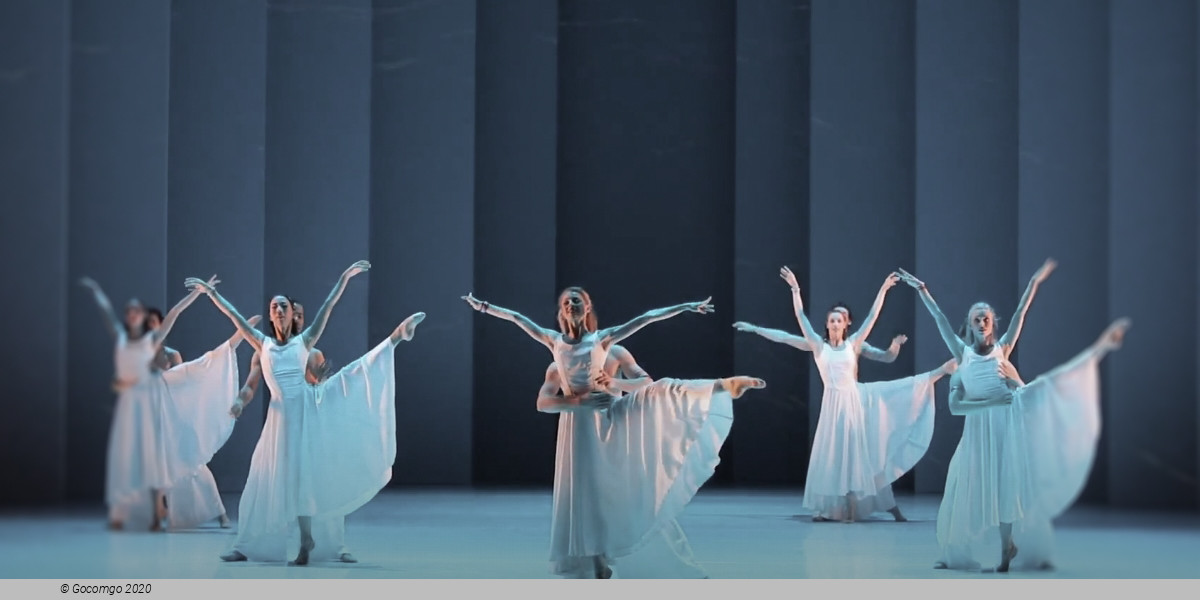
Experience the magic of three one-act ballets choreographed by MacArthur Genius Alexei Ratmanksy on the occasion of his 10th Anniversary as ABT Artist in Residence. Tales of youthful love, selfless devotion and exuberant folk traditions are colorfully brought to life in Songs of Bukovina, On the Dnieper and a World Premiere featuring ABT’s versatile dancers.

Venue Info

Metropolitan Opera - New York
Location   30 Lincoln Center

The Metropolitan Opera is an opera company based in New York City, resident at the Metropolitan Opera House at the Lincoln Center for the Performing Arts. The Metropolitan Opera is the largest classical music theatre in North America. It presents about 27 different operas each year from late September through May. As of 2018, the company's current music director is Yannick Nézet-Séguin.

The Metropolitan Opera Company was founded in 1883 as an alternative to New York's old established Academy of Music opera house. The subscribers to the Academy's limited number of private boxes represented the highest stratum in New York society. By 1880, these "old money" families were loath to admit New York's newly wealthy industrialists into their long-established social circle. Frustrated with being excluded, the Metropolitan Opera's founding subscribers determined to build a new opera house that would outshine the old Academy in every way. A group of 22 men assembled at Delmonico's restaurant on April 28, 1880. They elected officers and established subscriptions for ownership in the new company. The new theater, built at 39th and Broadway, would include three tiers of private boxes in which the scions of New York's powerful new industrial families could display their wealth and establish their social prominence. The first Met subscribers included members of the Morgan, Roosevelt, and Vanderbilt families, all of whom had been excluded from the Academy. The new Metropolitan Opera House opened on October 22, 1883, and was an immediate success, both socially and artistically. The Academy of Music's opera season folded just three years after the Met opened.

The operas are presented in a rotating repertory schedule, with up to seven performances of four different works staged each week. Performances are given in the evening Monday through Saturday with a matinée on Saturday. Several operas are presented in new productions each season. Sometimes these are borrowed from or shared with other opera companies. The rest of the year's operas are given in revivals of productions from previous seasons. The 2015–16 season comprised 227 performances of 25 operas.

The operas in the Met's repertoire consist of a wide range of works, from 18th-century Baroque and 19th-century Bel canto to the Minimalism of the late 20th century. These operas are presented in staged productions that range in style from those with elaborate traditional decors to others that feature modern conceptual designs.

The Met's performing company consists of a large symphony-sized orchestra, a chorus, a children's choir, and many supporting and leading solo singers. The company also employs numerous free-lance dancers, actors, musicians, and other performers throughout the season. The Met's roster of singers includes both international and American artists, some of whose careers have been developed through the Met's young artists programs. While many singers appear periodically as guests with the company, others, such as Renée Fleming and Plácido Domingo, long maintained a close association with the Met, appearing many times each season until they retired.

Important Info
Type: Ballet
City: New York, USA

E-tickets: Print at home or at the box office of the event if so specified. You will find more information in your booking confirmation email.

You can only select the category, and not the exact seats.
If you order 2 or 3 tickets: your seats will be next to each other.
If you order 4 or more tickets: your seats will be next to each other, or, if this is not possible, we will provide a combination of groups of seats (at least in pairs, for example 2+2 or 2+3).

Top of page