
Teatro Alla Scala 18 September 2021 - L’italiana in Algeri | GoComGo.com

L’italiana in Algeri

Teatro Alla Scala, Milan, Italy
All photos (6)
Select date and time
8 PM

E-tickets: Print at home or at the box office of the event if so specified. You will find more information in your booking confirmation email.

You can only select the category, and not the exact seats.
If you order 2 or 3 tickets: your seats will be next to each other.
If you order 4 or more tickets: your seats will be next to each other, or, if this is not possible, we will provide a combination of groups of seats (at least in pairs, for example 2+2 or 2+3).

Important Info
Type: Opera
City: Milan, Italy
Starts at: 20:00

E-tickets: Print at home or at the box office of the event if so specified. You will find more information in your booking confirmation email.

You can only select the category, and not the exact seats.
If you order 2 or 3 tickets: your seats will be next to each other.
If you order 4 or more tickets: your seats will be next to each other, or, if this is not possible, we will provide a combination of groups of seats (at least in pairs, for example 2+2 or 2+3).

Overview
History
Premiere of this production: 22 May 1813, Teatro San Benedetto, Venice

L'Italiana in Algeri (The Italian Girl in Algiers) is an operatic dramma giocoso in two acts by Gioachino Rossini to an Italian libretto by Angelo Anelli, based on his earlier text set by Luigi Mosca. It premiered at the Teatro San Benedetto in Venice on 22 May 1813. The music is characteristic of Rossini's style, remarkable for its fusion of sustained, manic energy with elegant, pristine melodies.

Synopsis

Place: Algiers
Time: The past

Act 1

The palace of the Bey of Algiers

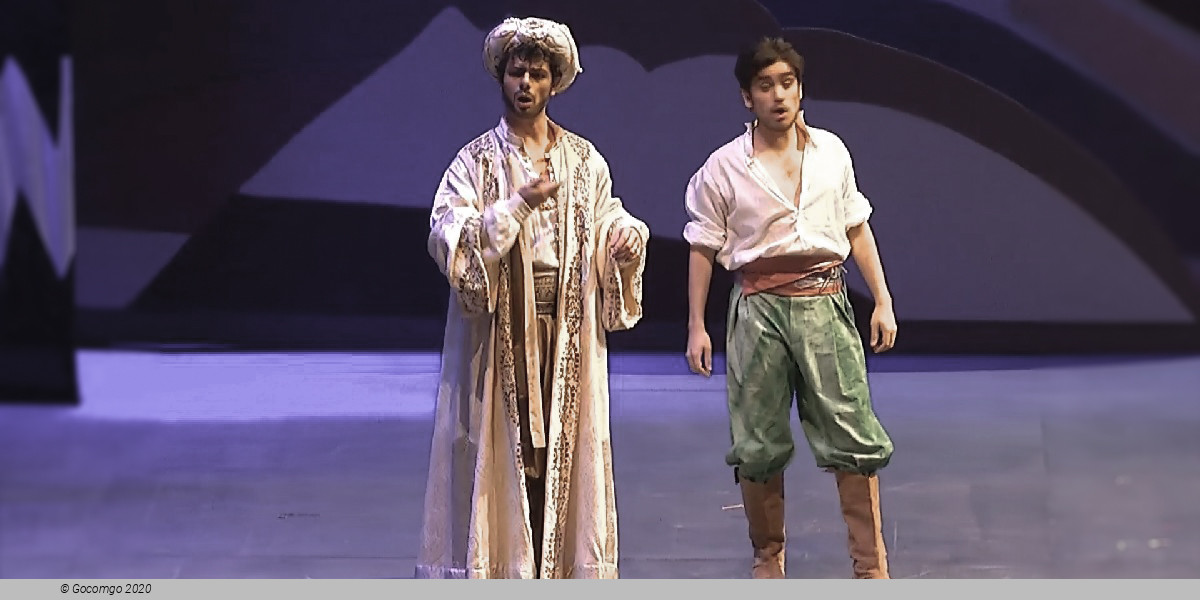
Elvira accompanied by her slave Zulma regrets the loss of the love of her husband, the Turkish Bey Mustafà. Left alone with Haly (since the Italian 'h' is silent, this corresponds to the name Ali, more familiar in the English-speaking world), Captain of the Corsairs, Mustafà reveals his plan to marry Elvira off to Lindoro, his Italian slave. The Bey is bored with his submissive harem, desiring a new challenge to his virility: he wants an Italian girl, and Haly must find one! Lindoro enters alone and sings about Isabella, his true love (Languir per una bella). Mustafà comes in to explain Lindoro's impending marriage. The enthusiastic Bey describes the attractions of the match, while Lindoro struggles to refuse (Se inclinassi a prender moglie).

The seashore

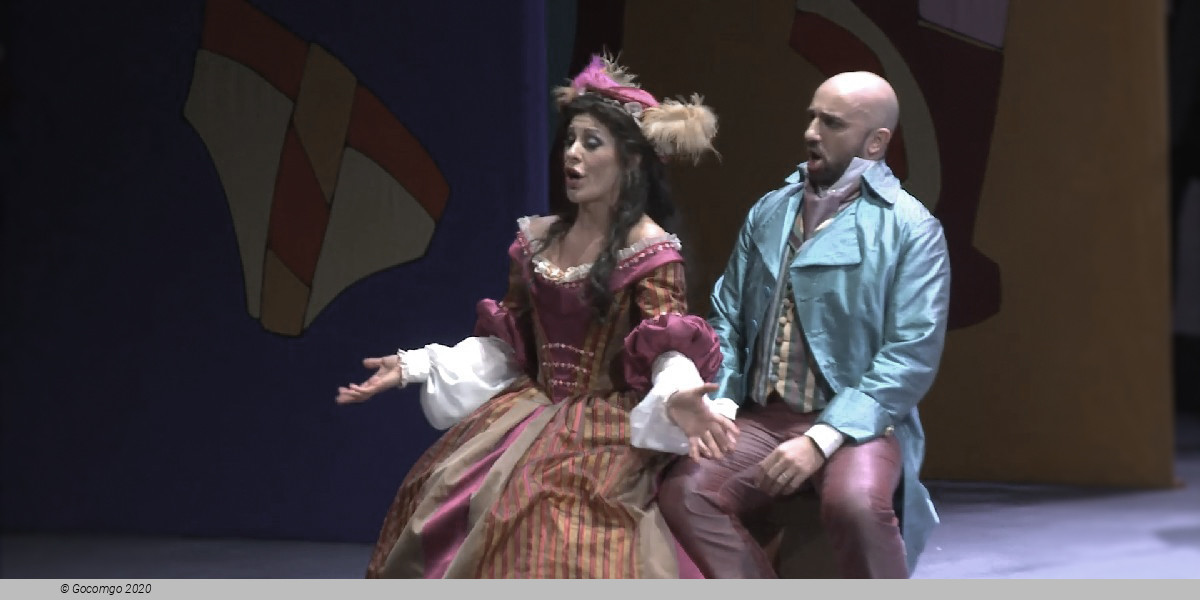
A ship has been wrecked in a storm. Its passengers include Isabella, in search of Lindoro, and Taddeo, her travelling companion and would-be lover. Isabella enters with a sorrowful cavatina Cruda sorte! Amor tiranno!, however she is not afraid (Già so per pratica) and will master the situation. Haly and his men take them prisoner. She passes off Taddeo as her uncle. Haly is delighted to learn she is an Italian – exactly what the Bey wanted! Left to consider their fate, Isabella is irritated by Taddeo's jealousy of Lindoro (Ai capricci della sorte), but they resolve to join forces.

The palace

Back in the palace, Lindoro and Elvira do not wish to marry, but Mustafà offers Lindoro passage on a ship returning to Italy if he takes Elvira. Lindoro agrees, admitting a vague possibility of marrying her in Italy. Haly enters with news of the arrival of the Italian beauty. Mustafà is elated (Già d'insolito ardore nel petto agitare).

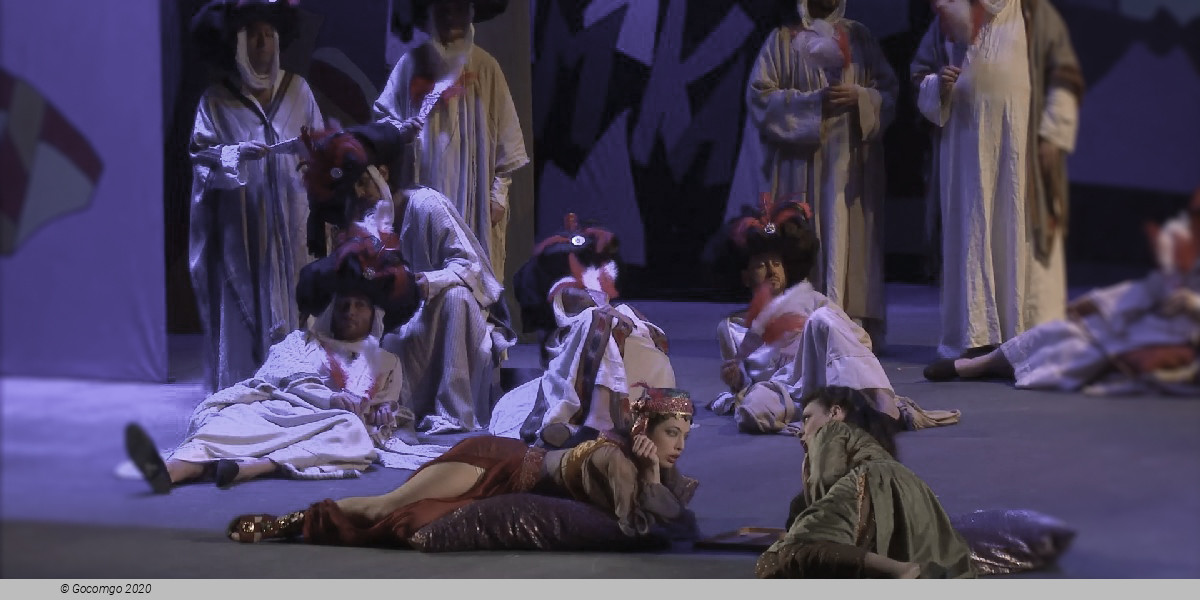
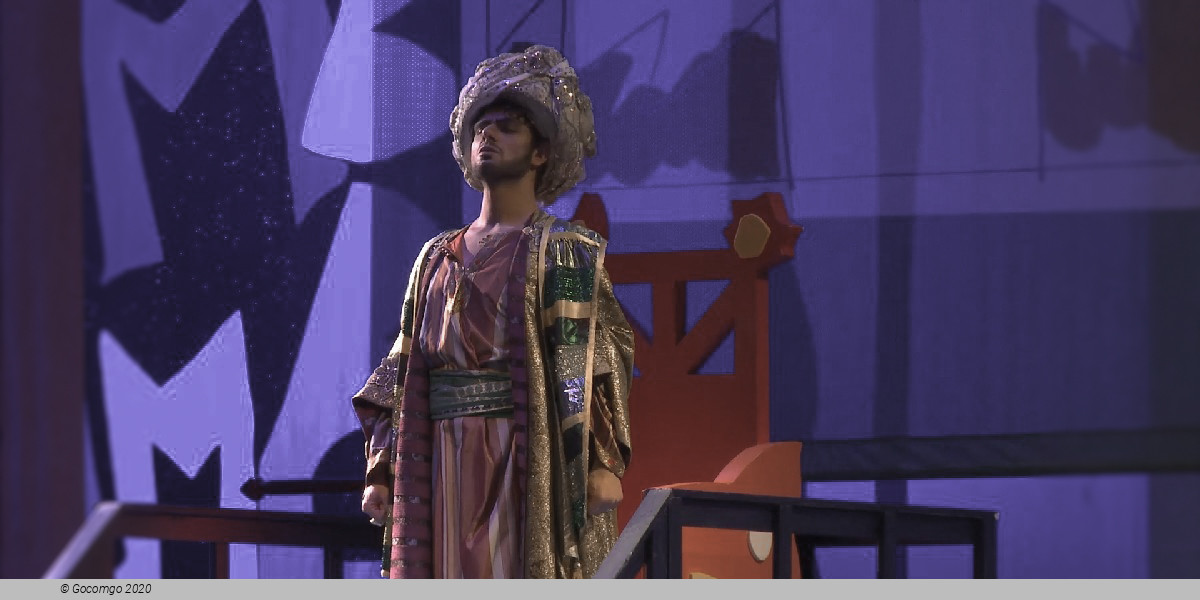
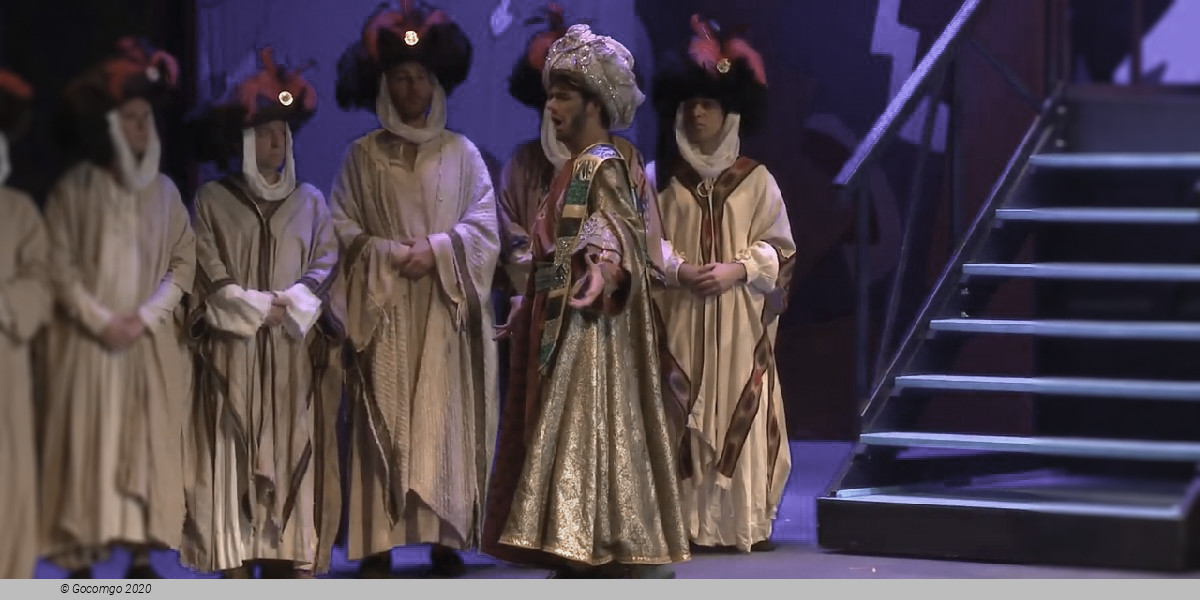
Surrounded by eunuchs (Viva, viva il flagel delle donne), Mustafà receives Isabella in a grand hall. He is enchanted, though she is rather amused by his appearance (Oh! Che muso, che figura!). At that moment, Lindoro, Elvira and Zulma arrive to say goodbye to Mustafà (Pria di dividerci da voi, Signore). Lindoro and Isabella are astonished to come face to face. Recovering herself, Isabella asks about Elvira, learning she is Mustafà's ex-wife, to be remarried to Lindoro! The act ends with an ensemble of confusion (Confusi e stupidi).

Act 2

In the palace

Elvira and Zulma (who have remained in Algiers after all) note Isabella's skill with men. Mustafà reveals his strategy for seducing Isabella: he installs Lindoro as Isabella's servant and his informer, and Taddeo will also be induced to help. Elvira and Zulma must tell Isabella he is coming to take coffee with her.

Isabella and Lindoro are alone. He explains that he had no intention of marrying Elvira. They agree to escape together and Lindoro sings of his happiness (Ah come il cor di giubilo). Mustafà enters with a reluctant Taddeo, acclaimed by the Turks as "Lord Kaimakan" (Viva il grande Kaimakan). He dislikes interceding with Isabella for the Bey, but is frightened to refuse (Ho un gran peso sulla testa).

In her apartment

Isabella is dressing in Turkish style. Zulma and Elvira deliver Mustafà's message: he is coming for coffee. Isabella orders three cups. Elvira should wait in a side room. As Mustafà approaches, Isabella sings a romantic cavatina, Per lui che adoro - she will receive him. Mustafà tells Taddeo to leave when he sneezes (Ti presento di mia man). Isabella greets Mustafà warmly and he sneezes, but Taddeo ignores the signal. Isabella calls for coffee and then – to Mustafà's horror and amazement – invites Elvira to join them.

Elsewhere in the palace

Haly sings in praise of the women of Italy (Le femmine d'Italia). The Italians enter, and Taddeo reveals to a surprised Lindoro that he is not her uncle but her lover (he himself is unaware of the other man's true identity). Lindoro tells Mustafà that Isabella will declare him her adored pappataci (literally a "silent eater": a man unable to resist the opposite sex). This, as Lindoro explains (Pappataci! Che mai sento!), is an Italian custom and a great honour, as the pappataci enjoy an idyllic life dedicated to eating, drinking and sleeping. Zulma and Haly speculate about Isabella's real intentions and the quantity of alcohol ordered for the ceremony.

Isabella's apartment

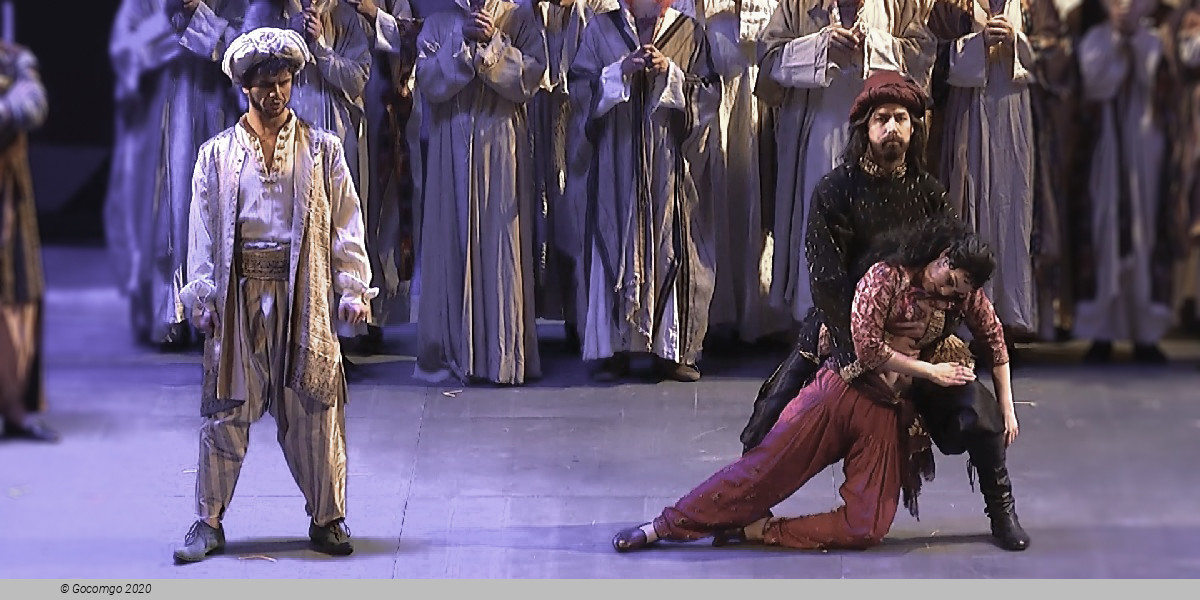
She addresses the Italian slaves who will be pappataci in the ceremony - she will lead them to freedom (Pensa alla patria). The ceremony begins (Dei pappataci s'avanza il coro); Mustafà is delighted with his new honour and changes into appropriate costume. Isabella explains his obligations. He must swear an oath of eating, drinking, and keeping silent, repeating the words after Taddeo. Following that his oath is tested, under provocation by Isabella and Lindoro.

A European ship lies alongside the palace: time to escape! Taddeo finally realizes who Lindoro is, but decides to go along with them anyway. Elvira, Zulma and Haly find the Bey still acting as a mad pappataci. Suddenly recovering his sanity, Mustafà calls his troops but they are all drunk. The Italians bid farewell and Mustafà begs Elvira's forgiveness. No more Italian girls for him!

Venue Info

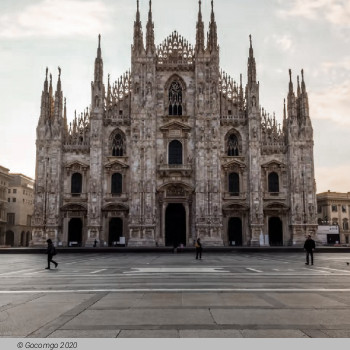
Teatro Alla Scala - Milan
Location   Via Filodrammatici, 2

Teatro Alla Scala is an opera house in Milan. Most of Italy's greatest operatic artists, and many of the finest singers from around the world, have appeared at La Scala. The theatre is regarded as one of the leading opera and ballet theatres globally. It is home to the La Scala Theatre Chorus, La Scala Theatre Ballet, La Scala Theatre Orchestra, and the Filarmonica della Scala orchestra.

The Teatro alla Scala was founded, under the auspices of the Empress Maria Theresa of Austria, to replace the Royal Ducal Theatre, which was destroyed by fire on 26 February 1776 and had until then been the home of opera in Milan. The cost of building the new theatre was borne by the owners of the boxes at the Ducal, in exchange for possession of the land on which stood the church of Santa Maria alla Scala (hence the name) and for renewed ownership of their boxes. Designed by the great neoclassical architect Giuseppe Piermarini, La Scala opened on 3 August 1778 with Antonio Salieri's opera L'Europa riconosciuta, to a libretto by Mattia Verazi.

With the advent of Rossini in 1812 (La pietra del paragone), the Teatro alla Scala was to become the appointed place of Italian opera seria: of its history dating back more than a century and of its subsequent tradition up till the present. The catalogue of Rossini's works performed until 1825 included: Il turco in Italia, La Cenerentola, Il barbiere di Siviglia, La donna del lago, Otello, Tancredi, Semiramide and Mosé. During that period the choreographies of Salvatore Viganò (1769-181) and of Carlo Blasis (1795-1878) also widened the theatre's artistic supremacy to include ballet.

An exceptional new season of serious opera opened between 1822 and 1825, with Chiara e Serafina by Gaetano Donizetti (1797-1848) and Il pirata by Vincenzo Bellini (1801-1835). The later operas of Donizetti performed at La Scala were (until 1850) Anna Bolena, Lucrezia Borgia, Torquato Tasso, La fille du régiment, La favorita, Linda di Chamonix, Don Pasquale, and Poliuto. These were followed (until 1836) by Bellini's I Capuleti e i Montecchi, Norma, La sonnambula, Beatrice di Tenda and I puritani.

In 1839 Oberto Conte di San Bonifacio inaugurated the cycle of operas by Giuseppe Verdi (1813-1901), the composer whose name is linked more than any other to the history of La Scala. After the dismal failure of Un giorno di regno, Nabucco was performed in 1842. It was the first, decisive triumph of Verdi's career. At the same time, the strong patriotic feelings stirred by Nabucco founded the "popularity" of opera seria and identified its image with the Scala.

Arturo Toscanini (1867-1957) became the artistic director and introduced radical reform into the theatre, both in its organisational aspects and in its relations with the public. Toscanini, one of the greatest conductors of all time, took up Verdi's musical inheritance and launched a tradition of interpretation that continued uninterruptedly and was renewed during the twentieth century. It was he who reappraised and regularly performed at the Scala the works of Richard Wagner (hitherto only belatedly and inadequately recognised). He also firmly extended the Scala's orchestral repertoire to include symphonic music.

In 1948 maestro Guido Cantelli (1920-1956) made his debut and established himself as one of the leading postwar conductors. Numerous opera performances productions (the Wagnerian cycle conducted in 1950 by Wilhelm Furtwängler, the Verdi repertoire by Victor De Sabata, etc), concerts (Herbert von Karajan, Dimitri Mitropoulos, Bruno Walter, etc), singers (Maria Callas, Renata Tebaldi, Giuseppe Di Stefano, Mario Del Monaco, etc), ballet performances (Margot Fonteyn, Serge Lifar, Maya Plissetskaya, Rudolf Nureyev), and productions (Luchino Visconti, Giorgio Strehler) belong not only to the history of the Scala, but to that of the history of musical theatre since the war.

In 1965 Claudio Abbado made his début at the Scala and in 1972 was named conductor of the Scala Orchestra. Until 1986 he directed among other works Il barbiere di Siviglia, Cenerentola, L'Italiana in Algeri by Rossini, Simon Boccanegra, Macbeth and Don Carlo by Verdi, the recent Al gran sole carico d'amore by Luigi Nono, and Pelléas et Mélisande by Claude Debussy. He also conducted numerous concerts. The chorus-master was Romano Gandolfi. In 1975 the ballet dancer Oriella Dorella debuted at La Scala. Among other contemporary composers, up till 1986 the Theatre continued to give works by Luciano Berio (La vera storia), Franco Donatoni (Atem) and Karlheinz Stockhausen (Samstag aus Licht).

In 1981 Riccardo Muti debuted at the Scala as an opera conductor (Mozart, Le nozze di Figaro). Giulio Bertola was appointed to direct the Chorus. In 1982 the Orchestra Filarmonica della Scala was established. In 1985 Alessandra Ferri made her debut at the Scala. In 1986 Riccardo Muti was appointed musical director. From 1989 to 1998 he reintroduced the best-loved works (Rigoletto, La traviata, Macbeth, La forza del destino) and numerous other titles by Verdi including Falstaff and Don Carlo.

In 1991 Roberto Gabbiani took over the directorship of the chorus. In 1997 La Scala was converted into a Foundation under private ownership, thus opening a decisive phase of modernisation.

On 7 December 2001 a new production of Otello, conducted by Muti, concluded the Verdi Year and, for the time being, performances at Piermarini’s original building in Piazza Scala. Major restoration and modernisation works of the Theatre began in January 2002.

The 2005-2006 Season, dedicated to the 250th anniversary of Mozart’s birth, was inaugurated by Idomeneo conducted by Daniel Harding. The 2006/07 season saw the return on 7 December of an opera by Verdi, Aida, conducted by Riccardo Chailly, and the launch of the Celebrations for the 50th Anniversary of Arturo Toscanini’s Death. On 7 December 2007 the 2007/08 season opened with Tristan und Isolde conducted by Daniel Barenboim. The opera marked the beginning of a closer collaboration between the Teatro alla Scala and the Israeli-Argentinian Maestro.

Important Info
Type: Opera
City: Milan, Italy
Starts at: 20:00
Top of page