
Teatro Alla Scala: At the Hawk s Well, Blake Works I Tickets | Event Dates & Schedule | GoComGo.com

At the Hawk s Well, Blake Works I Tickets

Teatro Alla Scala, Milan, Italy
Important Info
Type: Ballet
City: Milan, Italy
Duration: 1h 30min with 1 interval
Intervals: 1

E-tickets: Print at home or at the box office of the event if so specified. You will find more information in your booking confirmation email.

You can only select the category, and not the exact seats.
If you order 2 or 3 tickets: your seats will be next to each other.
If you order 4 or more tickets: your seats will be next to each other, or, if this is not possible, we will provide a combination of groups of seats (at least in pairs, for example 2+2 or 2+3).

Cast
Performers
Choose the date to see the peformers
Overview

Palais Garnier 

Creative team

  • Les Étoiles, les Premiers Danseurs et le Corps de Ballet
  • Recorded music

With the support of Odawara Art Foundation


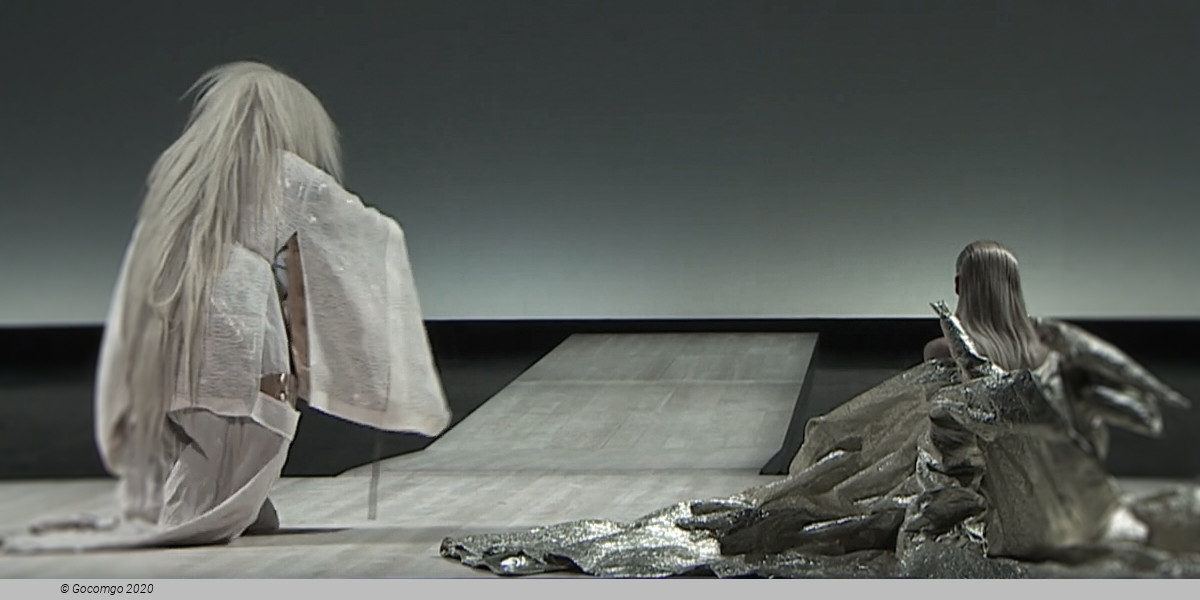
At the Hawk's Well is a one-act play by William Butler Yeats, first performed in 1916 and published in 1917. It is one of five plays by Yeats which are loosely based on the stories of Cuchulain the mythological hero of ancient Ulster. It was the first play written in English that utilised many of the features of the Japanese Noh Theatre.

The form of the play is stylised, abstract, symbolic, and ritualistic, unlike the more common realistic and plot-driven theatre of the time. The stage is, "any bare space before a wall against which stands a patterned screen", and the only props are a black cloth with "a gold pattern suggesting a hawk", and a blue cloth to represent a well. The actors' costumes are simple, striking and stylised, and the two main protagonists wear masks while the others have their faces made up to resemble masks. The puppet-like movement of the actors is accompanied throughout by a drum, gong, and zither.

The play is written in verse and opens and closes with the comments and interpretations of the musicians who speak both individually, and together as a chorus. The main body of the play consists of a short drama involving just three protagonists.

Characters

  • Three Musicians
  • The Guardian of the Well
  • An Old Man
  • A Young Man

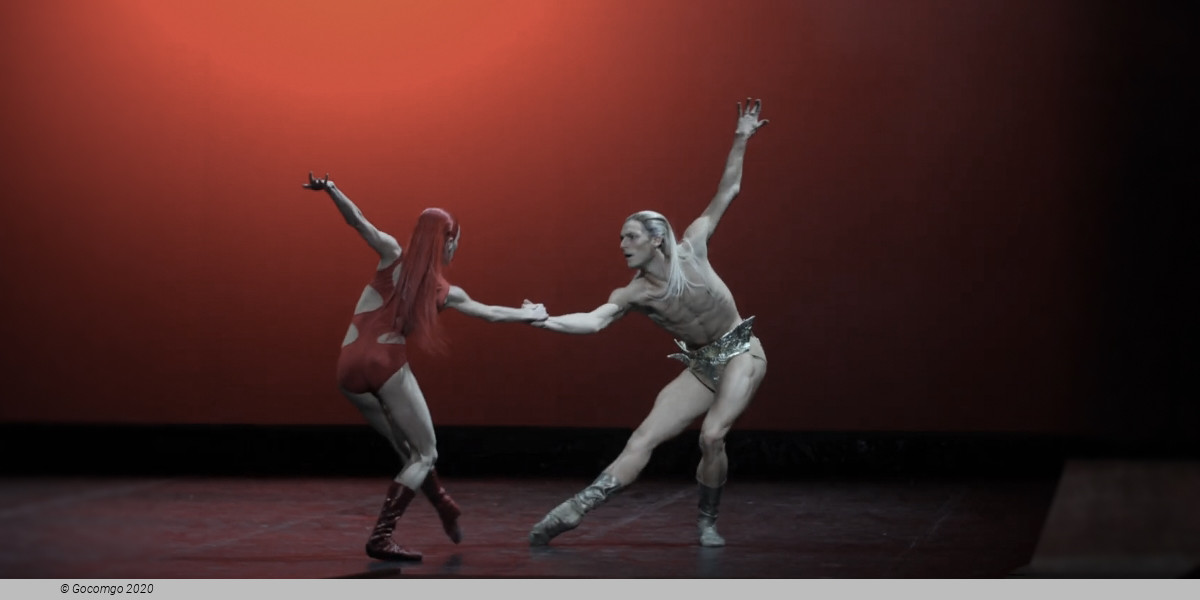
“Blake Works I” is the first ballet that Mr. Forsythe has created since 1999, when he choreographed “Woundwork I” and “Pas./Parts” for the Paris Opera. Benjamin Millepied, the outgoing director of dance, can count it as a major achievement to have brought Mr. Forsythe back to this company.

Synopsis

The play is set by a dried up well on a desolate mountainside which is guarded by a hawk-like woman. An old man has kept camp there for fifty years, waiting to drink the miraculous waters from the well which occasionally rise up. Cuchulain arrives at the spot, having heard a story that the waters bring immortality. The Old Man urges Cuchulain to leave the well, telling of his wasted lifetime there and how, even when the waters did rise up, he was thwarted by a sudden urge to sleep. But Cuchulain is determined to stay and convinced that he shall soon drink the waters. While they speak of a hawk which had attacked Cuchulain earlier in the day, and which the old man claims is a supernatural being which carries a curse of discontent and violence, the Guardian of the Well seems to fall into a trance, arises, and begins to dance with hawk-like motions. She then leaves the stage as the well waters bubble up. Cuchulain pursues her, but unable to find her he returns to the well to be informed by the Old Man he has missed the waters. Oblivious, he rushes out again to face the warrior women the Guardian of the Well has called out to battle, ignoring the Old Man's pleas to stay with him.

Themes

  • Choice in relation to identity
  • Fate and destiny
  • Age and youth
  • Natural and supernatural/physical and spiritual/mortality and immortality
  • Psychological obstacles, conflict, and insight
  • Rationality and impulse
  • Heroic nature
  • Conflict, change and transformation

“Blake Works I” is the final piece on an all-Forsythe program that includes the magisterial “Of Any if And” (1995) and “Approximate Sonata” (1996), both set to music by Thom Willems. This new ballet is done to seven songs by the English musician James Blake, who writes delicate, poetic ballads over electronic keyboard and syncopated percussion. The choice of music, with its allegiance to popular culture and its narrative implications, harkens back to Mr. Forsythe’s 1979 “Love Songs,” set to songs by Aretha Franklin and Dionne Warwick.

But the mood of “Blake Works I” is entirely different from the mordant humor of “Love Songs”: It is light, joyous, hopeful — a celebration of the youth, spirits, talent and collective knowledge of a new generation of Paris Opera dancers, who have never, in my experience of the company, looked better than they did throughout Monday’s performance.

That knowledge is built from years of detailed, specialized training. Even an 18-year-old ballet dancer has been learning his or her craft for thousands of hours, and that is what Mr. Forsythe brings to the fore here. Where “In the Middle” encapsulated the competitive, driven culture of the Paris Opera Ballet, “Blake Works I” shows its glorious technical heritage.

Mr. Forsythe also alludes constantly to ballet history. In an image strongly reminiscent of George Balanchine’s “Serenade,” the work opens with the 21-strong ensemble, in blue practice clothes, standing still onstage, their feet turned in, their heads angled. They all neatly tuck one foot behind the other, in the classic starting position for many classroom combinations, and as the leisurely beat of the music (“Forest Fire”) begins, they gently, rhythmically bend one knee, angling their hips to the side. First, one woman (the alluring Roxane Stojanov) steps into a sweeping sideways combination, her arms circling overhead; then the others begin to join in. Within moments, glorious contrapuntal waves of movement fill the stage. Fleeting glimpses of arm positions from “Sleeping Beauty,” “Apollo” and “Serenade” come and go, integrated into the loveliness of the waltzing, sweeping motion that fills the stage.

A trio for two women (Marion Gautier de Charnacé and Caroline Osmont) and a man (Pablo Legasa) follows, set to “Put That Away.” Here, Mr. Forsythe begins to play with variations on the themes of the first movement, with angling hips and shoulders, hands passing around and over the head, little syncopations inflecting a purely classical step that echo Balanchine’s “Agon” and “Apollo.”

A pas de deux for the mesmerizing Léonore Baulac and François Alu (startlingly dressed in dark jeans and a T-shirt) to “Color in Anything” follows. The dancers, moving arms and bodies against each other, look as if they were improvising, deciding the right way to dance — a metaphor for the delicate dynamics of their relationship.

Mr. Forsythe gives Ms. Baulac equal agency here, as he does for all the women in the piece. They are as alive, active and determined as the men, who are also allowed to be as graceful and delicate as the women.

In the next section, set to the bouncy “I Hope My Life,” Ludmila Pagliero, Ms. Baulac, Hugo Marchand and Germain Louvet head the full ensemble in a virtuoso display of the beaten footwork that is one of the glories of the French style. Later, in “Two Men Down,” Mr. Forsythe offers a friendly dance-off, almost a hoedown, that has Ms. Pagliero sending off the men.

Before that comes a quiet, spacious section for four couples, set to “Waves Know Shores,” harkening back to the courtly dances and framing arms of Balanchine’s “Ballet Imperial,” a work that refers to 19th-century Russian ballets. These layers of ballet history shimmer through “Blake Works I,” which ends with a quiet pas de deux (“Forever”) for Ms. Pagliero and Mr. Louvet. Toward the end of the song, Mr. Blake sings, “How wonderful you are,” as the dancers quietly circle their arms overhead and down, then tuck a foot behind in the opening stance of the ballet.

How wonderful they are, and how wonderful “Blake Works I” is. It’s a love letter to these dancers and to the art of ballet itself.

Venue Info

Teatro Alla Scala - Milan
Location   Via Filodrammatici, 2

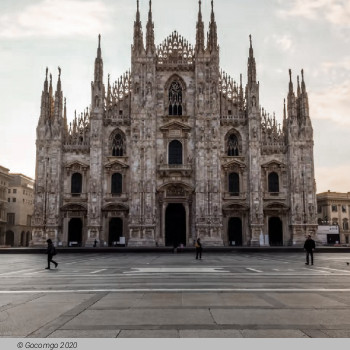
Teatro Alla Scala is an opera house in Milan. Most of Italy's greatest operatic artists, and many of the finest singers from around the world, have appeared at La Scala. The theatre is regarded as one of the leading opera and ballet theatres globally. It is home to the La Scala Theatre Chorus, La Scala Theatre Ballet, La Scala Theatre Orchestra, and the Filarmonica della Scala orchestra.

The Teatro alla Scala was founded, under the auspices of the Empress Maria Theresa of Austria, to replace the Royal Ducal Theatre, which was destroyed by fire on 26 February 1776 and had until then been the home of opera in Milan. The cost of building the new theatre was borne by the owners of the boxes at the Ducal, in exchange for possession of the land on which stood the church of Santa Maria alla Scala (hence the name) and for renewed ownership of their boxes. Designed by the great neoclassical architect Giuseppe Piermarini, La Scala opened on 3 August 1778 with Antonio Salieri's opera L'Europa riconosciuta, to a libretto by Mattia Verazi.

With the advent of Rossini in 1812 (La pietra del paragone), the Teatro alla Scala was to become the appointed place of Italian opera seria: of its history dating back more than a century and of its subsequent tradition up till the present. The catalogue of Rossini's works performed until 1825 included: Il turco in Italia, La Cenerentola, Il barbiere di Siviglia, La donna del lago, Otello, Tancredi, Semiramide and Mosé. During that period the choreographies of Salvatore Viganò (1769-181) and of Carlo Blasis (1795-1878) also widened the theatre's artistic supremacy to include ballet.

An exceptional new season of serious opera opened between 1822 and 1825, with Chiara e Serafina by Gaetano Donizetti (1797-1848) and Il pirata by Vincenzo Bellini (1801-1835). The later operas of Donizetti performed at La Scala were (until 1850) Anna Bolena, Lucrezia Borgia, Torquato Tasso, La fille du régiment, La favorita, Linda di Chamonix, Don Pasquale, and Poliuto. These were followed (until 1836) by Bellini's I Capuleti e i Montecchi, Norma, La sonnambula, Beatrice di Tenda and I puritani.

In 1839 Oberto Conte di San Bonifacio inaugurated the cycle of operas by Giuseppe Verdi (1813-1901), the composer whose name is linked more than any other to the history of La Scala. After the dismal failure of Un giorno di regno, Nabucco was performed in 1842. It was the first, decisive triumph of Verdi's career. At the same time, the strong patriotic feelings stirred by Nabucco founded the "popularity" of opera seria and identified its image with the Scala.

Arturo Toscanini (1867-1957) became the artistic director and introduced radical reform into the theatre, both in its organisational aspects and in its relations with the public. Toscanini, one of the greatest conductors of all time, took up Verdi's musical inheritance and launched a tradition of interpretation that continued uninterruptedly and was renewed during the twentieth century. It was he who reappraised and regularly performed at the Scala the works of Richard Wagner (hitherto only belatedly and inadequately recognised). He also firmly extended the Scala's orchestral repertoire to include symphonic music.

In 1948 maestro Guido Cantelli (1920-1956) made his debut and established himself as one of the leading postwar conductors. Numerous opera performances productions (the Wagnerian cycle conducted in 1950 by Wilhelm Furtwängler, the Verdi repertoire by Victor De Sabata, etc), concerts (Herbert von Karajan, Dimitri Mitropoulos, Bruno Walter, etc), singers (Maria Callas, Renata Tebaldi, Giuseppe Di Stefano, Mario Del Monaco, etc), ballet performances (Margot Fonteyn, Serge Lifar, Maya Plissetskaya, Rudolf Nureyev), and productions (Luchino Visconti, Giorgio Strehler) belong not only to the history of the Scala, but to that of the history of musical theatre since the war.

In 1965 Claudio Abbado made his début at the Scala and in 1972 was named conductor of the Scala Orchestra. Until 1986 he directed among other works Il barbiere di Siviglia, Cenerentola, L'Italiana in Algeri by Rossini, Simon Boccanegra, Macbeth and Don Carlo by Verdi, the recent Al gran sole carico d'amore by Luigi Nono, and Pelléas et Mélisande by Claude Debussy. He also conducted numerous concerts. The chorus-master was Romano Gandolfi. In 1975 the ballet dancer Oriella Dorella debuted at La Scala. Among other contemporary composers, up till 1986 the Theatre continued to give works by Luciano Berio (La vera storia), Franco Donatoni (Atem) and Karlheinz Stockhausen (Samstag aus Licht).

In 1981 Riccardo Muti debuted at the Scala as an opera conductor (Mozart, Le nozze di Figaro). Giulio Bertola was appointed to direct the Chorus. In 1982 the Orchestra Filarmonica della Scala was established. In 1985 Alessandra Ferri made her debut at the Scala. In 1986 Riccardo Muti was appointed musical director. From 1989 to 1998 he reintroduced the best-loved works (Rigoletto, La traviata, Macbeth, La forza del destino) and numerous other titles by Verdi including Falstaff and Don Carlo.

In 1991 Roberto Gabbiani took over the directorship of the chorus. In 1997 La Scala was converted into a Foundation under private ownership, thus opening a decisive phase of modernisation.

On 7 December 2001 a new production of Otello, conducted by Muti, concluded the Verdi Year and, for the time being, performances at Piermarini’s original building in Piazza Scala. Major restoration and modernisation works of the Theatre began in January 2002.

The 2005-2006 Season, dedicated to the 250th anniversary of Mozart’s birth, was inaugurated by Idomeneo conducted by Daniel Harding. The 2006/07 season saw the return on 7 December of an opera by Verdi, Aida, conducted by Riccardo Chailly, and the launch of the Celebrations for the 50th Anniversary of Arturo Toscanini’s Death. On 7 December 2007 the 2007/08 season opened with Tristan und Isolde conducted by Daniel Barenboim. The opera marked the beginning of a closer collaboration between the Teatro alla Scala and the Israeli-Argentinian Maestro.

Important Info
Type: Ballet
City: Milan, Italy
Duration: 1h 30min with 1 interval
Intervals: 1

E-tickets: Print at home or at the box office of the event if so specified. You will find more information in your booking confirmation email.

You can only select the category, and not the exact seats.
If you order 2 or 3 tickets: your seats will be next to each other.
If you order 4 or more tickets: your seats will be next to each other, or, if this is not possible, we will provide a combination of groups of seats (at least in pairs, for example 2+2 or 2+3).

Top of page