


Staatsoper Hamburg 28 May 2021 - Agrippina | GoComGo.com

Agrippina

Staatsoper Hamburg, Main Stage, Hamburg, Germany
All photos (6)
Select date and time
6:30 PM
Request for Tickets
Important Info
Type: Opera
City: Hamburg, Germany
Starts at: 18:30
Duration: 3h 50min
Sung in: Italian
Titles in: German,English

E-tickets: Print at home or at the box office of the event if so specified. You will find more information in your booking confirmation email.

You can only select the category, and not the exact seats.
If you order 2 or 3 tickets: your seats will be next to each other.
If you order 4 or more tickets: your seats will be next to each other, or, if this is not possible, we will provide a combination of groups of seats (at least in pairs, for example 2+2 or 2+3).

Overview

Introduction at 5.50 pm

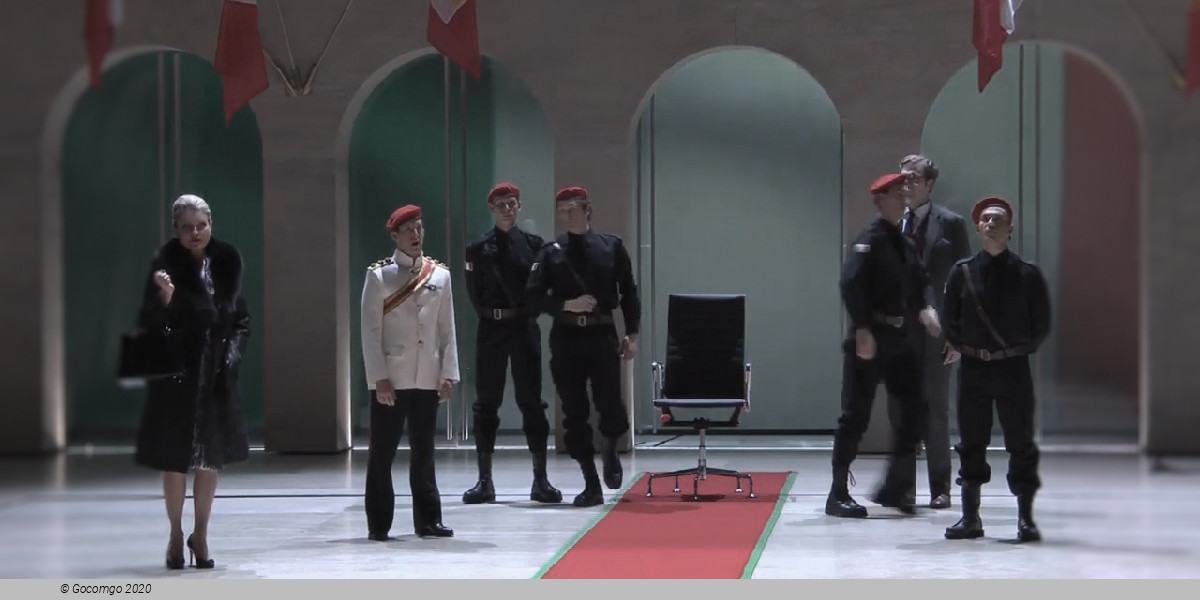
Agrippina wants to take advantage of the death of her husband, the Roman emperor Claudio, to install Nerone, her son by a first marriage, on the throne. Claudio’s death, however, was fake news. When he returns unexpectedly, he wants to appoint the military leader Ottone, who has saved his life, his successor. Poppea, who loves Ottone, would ascend to the throne with him. In order to prevent this, Agrippina makes false promises, sows distrust through rumours and gains everyone’s trust with her falsehoods. For a while, she even succeeds: the emperor and Poppea turn away from Ottone. Agrippina plays with high stakes, pulling the other protagonists into her web of intrigues, so that the emperor finally loses all orientation and gives everyone what he or she demands.

A co-production between Staatsoper Hamburg with the Bayerische Staatsoper Munich, the Royal Opera House Covent Garden and De Nationale Opera Amsterdam

History
Premiere of this production: 26 December 1709, Teatro San Giovanni Grisostomo

Agrippina is an opera seria in three acts by George Frideric Handel with a libretto by Cardinal Vincenzo Grimani. Composed for the 1709–10 Venice Carnevale season, the opera tells the story of Agrippina, the mother of Nero, as she plots the downfall of the Roman Emperor Claudius and the installation of her son as emperor. Grimani's libretto, considered one of the best that Handel set, is an "anti-heroic satirical comedy", full of topical political allusions. Some analysts believe that it reflects Grimani's political and diplomatic rivalry with Pope Clement XI.

Synopsis

Act 1

On hearing that her husband, the Emperor Claudius, has died in a storm at sea, Agrippina plots to secure the throne for Nero, her son by a previous marriage. Nero is unenthusiastic about this project, but consents to his mother's wishes ("Con saggio tuo consiglio"). Agrippina obtains the support of her two freedmen, Pallas and Narcissus, who hail Nero as the new Emperor before the Senate.

With the Senate's assent, Agrippina and Nero begin to ascend the throne, but the ceremony is interrupted by the entrance of Claudius's servant Lesbus. He announces that his master is alive ("Allegrezza! Claudio giunge!"), saved from death by Otho, the commander of the army. Otho himself confirms this and reveals that Claudius has promised him the throne as a mark of gratitude. Agrippina is frustrated, until Otho secretly confides to her that he loves the beautiful Poppaea more than he desires the throne. Agrippina, aware that Claudius also loves Poppaea, sees a new opportunity of furthering her ambitions for Nero. She goes to Poppaea and tells her, falsely, that Otho has struck a bargain with Claudius whereby he, Otho, gains the throne but gives Poppaea to Claudius. Agrippina advises Poppaea to turn the tables on Otho by telling the Emperor that Otho has ordered her to refuse Claudius's attentions. This, Agrippina believes, will make Claudius revoke his promise to Otho of the throne.

Poppaea believes Agrippina. When Claudius arrives at Poppaea's house she denounces what she believes is Otho's treachery. Claudius departs in fury, while Agrippina cynically consoles Poppaea by declaring that their friendship will never be broken by deceit ("Non ho cor che per amarti").

Act 2

Pallas and Narcissus realize that Agrippina has tricked them into supporting Nero and decide to have no more to do with her. Otho arrives, nervous about his forthcoming coronation ("Coronato il crin d'alloro"), followed by Agrippina, Nero and Poppaea, who have come to greet Claudius. All combine in a triumphal chorus ("Di timpani e trombe") as Claudius enters. Each in turns pays tribute to the Emperor, but Otho is coldly rebuffed as Claudius denounces him as a traitor. Otho is devastated and appeals to Agrippina, Poppaea, and Nero for support, but they all reject him, leaving him in bewilderment and despair ("Otton, qual portentoso fulmine" followed by "Voi che udite il mio lamento").

However, Poppaea is touched by her former beloved's grief, and wonders if he might not be innocent ("Bella pur nel mio diletto"). She devises a plan and when Otho approaches her, she pretends to talk in her sleep recounting what Agrippina has told her earlier. Otho, as she intended, overhears her and fiercely protests his innocence. He convinces Poppaea that Agrippina has deceived her. Poppaea swears revenge ("Ingannata una sol volta", alternate aria "Pur punir chi m'ha ingannata") but is distracted when Nero comes forward and declares his love for her. Meanwhile, Agrippina, having lost the support of Pallas and Narcissus, manages to convince Claudius that Otho is still plotting to take the throne. She advises Claudius that he should end Otho's ambitions once and for all by abdicating in favour of Nero. Claudius agrees, believing that this will enable him to win Poppaea.

Act 3

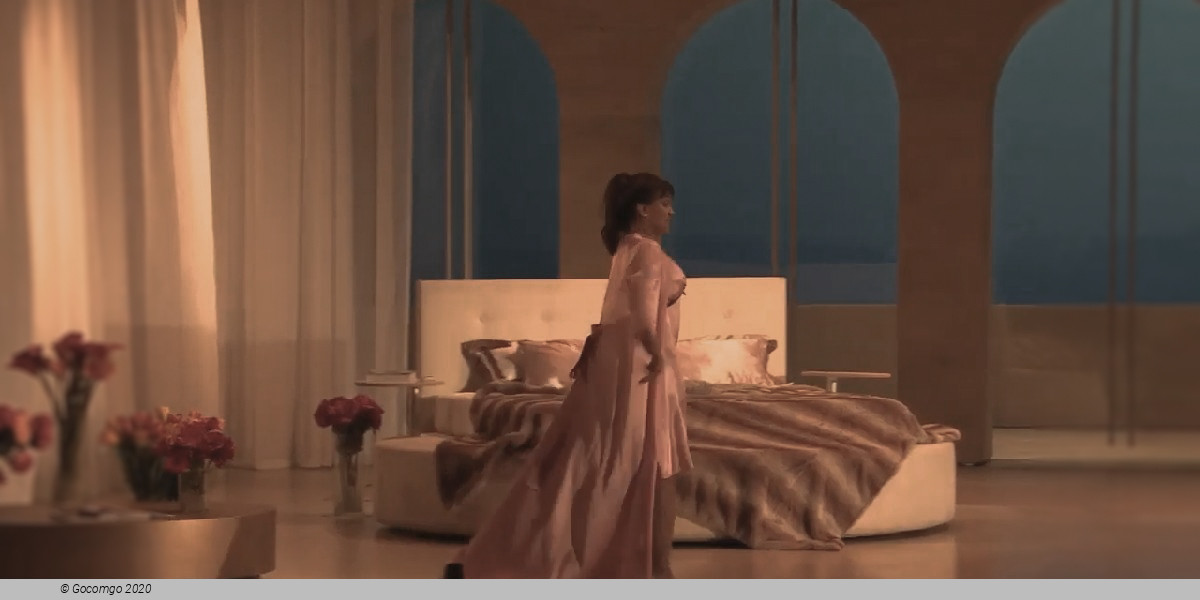
Poppaea now plans some deceit of her own, in an effort to divert Claudius's wrath from Otho with whom she has now reconciled. She hides Otho in her bedroom with instructions to listen carefully. Soon Nero arrives to press his love on her ("Coll'ardor del tuo bel core"), but she tricks him into hiding as well. Then Claudius enters; Poppaea tells him that he had earlier misunderstood her: it was not Otho but Nero who had ordered her to reject Claudius. To prove her point she asks Claudius to pretend to leave, then she summons Nero who, thinking Claudius has gone, resumes his passionate wooing of Poppaea. Claudius suddenly reappears and angrily dismisses the crestfallen Nero. After Claudius departs, Poppaea brings Otho out of hiding and the two express their everlasting love in separate arias.

At the palace, Nero tells Agrippina of his troubles and decides to renounce love for political ambition ("Come nube che fugge dal vento"). But Pallas and Narcissus have by now revealed Agrippina's original plot to Claudius, so that when Agrippina urges the Emperor to yield the throne to Nero, he accuses her of treachery. She then claims that her efforts to secure the throne for Nero had all along been a ruse to safeguard the throne for Claudius ("Se vuoi pace"). Claudius believes her; nevertheless, when Poppaea, Otho, and Nero arrive, Claudius announces that Nero and Poppaea will marry, and that Otho shall have the throne. No one is satisfied with this arrangement, as their desires have all changed, so Claudius in a spirit of reconciliation reverses his judgement, giving Poppaea to Otho and the throne to Nero. He then summons the goddess Juno, who descends to pronounce a general blessing ("V'accendano le tede i raggi delle stelle").

Venue Info

Staatsoper Hamburg - Hamburg
Location   Große Theaterstraße 25

Staatsoper Hamburg is the oldest publicly accessible musical theater in Germany, located in Hamburg. It was founded in 1678. With the emergence of the Hamburg Opera House, researchers attribute the formation of a national German opera school.

Opera in Hamburg dates to 2 January 1678 when the Oper am Gänsemarkt was inaugurated with a performance of a biblical Singspiel by Johann Theile. It was not a court theatre but the first public opera house in Germany established by the art-loving citizens of Hamburg, a prosperous member of the Hanseatic League.

The Hamburg Bürgeroper resisted the dominance of the Italianate style and rapidly became the leading musical center of the German Baroque. In 1703, George Friedrich Handel was engaged as violinist and harpsichordist and performances of his operas were not long in appearing. In 1705, Hamburg gave the world première of his opera Nero.

In 1721, Georg Philipp Telemann, a central figure of the German Baroque, joined the Hamburg Opera, and in subsequent years Christoph Willibald Gluck, Johann Adolph Hasse and various Italian companies were among the guests.

To replace the aging wooden structure, the first stone was laid on 18 May 1826 for the Stadt-Theater on the present-day site of the Staatsoper Hamburg. The new theater, with seating for 2,800 guest, was inaugurated less than a year later with Beethoven's incidental music to Egmont.

In 1873, both the exterior and interior of the structure were renovated in the reigning "Gründerzeit" style of the time, and again in 1891, when electric lighting was introduced.

Under the direction of Bernhard Pollini, the house mounted its first complete Ring Cycle in 1879. In 1883, the year of Wagner's death, a cycle comprising nine of his operas commenced. The musical directors Hans von Bülow (from 1887 to 1890) and Gustav Mahler (from 1891 to 1897) also contributed to the fame of the opera house.

In the beginning of the 20th century, opera was an important part of the theatre's repertoire; among the 321 performances during the 1907–08 season, 282 were performances of opera. The Stadt-Theater performed not only established repertoire but also new works, such as Paul Hindemith's Sancta Susanna, Igor Stravinsky's The Soldier's Tale, Ernst Krenek's Jonny spielt auf, and Leoš Janáček's Jenůfa. Ferruccio Busoni's Die Brautwahl (1912) and Erich Wolfgang Korngold's Die tote Stadt (1920) both had their world premieres in Hamburg. In the 1930s, after Hitler came to power, the opera house was renamed Hamburgische Staatsoper.

On the night of 2 August 1943, both the auditorium and its neighbouring buildings were destroyed during air raids by fire-bombing; a low-flying airplane dropped several petrol and phosphorus containers onto the middle of the roof of the auditorium, causing it to erupt into a conflagration.

The current Staatsoper opened on 15 October 1955 with Mozart's Die Zauberflöte. Hamburg continued to devote itself to new works, such as Hans Werner Henze's The Prince of Homburg (1960), Stravinsky's The Flood (1963), Gian Carlo Menotti's Help, Help, the Globolinks! (1968), and Mauricio Kagel's Staatstheater (1971).

In 1967, under the direction of Joachim Hess, the Staatsoper Hamburg became the first company to broadcasts its operas in color on television, beginning with Die Hochzeit des Figaro (a German translation of Le Nozze di Figaro). Ten of these television productions have been released on DVD by ArtHaus Musik as Cult Opera of the 1970s, as well as separately. All of these were performed in German regardless of the original language (six were written in German, one in French, two in English, and one in Italian).

More recently, Hamburg gave the world premières of Wolfgang Rihm's Die Eroberung von Mexico (1992) and Helmut Lachenmann's Das Mädchen mit den Schwefelhölzern (1997), for which it received much international acclaim. The company has won the "Opera House of the Year" award by the German magazine Opernwelt in 1997 and in 2005.

Important Info
Type: Opera
City: Hamburg, Germany
Starts at: 18:30
Duration: 3h 50min
Sung in: Italian
Titles in: German,English
Top of page