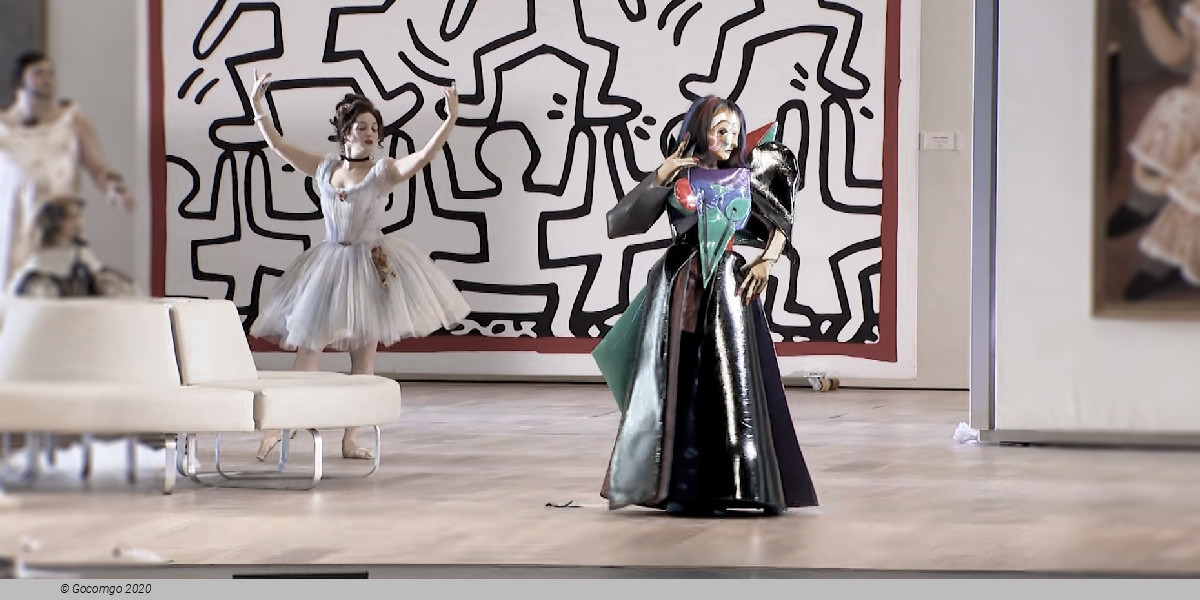
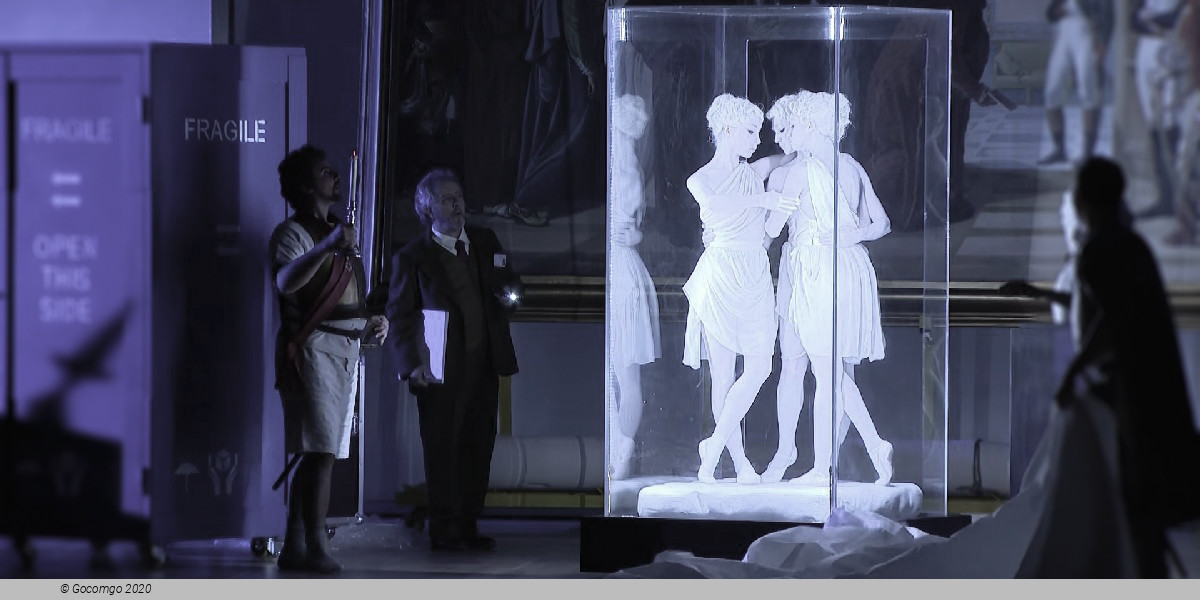
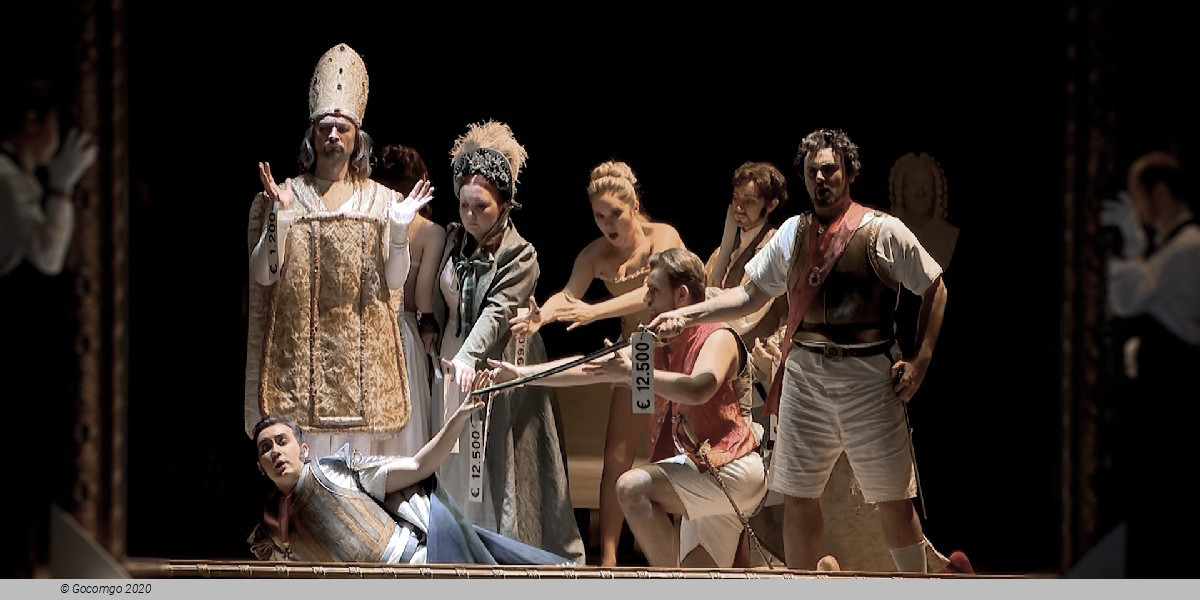
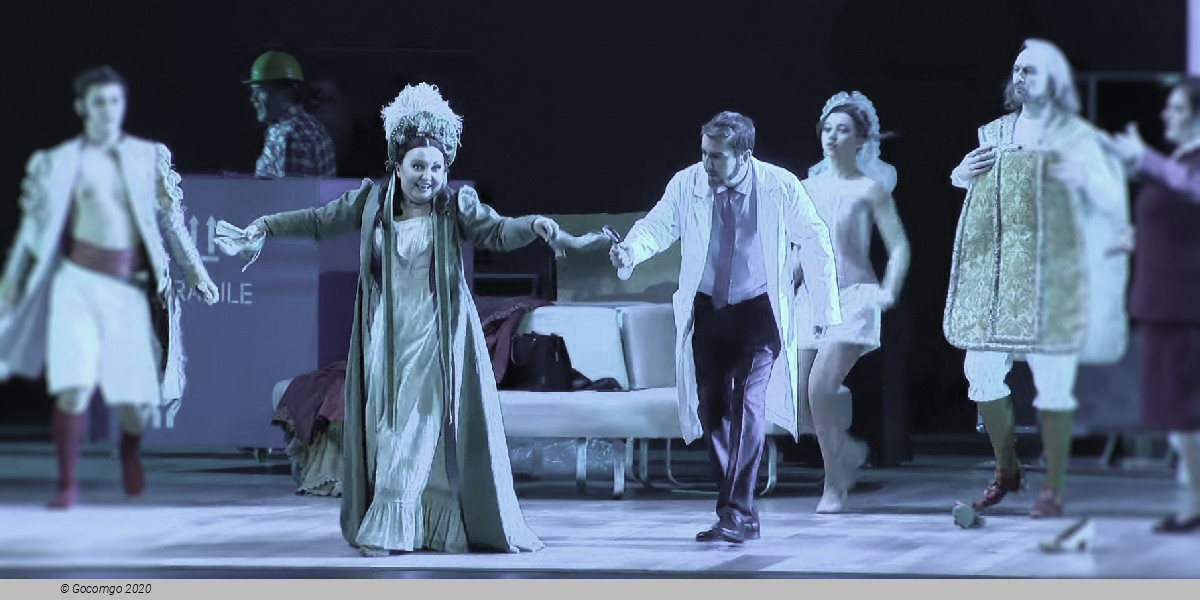
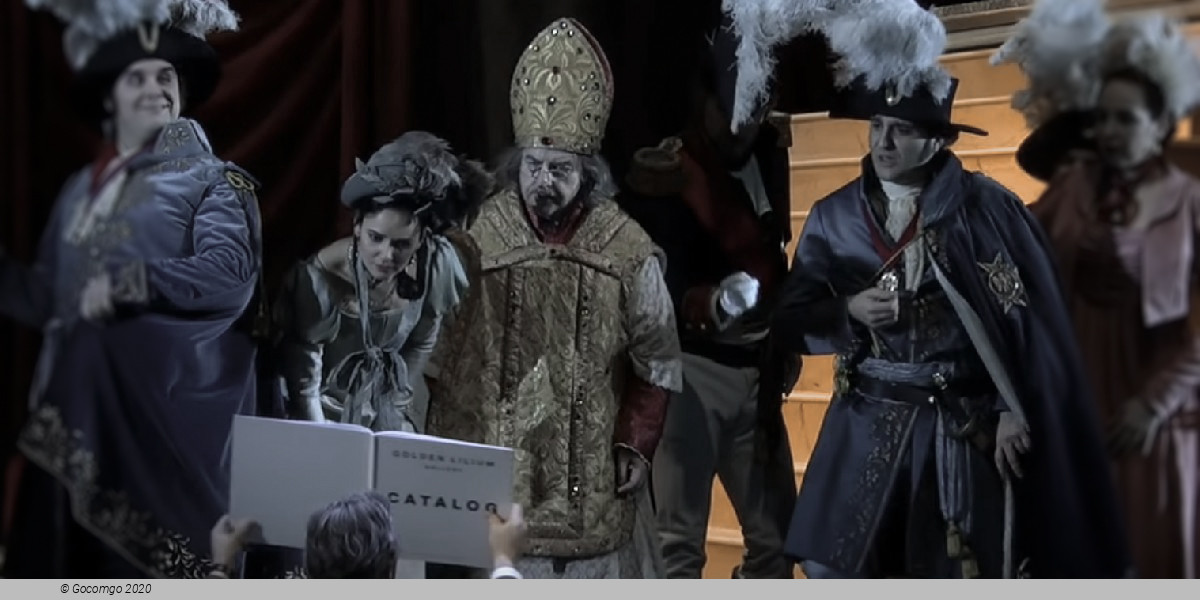
In Europe: A group of nobles from all over Europe gathered in a hotel to attend the upcoming coronation of the new French king in the cathedral of Reims. The hotel’s owner, Madame Cortese, and her employees are getting all the staff to get everything ready for the departure. The hotel doctor Don Prudenzio is conscientiously checking the travel group’s breakfast. The Countess of Folleville is eagerly awaiting her precious festive attire. Upon hearing that this has been damaged in an accident, the Parisian lady faints. It is only with the message that one of her hats has been saved that she regains consciousness and all the worried hotel guests around her breathe a sigh of relief. Austrian Baron von Trombonok and the Italian Don Profondo are amongst the guests and become witnesses to the display of jealously between the Spaniard Don Alvaro and the Russian Count Libenskof. Libenskof is in a relationship with Polish Marquise Melibea and Alvaro is crazy about her. Offended by Libenskof's suspicions, Melibea wants to leave him. It is only the sudden song of the Roman poet Corinna that calms the tempers. Madame Cortese is extremely worried as the horses needed for the journey haven’t arrived yet. A further guest of the hotel, Englishman Lord Sidney, is consumed by love for Corinna. Chevalier Belfiore has also noticed the ethereal singer and wants to win her over with his French charm. She, nevertheless, resolutely rejects him. All ready for the departure, Don Profondo gathers the guests and their luggage. However, the sudden news that there are no horses ruins all the travel plans. Faced with the truth, the travel group realises that they are stuck here and will miss the coronation! Only a letter, which Madame Cortese receives from her husband eases the situation. After the coronation in Reims there will be a whole week of festivities in the capital where everyone who was unable to attend the coronation will be able to celebrate. The Countess of Folleville immediately offers everyone the chance to stay in her house in Paris. Relieved, the group decides to end the evening with a lavish banquet in honour of the king and to continue travelling to Paris the next day. Marquise Melibea makes up with Count Libenskof and is captured by his declaration of love. The guests celebrating with hymns and songs from the their home countries: "Long live the new ruler!"
Act 1
Scene 1: Introduction
The housekeeper Maddalena is unhappy with the preparations made by the servants for the arrival of the important people who are travelling to Reims for the coronation of Charles X of France. ("Presto, presto ... su, corraggio") The servants repudiate her assertions. The hotel's doctor, Don Prudenzio, announces that, because of the impending arrivals, the normal business of the spa will be suspended. The spa attendants rejoice and depart. He checks with Antonio that his instructions about the necessary meals for the visitors have been followed.
Madame Cortese, the proprietress of the hotel, appears. She regrets that she will be unable to attend the coronation ("Di vaghi raggi adorno"), but is keen to show off the hotel to the visitors in the hope that they will return some day to take the waters. She particularly requests that everyone should be enthusiastic about each of the travellers' specific interests. Everyone agrees, and she is left alone.
Scene 2: The Countess of Folleville's arrival
The Countess calls for her maid, Modestina, and Madame Cortese goes to search for her. Modestina appears, and the Countess, worried that her clothes have not yet arrived, asks why there has been no reply to a letter that she had sent. Modestina had entrusted the letter to the Countess's cousin, Don Luigino, who immediately arrives to say that the stagecoach which he had hired to carry the boxes had overturned on the way. The Countess faints and Don Luigino calls for help.
Maddalena, Antonio, Don Prudenzio and the servants arrive, together with Baron Trombonok. Don Prudenzio and the Baron argue about how to resuscitate the Countess, but she recovers sufficiently to lament the loss of her garments. ("Partir, o ciel! desio") However, when Modestina appears with a large box containing a beautiful Paris bonnet, she rejoices that it, at least, has been saved from the accident. ("Che miro! Ah! Quel sorpresa!") Everyone is amused by this sudden turn of events, and all except Antonio and the Baron depart.
Scene 3: Sextet
After agreeing with the Baron the arrangements for party's departure in the evening, Antonio leaves. The Baron cannot help laughing at the Countess's sudden recovery and the insanity of the world in general. He is joined by Don Profondo, Don Alvaro, the Marquise Melibea, Count Libenskof. It is clear that Don Alvaro and the Count are rivals for the Marquise's affections. They are all waiting for the new horses which will be necessary for the continuation of the journey, but Madame Cortese, who now arrives, says that she cannot understand why they have not arrived. Alvaro and Libenskof quarrel, the ladies are alarmed, and the Baron and Don Profondo are amused by the idiocy of lovers. ("Non pavento alcun periglio")
A harp prelude is heard, and the poetess Corinna sings offstage of brotherly love, to everyone's delight. ("Arpa gentil")
Act 2
Scene 1: Lord Sidney's aria
Madame Cortese is still waiting for the return of her servant Gelsomino with news of the horses. Lord Sidney approaches, and she muses on his unwillingness to approach Corinna who, she is sure, reciprocates his love.
Sidney, alone, laments his situation. ("Invan strappar dal core") His mood lifts when girls singing in praise of Corinna enter with flowers, but then he is disturbed by Don Profondo's strange requests for information about the location of antiquities, and departs.
Scene 2: Corinna's duet with the Chevalier Belfiore
Profondo is joined by Corinna and her companion Delia. Corinna asks when the party is to depart, and he and Delia leave Corinna alone while they go to see whether the horses have arrived.
Corinna is joined by the Chevalier, who declares his love. ("Nel suo divin sembiante") She is taken aback and repudiates him. The Chevalier retreats, hoping to try again later, and Corinna returns to her room.
Scene 3: Don Profondo's aria
Don Profondo, who has seen the Chevalier with Corinna, reflects that the Countess will scratch the Chevalier's eyes out if she finds out what he has been doing. He then turns his attention to enumerating the effects of his fellow-travellers (as requested by the Baron), noting that their possessions tend to sum up their each of their nations' characteristics. ("Medaglie incomparabili") He looks forward to the impending departure.
The Countess appears, looking for the Chevalier. She is not pleased when Don Profondo tells her that he has been having a poetry lesson. Don Alvaro and Count Libenskof join them, asking about the horses, and the Baron, too, appears, looking woebegone. What has happened? The rest of the travellers arrive, and the Baron produces the courier Zefirino, who is obliged to report that there are no horses to be had anywhere, not even for ready money. There will be no journey to Reims for the coronation!
Scene 4: Grand concerted ensemble for 14 voices
Everyone is horrified. ("Ah! A tal colpo inaspettato") But Madame Cortese appears with a letter from Paris. Don Profondo reads it out: the King will return from Reims in a few days and there will be great festivities. Anyone who was unable to get to Reims will be consoled by an even finer spectacle. The Countess steps forward to invite the entire company to her home in Paris for the celebrations. A stagecoach will convey them there on the following day, but in the meantime a grand banquet, with invitations to the public, will be held at the Golden Lily, paid for with the money that would have been spent at the coronation. Any money left over will be given to the poor.
Act 3
Scene 1: Duet for the Count and the Marquise
When everyone else has left, the Baron tries to reconcile the jealous Count with the Marquise, who has been seen with Don Alvaro. When he departs, the misunderstanding is resolved and harmony is restored. ("D'alma celeste, oh Dio!")
They depart, and the scene changes to the hotel's garden. Antonio and Maddalena ensure that all is prepared for the banquet. The Baron has engaged a travelling company to provide entertainment with singing and dancing.
Scene 2: Finale
After the opening chorus ("L'allegria è un sommo bene"), the Baron introduces a series of short national songs sung by each of the travellers, some of them set to well-known tunes, and ending with, first, a French anthem (the Marche Henri IV) for the Duchesse de Berry, then a rustic Tyrolean duet for Madame Cortese and Don Profondo, and finally an improvised solo for Corinna on one of a number of mostly French subjects suggested by each traveller and drawn from an urn. The winning subject turns out, appropriately enough, to be "Charles X, King of France". The opera ends with dances and a chorus.










 Theaterplatz 2