




Royal Danish Theatre 1 June 2023 - Peter Grimes | GoComGo.com

Peter Grimes

Royal Danish Theatre, The Opera House - Main Stage, Copenhagen, Denmark
All photos (6)
Select date and time
7 PM

E-tickets: Print at home or at the box office of the event if so specified. You will find more information in your booking confirmation email.

You can only select the category, and not the exact seats.
If you order 2 or 3 tickets: your seats will be next to each other.
If you order 4 or more tickets: your seats will be next to each other, or, if this is not possible, we will provide a combination of groups of seats (at least in pairs, for example 2+2 or 2+3).

Important Info
Type: Opera
City: Copenhagen, Denmark
Starts at: 19:00
Intervals: 2
Duration: 3h 15min

E-tickets: Print at home or at the box office of the event if so specified. You will find more information in your booking confirmation email.

You can only select the category, and not the exact seats.
If you order 2 or 3 tickets: your seats will be next to each other.
If you order 4 or more tickets: your seats will be next to each other, or, if this is not possible, we will provide a combination of groups of seats (at least in pairs, for example 2+2 or 2+3).

Overview

The story of the outsider Peter Grimes mirrored composer Benjamin Britten’s own life. The modern opera classic is a tale of personal persecution in a restrictive society.

Benjamin Britten created his seminal work, Peter Grimes, during World War II while exiled in California with his partner, Peter Pears. Yearning for the isles of his British homeland, he stumbled upon the eighteenth-century poem about the fisherman, Peter Grimes. The poem became the seedling of his portrayal of an outlander, who suffers persecution as a deviant by the narrow-minded society that surrounds him.

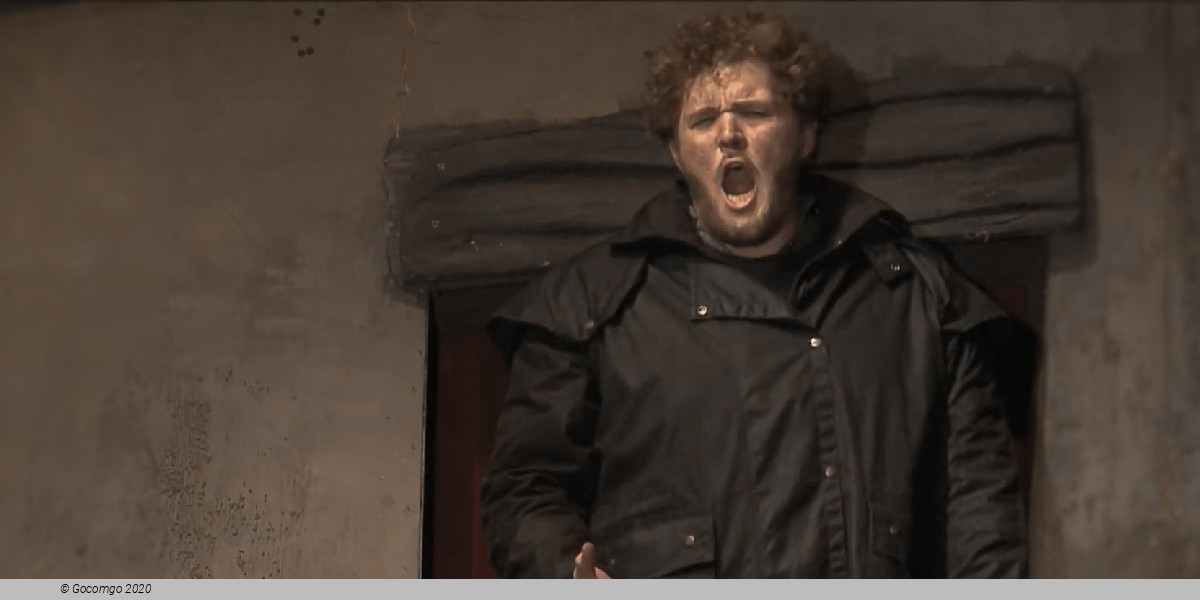
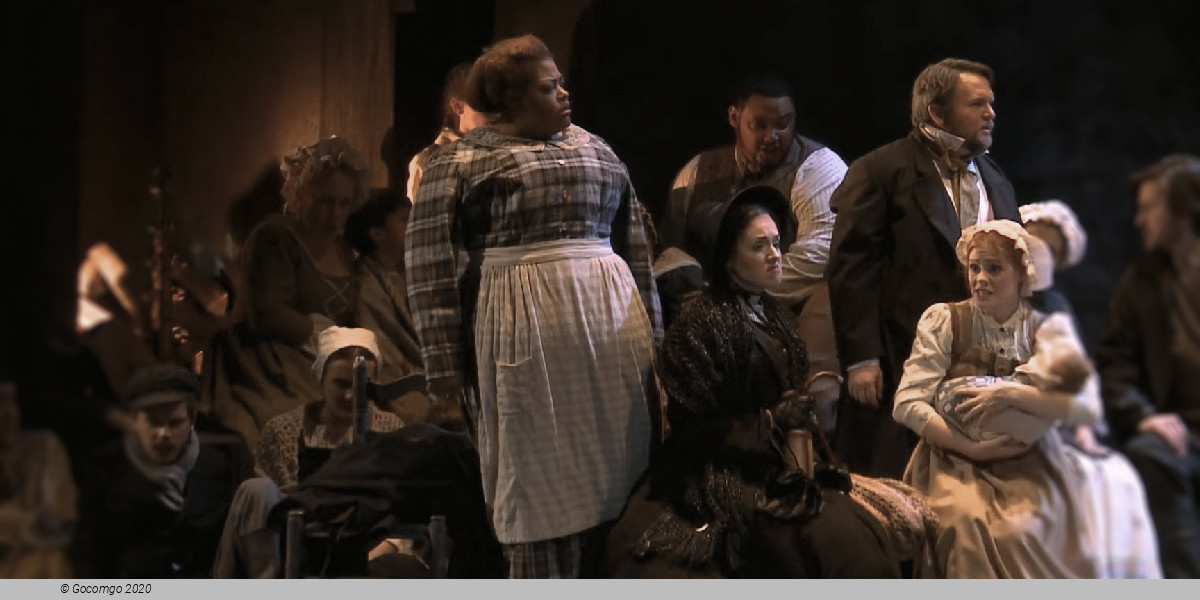
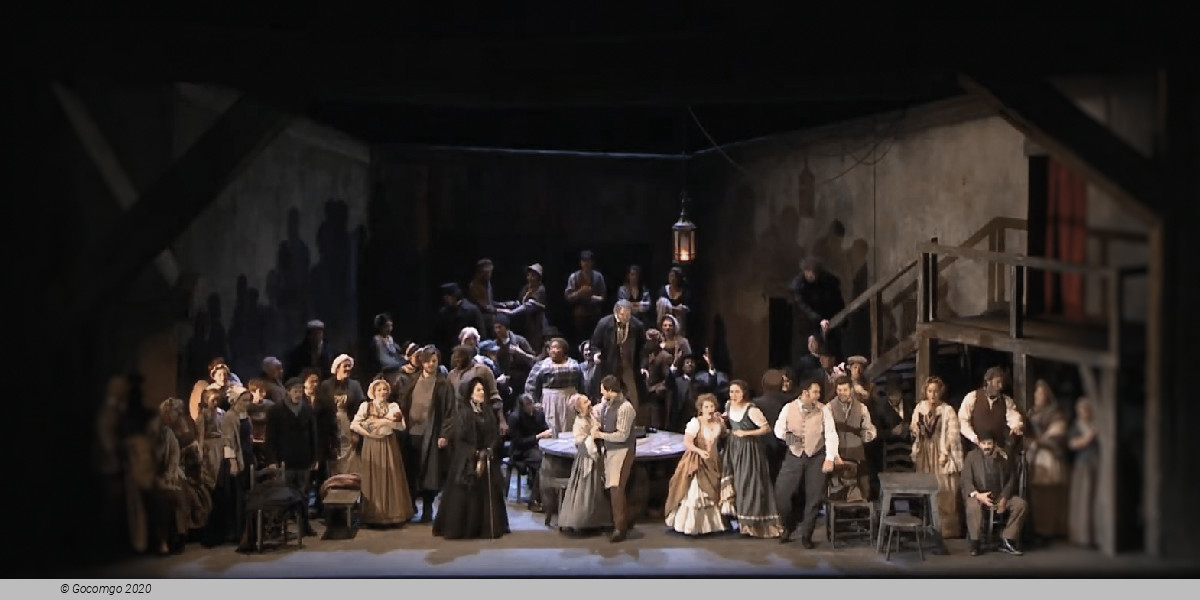
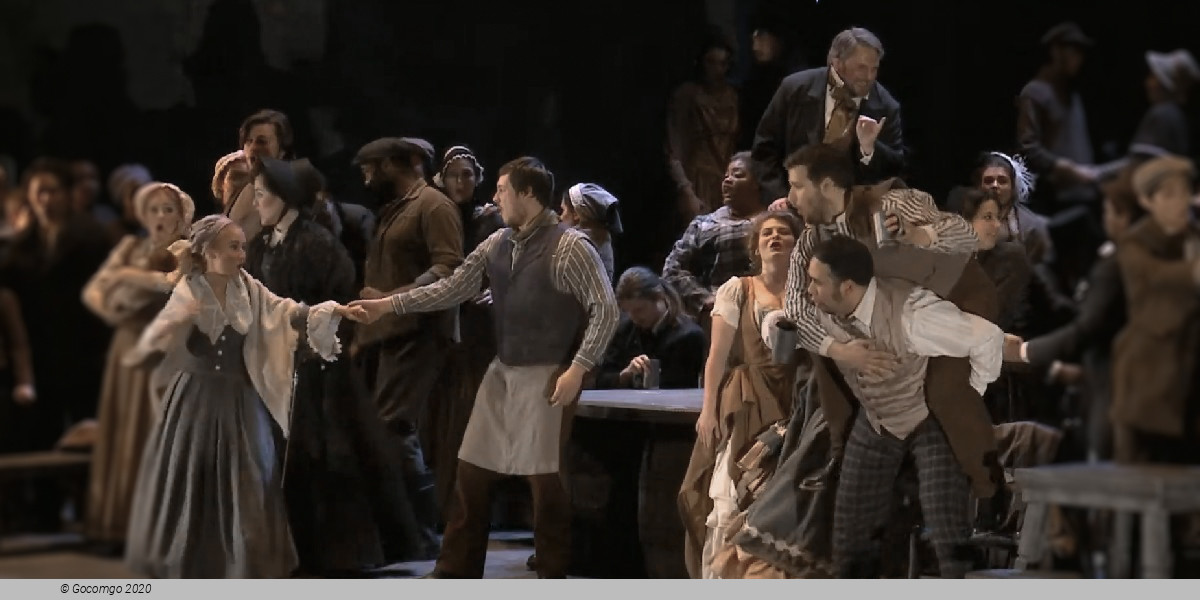
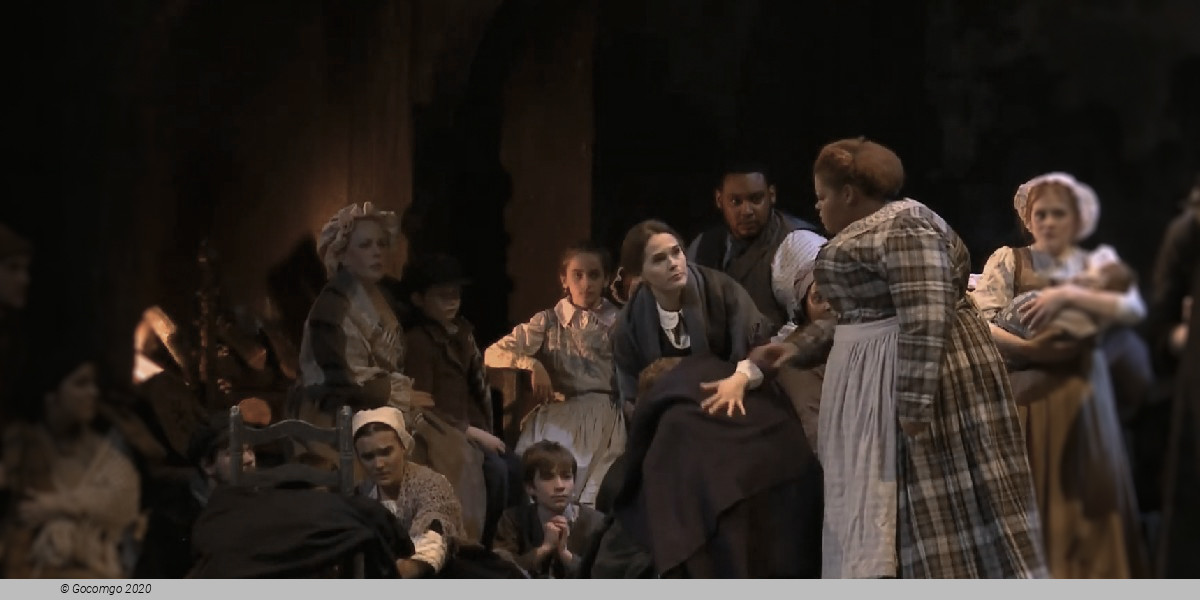
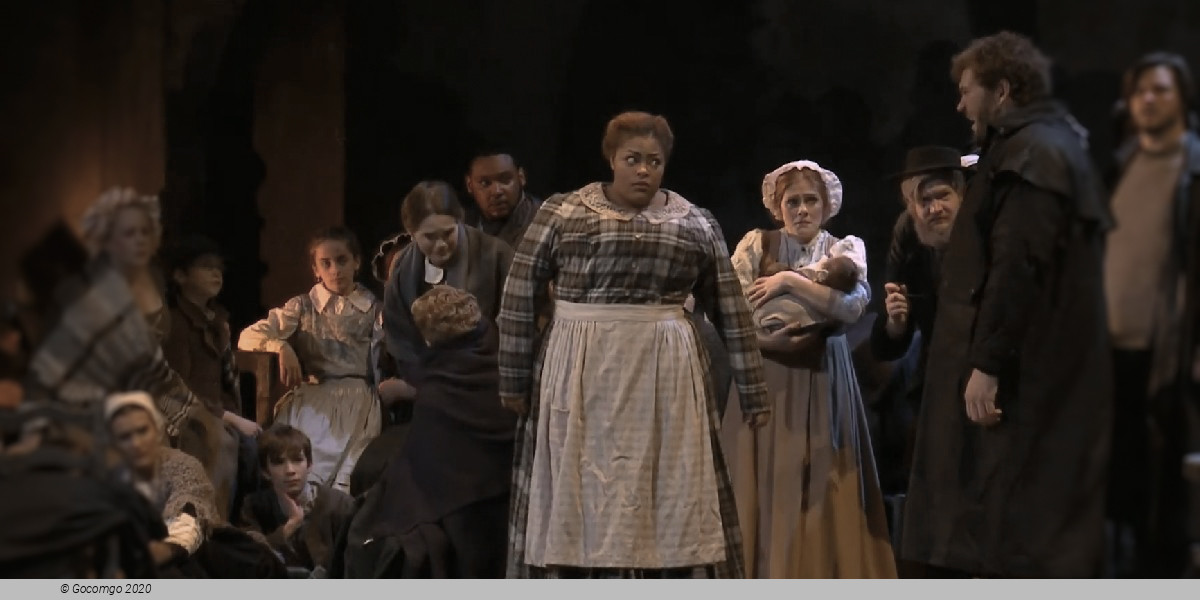
The Royal Danish Opera Chorus entertains a pivotal role in the opera when, in a savage frenzy, they set out to persecute Grimes. Niels Jørgen Riis debuts as the proud fisherman Peter Grimes, and Sine Bundgaard makes her first appearance as the schoolteacher Ellen Orford, who is the only person in the small-minded fishing hamlet who offers to help Peter in his struggle for survival.

Polish film and opera director Mariusz Treliński has staged opera productions worldwide, such as at the Staatsoper Unter den Linden in Berlin, the Metropolitan Opera in New York, and the Festival d’Aix-en-Provence.

History
Premiere of this production: 07 June 1945, Sadler`s Wells, London

Peter Grimes is an opera by Benjamin Britten, with a libretto adapted by Montagu Slater from the narrative poem, "Peter Grimes", in George Crabbe's book The Borough. The "borough" of the opera is a fictional village which shares some similarities with Crabbe's, and later Britten's, own home of Aldeburgh, a town on England's east coast.

Synopsis

Prologue

A Suffolk coastal village, mid-19th century (The date is not specified, but the foghorn in Act III places it later than the date of Crabbe's poem)

Peter Grimes is questioned at an inquest over the death at sea of his apprentice. The townsfolk, all present, make it clear that they think Grimes is guilty and deserving of punishment. Although the coroner, Mr Swallow, determines the boy's death to be accidental and clears Grimes without a proper trial, he advises Grimes not to get another apprentice—a proposal against which Grimes vigorously protests. As the court is cleared, Ellen Orford, the schoolmistress whom Grimes wishes to marry as soon as he gains the Borough's respect, attempts to comfort Grimes as he rages against what he sees as the community's unwillingness to give him a true second chance.

Act 1

The same, some days later

After the first orchestral Interlude (in the Four Sea Interludes concert version entitled "Dawn"), the chorus, who constitute "the Borough", sing of their weary daily round and their relationship with the sea and the seasons. Grimes calls for help to haul his boat ashore, but is shunned by most of the community. Belatedly, Balstrode and the apothecary, Ned Keene, assist Grimes by turning the capstan. Keene tells Grimes that he has found him a new apprentice (named John) from the workhouse. Nobody will volunteer to fetch the boy, until Ellen offers ("Let her among you without fault...").

As a storm approaches, most of the community—after securing windows and equipment—take shelter in the pub. Grimes stays out, and alone with Balstrode confesses his ambitions: to make his fortune with a "good catch", buy a good home and marry Ellen Orford. Balstrode suggests "without your booty Ellen will have you now", only to provoke Grimes's furious "No, not for pity!" Balstrode abandons Grimes to the storm, as the latter ruminates "What harbour shelters peace?" The storm then breaks with a vengeance (second orchestral Interlude).

In the pub, tensions are rising due both to the storm and to the fiery Methodist fisherman, Bob Boles, getting increasingly drunk and lecherous after the pub's main attraction, the two "nieces". Grimes suddenly enters ("Now the Great Bear and Pleiades..."), and his wild appearance unites almost the entire community in their fear and mistrust of his "temper". Ned Keene saves the situation by starting a round ("Old Joe has gone fishing"). Just as the round reaches a climax, Ellen arrives with the apprentice, both drenched. Grimes immediately sets off with the apprentice to his hut, despite the terrible storm.

Act 2

The same, some weeks later

On Sunday morning (the third orchestral Interlude), while most of the Borough is at church, Ellen talks with John, the apprentice. She is horrified when she finds a bruise on his neck. When she confronts Grimes about it, he brusquely claims that it was an accident. Growing agitated at her mounting concern and interference, he strikes her and runs off with the boy. This does not go unseen: first Keene, Auntie, and Bob Boles, then the chorus comment on what has happened, the latter developing into a mob to investigate Grimes's hut. As the men march off, Ellen, Auntie, and the nieces sing sadly of the relationship of women with men. The fourth interlude (Passacaglia) follows as the scene changes.

At the hut, Grimes impatiently drives the ever silent John into changing out of his Sunday clothes and into fisherman's gear, and then becomes lost in his memories of his previous, now dead apprentice, reliving the boy's death of thirst. When he hears the mob of villagers approaching, he quickly comes back to reality, stirred both by a paranoid belief that John has been "gossiping" with Ellen, so provoking the "odd procession", and at the same time feeling defiant. He gets ready to set out to sea, and he tells John to be careful climbing down the cliff to his boat, but to no avail: the boy falls to his death. When the mob reaches the hut Grimes is gone, and they find nothing out of order, so they disperse.

Act 3

The same, two days later, night time in the Borough ("Moonlight" in the Sea Interludes).

While a dance is going on, Mrs Sedley tries to convince the authorities that Grimes is a murderer, but to no avail. Ellen and Captain Balstrode confide in each other: Grimes has disappeared, and Balstrode has discovered a jersey washed ashore: a jersey that Ellen recognises as one she had knitted for John. Mrs Sedley overhears this, and with the knowledge that Grimes has returned, she is able to instigate another mob. Singing "Him who despises us we'll destroy", the villagers go off in search of Grimes. The sixth interlude, not included in the Sea Interludes, covers the change of scene.

While the chorus can be heard searching for him, Grimes appears onstage, singing a long monologue sparsely accompanied by cries from the off-stage chorus, and a fog horn (represented by a solo tuba): John's death has seemingly shattered Grimes's sanity. Ellen and Balstrode find him, and the old captain encourages Grimes to take his boat out to sea and sink it. Grimes leaves. The next morning, the Borough begins its day anew, as if nothing has happened. There is a report from the coastguard of a ship sinking off the coast. This is dismissed by Auntie as "one of these rumours."

Venue Info

Royal Danish Theatre - Copenhagen
Location   August Bournonvilles Passage 2-8

The Royal Danish Theatre is the major opera house in Denmark. It has been located at Kongens Nytorv in Copenhagen since 1748, originally designated as the king's theatre but with public access. The theatre presents opera, the Royal Danish Ballet, classical music concerts (by the Royal Danish Orchestra, which dates back to 1448), and drama in several locations.

The Royal Danish Theatre organization is under the control of the Danish Ministry of Culture, and its objectives are to ensure the staging of outstanding performances that do justice to the various stages that it controls.

The first edifice on the site was designed by court architect Nicolai Eigtved, who also masterminded Amalienborg Palace. In 1774, the old theatre seating 800 theatergoers were reconstructed by architect C.F. Harsdorff to accommodate a larger audience.

During the theatre's first seasons the staffing was modest. Originally, the ensemble consisted of eight actors, four actresses, two male dancers, and one female dancer. Gradually over the following decades, the Royal Danish Theatre established itself as the kind of multi-theatre we know today, home to drama, opera, ballet, and concerts – all under the same roof and management.

An important prerequisite for the theatre's artistic development is its schools. The oldest is the ballet school, established at the theatre in 1771. Two years later, a vocal academy was established as a forerunner for the opera academy. A number of initiatives were considered regarding a drama school, which was established much later.

King Frederik VI, who ascended the throne in 1808, is probably the monarch who most actively took part in the management of the Royal Danish Theatre, not as an arbiter of taste but as its supreme executive chef.

The theatre's bookkeeping accounts of these years show numerous endorsements where the king took personal decisions on everything from wage increases and bonuses to the purchase of shoelaces for the ballerinas. Indeed, the Royal Danish Theatre became the preoccupation of an introverted nation, following the English Wars had suffered a state bankruptcy. "In Denmark, there is only one city and one theatre," as philosopher Søren Kierkegaard put it.

This was the theatre to which the 14-year-old fairytale storyteller Hans Christian Andersen devoted his early ambition. This was also the theatre that became the social and artistic focal point of the many brilliant artists of Denmark's Golden Age.

After the abolition of absolute monarchy in 1849, the Royal Danish Theatre's status as "the city's theatre" fell into decline. No longer enjoying a monopoly within the performing arts, the Royal Danish Theatre was now required by its new owner, the state, to serve the entire nation. The dilapidated building at Kongens Nytorv also found it hard to compete with the splendor of the new popular stage that was rapidly emerging across town. The solution was to construct a brand new theatre building. It was designed in the Historicist style of the times by architects William Dahlerup and Ove Pedersen and situated alongside the old theatre, which was subsequently demolished.

The inauguration of what we today call the Old Stage took place on 15 October 1874. Here opera and ballet were given ample scope. But due to the scale of the building, the auditorium was less suited for spoken drama, which is why a new playhouse was required.

The Royal Danish Theatre has over the past decade undergone the most extensive transformation ever in its over 250-year history. The Opera House in Copenhagen was inaugurated in January 2005, donated by the AP Møller and Chastine Mc-Kinney Møller Foundation, and designed by architect Henning Larsen. And the Royal Danish Playhouse was completed in 2008. Located by Nyhavn Canal across from the Opera House, the playhouse is designed by architects Boje Lundgaard and Lene Tranberg.

Today, the Royal Danish Theatre comprises the Old Stage, located by Kongens Nytorv, the Opera House, and the Royal Danish Playhouse. 

Important Info
Type: Opera
City: Copenhagen, Denmark
Starts at: 19:00
Intervals: 2
Duration: 3h 15min
Top of page