

Queen’s Theatre 9 July 2023 - "Bastien and Bastienne" and "La Serva padrona" | GoComGo.com

"Bastien and Bastienne" and "La Serva padrona"

Queen’s Theatre, Paris, France
All photos (7)
Select date and time
8 PM
Request for Tickets
Important Info
Type: Opera
City: Paris, France
Starts at: 20:00
Intervals: 1
Duration: 2h 10min
Sung in: French

E-tickets: Print at home or at the box office of the event if so specified. You will find more information in your booking confirmation email.

You can only select the category, and not the exact seats.
If you order 2 or 3 tickets: your seats will be next to each other.
If you order 4 or more tickets: your seats will be next to each other, or, if this is not possible, we will provide a combination of groups of seats (at least in pairs, for example 2+2 or 2+3).

Overview

Bastien and Bastienne, Singspiel in one act K. 50 to a booklet by Friedrich Wilhelm Weiskern, Johann H. F. Müller and Johann Andreas Schachtner first performed in Vienna in 1768.
La Serva padrona, intermezzo in two parts on a booklet by Gennarantonio Federico, first performed in Naples in 1733.

An Opéra Royal / Château de Versailles Spectacles, Théâtre-Sénart production

History
Premiere of this production: 02 October 1890, Architektenhaus, Berlin

Bastien und Bastienne (Bastien and Bastienne) is a one-act singspiel, a comic opera, by Wolfgang Amadeus Mozart. Bastien und Bastienne was one of Mozart's earliest operas, written in 1768 when he was only twelve years old. 

Premiere of this production: 05 September 1733, Teatro San Bartolomeo, Naples

La serva padrona (The Servant Turned Mistress) is an opera buffa by Giovanni Battista Pergolesi (1710–1736) to a libretto by Gennaro Federico, after the play by Jacopo Angello Nelli. The opera is only 45 minutes long and was originally performed as an intermezzo between the acts of a larger serious opera. (The same libretto was set by Giovanni Paisiello in 1781.)

Synopsis

Place: A pastoral village
Time: Indeterminate

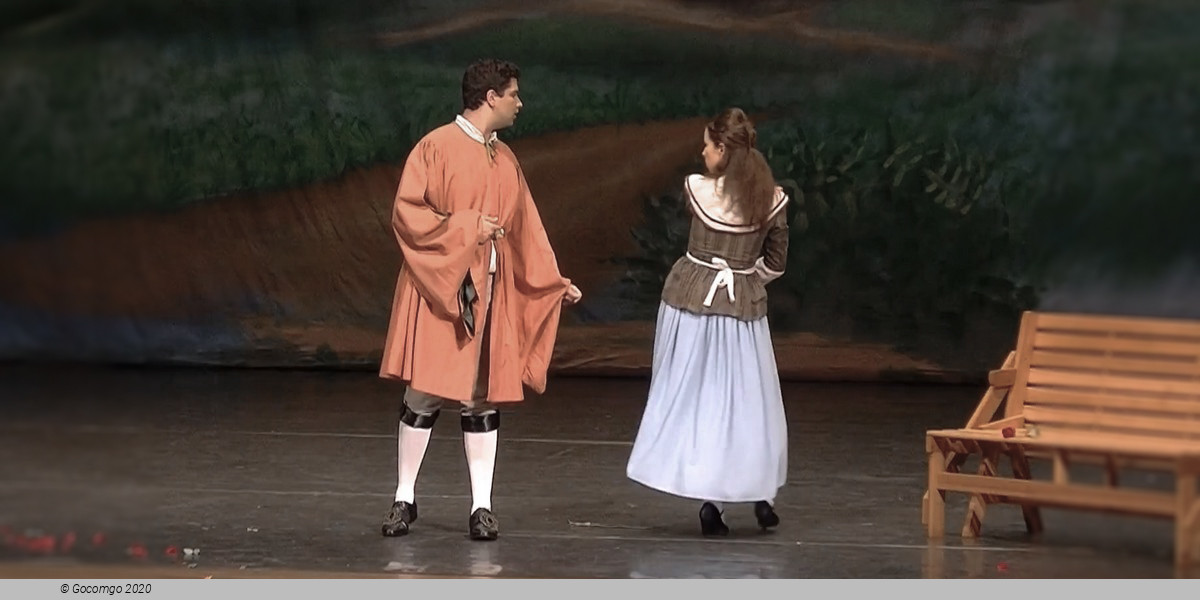
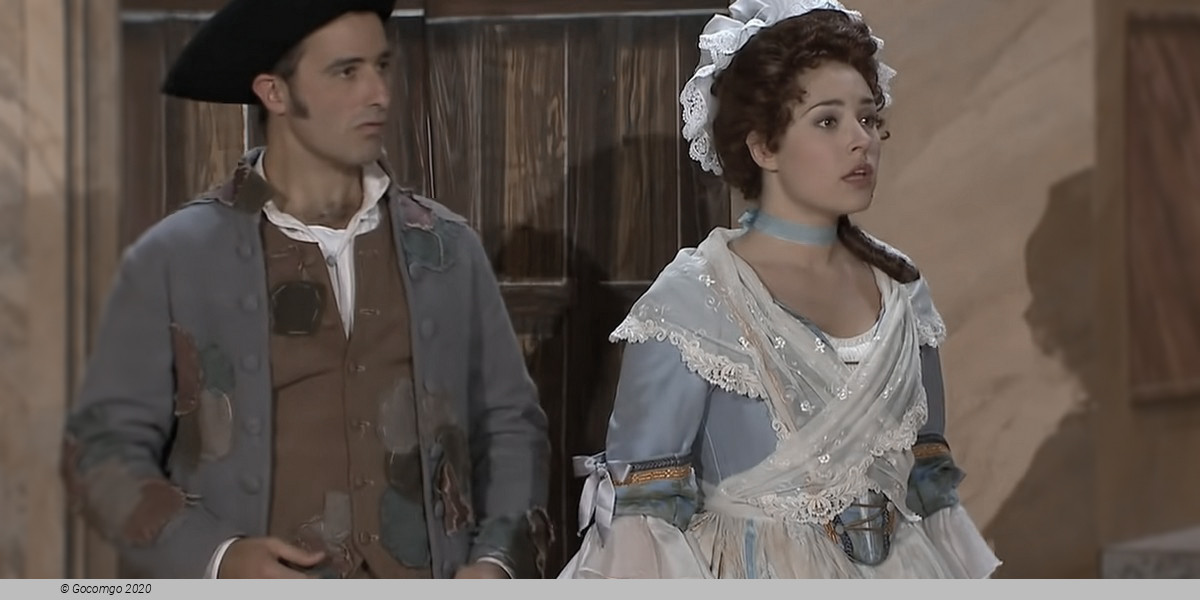
Bastienne, a shepherdess, fears that her "dearest friend", Bastien, has forsaken her for another pretty face, and decides to go into the pasture to be comforted by her flock of lambs.

Before she can leave, however, she runs into Colas, the village soothsayer. Bastienne requests the help of his magical powers to help win back her Bastien. Colas (being a soothsayer) knows all about the problem, and comforts her with the knowledge that Bastien has not abandoned her, rather, he's merely been distracted lately by 'the lady of the manor'. His advice is to act coldly towards Bastien, which will make him come running back.

Bastien is heard approaching, so Bastienne hides herself. Bastien swaggers in, proclaiming how much he loves Bastienne. Colas informs him that Bastienne has a new lover. Bastien is shocked and asks the magician for help.

Colas opens his book of spells and recites a nonsense aria filled with random syllables and Latin quotations. Colas declares the spell a success and that Bastienne is in love with Bastien once more. Bastienne, however, decides to keep up the game a bit longer and spurns Bastien with great vehemence. Bastien threatens suicide, which Bastienne merely shrugs off.

Finally, the two decide that they have gone far enough and agree to reconcile. Colas joins them as they all sing a final trio in praise of the magician.

Intermezzo 1 – Dressing room

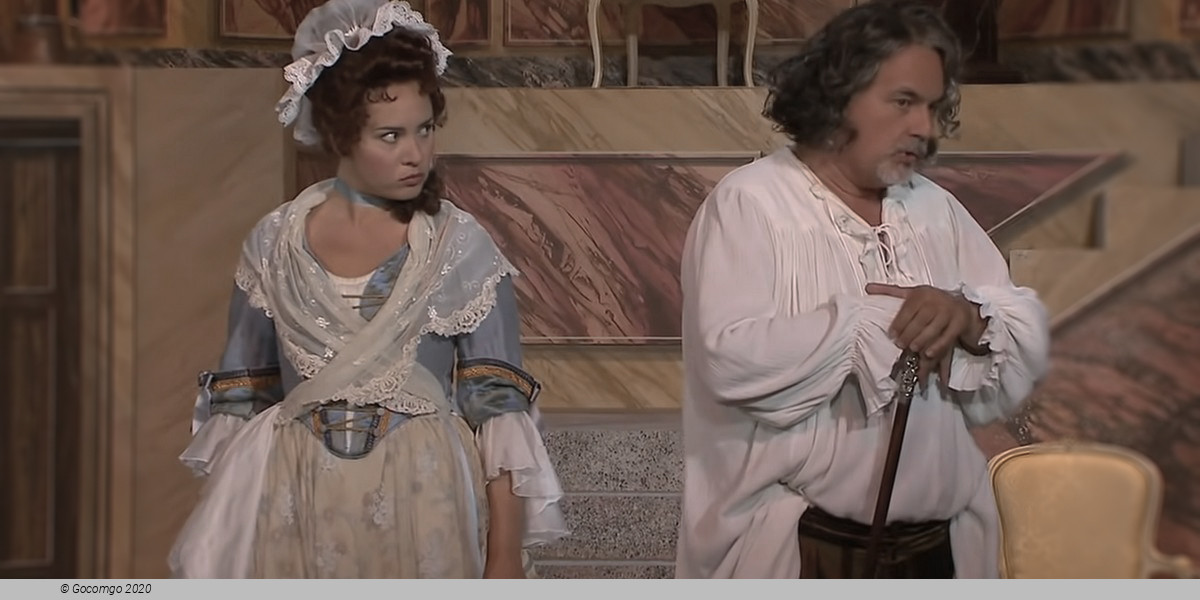
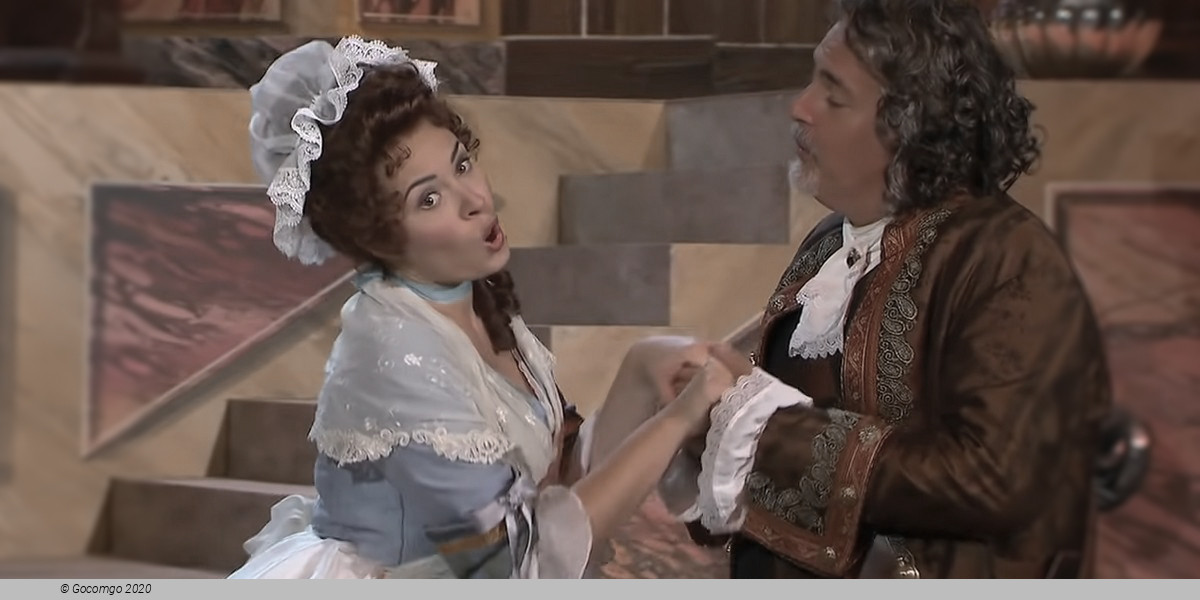
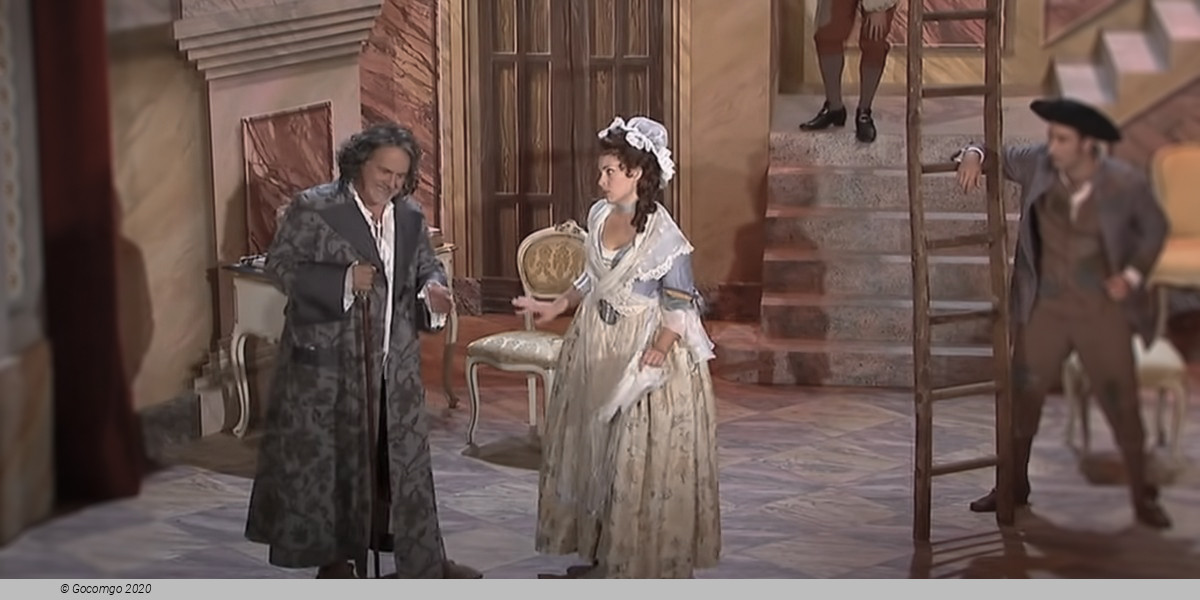
Uberto, an elderly bachelor, is angry and impatient with his maidservant, Serpina, because she has not brought him his chocolate today. Serpina has become so arrogant that she thinks she is the mistress of the household. Indeed, when Uberto calls for his hat, wig and coat, Serpina forbids him from leaving the house, adding that from then on he will have to obey her orders. Uberto thereupon orders Vespone to find him a woman to marry so that he can rid himself of Serpina.

Intermezzo 2 – Same dressing room

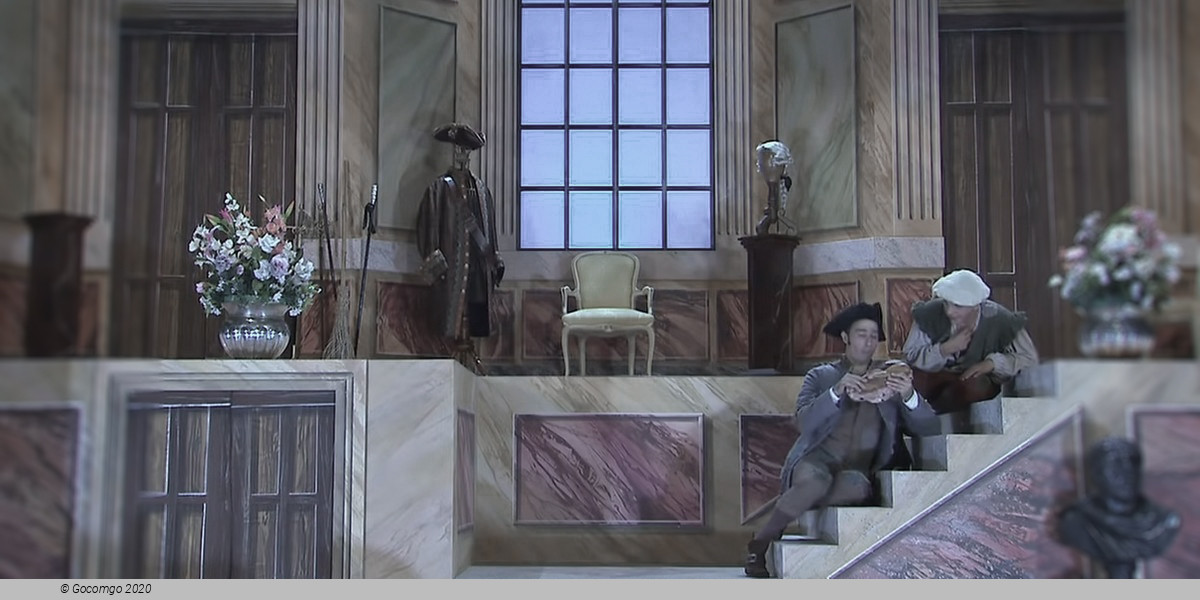
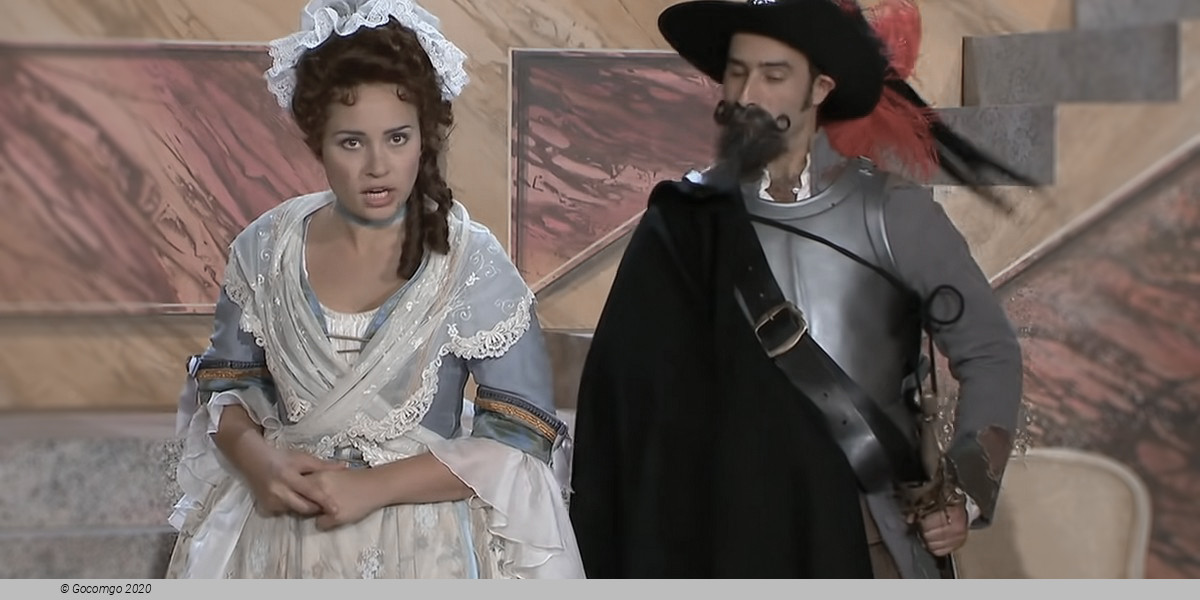
Serpina convinces Vespone to trick Uberto into marrying her. She informs Uberto that she is to marry a military man named Tempesta. She will be leaving his home and apologizes for her behavior. Vespone, disguised as Tempesta, arrives and, without saying a word, demands 4,000 crowns for a dowry. Uberto refuses to pay such a sum. Tempesta threatens him to either pay the dowry or marry the girl himself. Uberto agrees to marry Serpina. Serpina and Vespone reveal their trick; but Uberto realizes that he has loved the girl all along. They will marry after all; and Serpina will now be the true mistress of the household.

Venue Info

Queen’s Theatre - Paris
Location   Place d'Armes, Versailles

A great lover of the dramatic arts, Marie-Antoinette eventually grew tired of the temporary stages knocked together for performances in the gallery of the Grand Trianon and the orangery of the Petit Trianon. Once she had decided to commission her personal architect Richard Mique to build her a real theatre, work was completed in spring 1780, and the official inauguration was on 1 June.

Cleverly tucked away amidst the foliage of the gardens, the entrance to the theatre is a discreet portico in the classical style. The theatre itself was large enough to seat two hundred and fifty spectators, in a décor dominated by blue, white, and gold. The sculpted decorations were created using the quick (and cheap) technique of papier mâché, in which the craftsmen of the Menus Plaisirs were acknowledged, experts. The various shades of gold blend harmoniously with the false marble paneling dominated by violet tones. The ceiling, painted by Lagrenée, was completed just a few days before the inauguration of the theatre and depicted Apollo surrounded by the Graces and Muses. The original was replaced by a copy in the 19th century. The vast stage (eight layers, two floors below stage level and two in the rafters), was expertly fitted out by mechanical specialist Pierre Boullet, successor to Blaise-Henri Arnoult, who designed the machinery of the Royal Opera. The orchestra pit has room for around twenty musicians.

The queen intended the Trianon theatre to play a double role: it needed to provide a stage for the works commissioned from the artist of the Royal Academy of Music, and thus offer satisfactory technical facilities, but it also needed to allow the queen to indulge her passion for amateur dramatics and to put on comedies with her friends whenever she fancied. Between 1780 and 1785 Marie-Antoinette used her theatre for both purposes. She commissioned new works which reflected her interest in the music of the day. Featured artists included Gluck, Grétry, Sacchini, and Paisiello, whose Barber of Seville, first performed in Saint Petersburg for Catherine II, had its French premiere at the Trianon theatre in 1784. Falling out of favor with the queen after 1785, the theatre survived the revolutionary period relatively unscathed. It was used occasionally in the nineteenth and early twentieth centuries and underwent restoration between 1925 and 1936 and again in 2001.

The original machinery has been restored to working order, making the Trianon theatre the only eighteenth-century theatre in France which is still intact and fully functioning. Along with an exceptional set dating from 1754 and showing the temple of Minerva from the first act of Quinault and Lully’s Thésée - designed by the Slodtz brothers for the theatre at Fontainebleau - the Queen’s Theatre still has various items of scenery (including two full sets) produced in the nineteenth century by Pierre-Luc-Charles Cicéri and his workshop: a ‘rustic interior’, a forest, and fragments of a public square and ‘rich salon’.

On account of its small size and distance from the palace, the auditorium is no longer used for performances. This has helped to preserve the theatre in its original condition, without the need to install modern safety features which would inevitably compromise its period authenticity. The theatre is still open to the public as part of the guided tour ‘Special effects at the Queen’s Theatre’, which includes a live demonstration of how the sets were changed.

Important Info
Type: Opera
City: Paris, France
Starts at: 20:00
Intervals: 1
Duration: 2h 10min
Sung in: French
Top of page