
Oslo Opera House 19 February 2022 - Vilde Frang and Chamber Orchestra of Europe | GoComGo.com

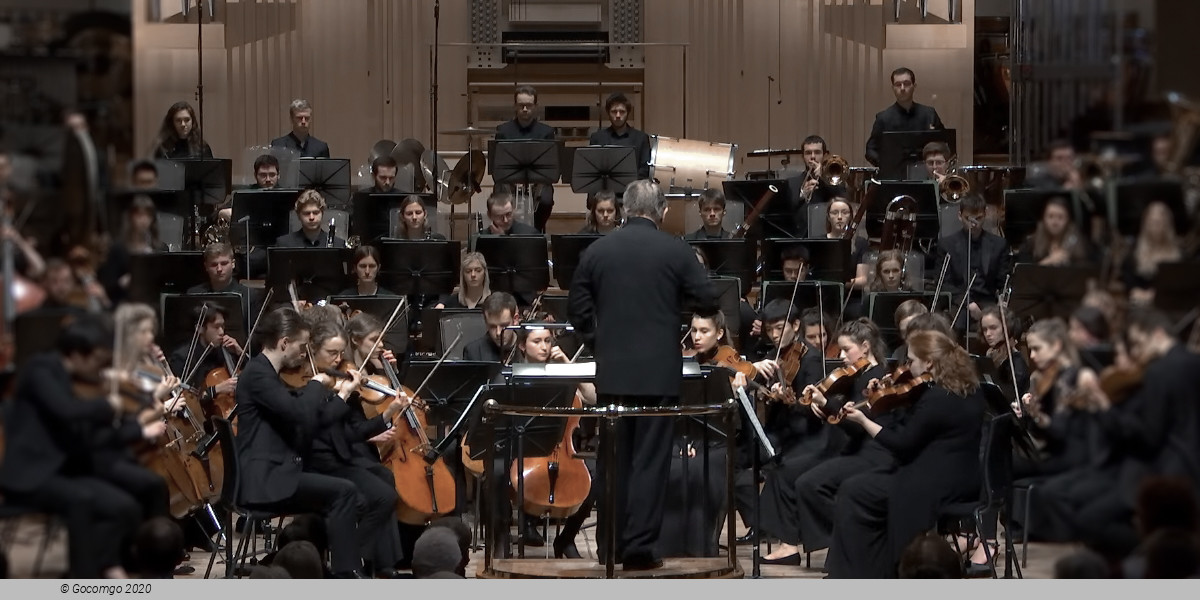
Vilde Frang and Chamber Orchestra of Europe

Oslo Opera House, Main Stage, Oslo, Norway
All photos (1)
Select date and time
6 PM

E-tickets: Print at home or at the box office of the event if so specified. You will find more information in your booking confirmation email.

You can only select the category, and not the exact seats.
If you order 2 or 3 tickets: your seats will be next to each other.
If you order 4 or more tickets: your seats will be next to each other, or, if this is not possible, we will provide a combination of groups of seats (at least in pairs, for example 2+2 or 2+3).

Important Info
Type: Classical Concert
City: Oslo, Norway
Starts at: 18:00
Duration: 2h

E-tickets: Print at home or at the box office of the event if so specified. You will find more information in your booking confirmation email.

You can only select the category, and not the exact seats.
If you order 2 or 3 tickets: your seats will be next to each other.
If you order 4 or more tickets: your seats will be next to each other, or, if this is not possible, we will provide a combination of groups of seats (at least in pairs, for example 2+2 or 2+3).

Programme
Wolfgang Amadeus Mozart: Don Giovanni, K527: overture
Robert Schumann: Violin Concerto in D minor
Ludwig van Beethoven: Symphony no. 3 in E flat major "Eroica", Op.55
Overview

One of the world’s greatest chamber orchestras is performing a goody bag of classical treats during its very first visit to Norway – with celebrity violinist Vilde Frang on board.

There is every reason to be excited when the Chamber Orchestra of Europe – considered ‘the finest chamber orchestra in the world’ (BBC 2) – performs at the Oslo Opera House in February. Over the years, the CEO has performed in the most famous concert halls worldwide and together with many of the world’s greatest performers. Next on its list is a collaboration with Vilde Frang – who began playing the violin at the age of four, debuted with the Norwegian Radio Orchestra at ten, and has become an internationally in-demand and award-winning violin player. During this concert, we will hear her masterful performance of Schumann’s Violin Concerto. The program also includes two of our most beloved classical works.

Mozart’s last-minute overture 

The musical line-up starts with the overture from Mozart’s Don Giovanni. Rumour has it that Mozart composed the overture the night before the premiere in 1787. The story goes that the genius composer had been out drinking when one of his friends reminded him that he had not yet finished composing the opera. At midnight, Mozart went up to his room and completed the overture in only three hours – while his wife, Constanze, told him stories to keep him awake. 

Schumann’s secret concert 

Schumann’s passionate Violin Concerto in D Minor is his only violin concerto – and believe it or not, it was a spiritualist séance that made it known to the world. Schumann wrote the concerto in 1856 at the end of his life and died before it was finished. His widow, Clara, was not particularly thrilled about the work and hid the notes away with instructions ‘Not to be performed for 100 years. In 1937, a violinist in England claimed to have been told during a spiritualist séance with an Ouija board that a violin concerto written by none other than Schumann existed. After searching high and low, the forgotten notes were found in the Prussian State Library in Berlin! And a good thing too because otherwise, we would not have the pleasure of enjoying the concerto at the Oslo Opera House. 

Beethoven’s tribute to Napoleon 

The program is rounded off with what may be Beethoven’s most influential work, the Eroica Symphony. Completed in 1804, the symphony was originally intended as Beethoven’s tribute to the military general Napoleon, from the intense first movement via the sorrowful second movement to the third movement, full of tempo and temperament, and concluding with a fourth variation that gives the hero a triumphant ending. It also proved to be triumphant for Beethoven, who experienced his major breakthrough with this symphony.  

Vilde Frang and the COE 

Violinist Vilde Frang is a high-profile soloist and chamber musician both at home and abroad. She plays weekly with the world’s greatest conductors and orchestras and as a chamber musician, she has collaborated with musicians like Gidon Kremer, Yuri Bashmet, Martha Argerich, and Janine Jansen, as well as toured with Anne-Sophie Mutter. 

The COE was established in 1981 by a group of young musicians who had graduated from the European Community Youth Orchestra (now called the EUYO). Their ambition was to continue to work together on the highest possible professional level. Today’s members all pursue parallel careers as soloists or section leaders for nationally based orchestras, as prominent chamber musicians, or as music teachers. What they all have in common is a passion for and a wealth of knowledge of music.

Venue Info

Oslo Opera House - Oslo
Location   Kirsten Flagstads Plass 1

The Oslo Opera House is the home of The Norwegian National Opera and Ballet, and the national opera theatre in Norway. The building is situated in the Bjørvika neighbourhood of central Oslo, at the head of the Oslofjord. It is operated by Statsbygg, the government agency which manages property for the Norwegian government. The structure contains 1,100 rooms in a total area of 38,500 m2 (414,000 sq ft). The main auditorium seats 1,364 and two other performance spaces can seat 200 and 400. The main stage is 16 m (52 ft) wide and 40 m (130 ft) deep. The angled exterior surfaces of the building are covered with marble from Carrara, Italy and white granite and make it appear to rise from the water. It is the largest cultural building constructed in Norway since Nidarosdomen was completed circa 1300.

In 1999, after a long national debate, the Norwegian legislature decided to construct a new opera house in the city. A design competition was held and, of the 350 entries received, the judges chose that of Snøhetta. Construction started in 2003 and was completed in 2007, ahead of schedule and 300 million NOK (~US$52 million) under its budget of 4.4 billion NOK (~US$760 million). The gala opening on 12 April 2008 was attended by His Majesty King Harald, Queen Margrethe II of Denmark and President Tarja Halonen of Finland and other leaders. During the first year of operation, 1.3 million people passed through the building's doors.

The Opera House won the culture award at the World Architecture Festival in Barcelona in October 2008 and the 2009 European Union Prize for Contemporary Architecture.

The roof of the building angles to ground level, creating a large plaza that invites pedestrians to walk up and enjoy the panoramic views of Oslo. While much of the building is covered in white granite and La Facciata, a white Italian carrara marble, the stage tower is clad in white aluminium, in a design by Løvaas & Wagle that evokes old weaving patterns.

The lobby is surrounded by 15 m (49 ft) tall windows with minimal framing and special glass that allows maximum views of the water. The roof is supported by thin angled columns also designed not to interfere with views.

Interior surfaces are covered in oak to bring warmth to spaces in contrast to the coolness of the white exterior. The main auditorium is a horseshoe shape and illuminated by an oval chandelier containing 5,800 handmade crystals. Seats include monitors for the electronic libretto system, allowing audiences to follow opera libretti in Norwegian and English in addition to the original language.

Several art projects were commissioned for the interior and exterior of the Opera House. The most notable is She Lies, a sculpture constructed of stainless steel and glass panels by Monica Bonvicini. It is permanently installed on a concrete platform in the fjord adjacent to Opera House and floats on the water moving in response to tides and wind to create an ever-changing face to viewers. The work was unveiled by Her Majesty Queen Sonja on 11 May 2010.

A perforated wall panel which covers roof supports in the lobby was designed by Olafur Eliasson. It features hexagonal opening and is illuminated from below and behind to create the illusion of melting ice. Other artists involved in the construction include Kristian Blystad, Jorunn Sannes and Kalle Grude, who designed the shape of the pavers on the forecourt and roof; Bodil Furu and Trine Lise Nedreaas, who created a film and video project; Marte Aas, Talleiv Taro Manum, Tom Sandberg, Gerd Tinglum and Nina Witoszek Fitzpatrick, who created the art book Site Seeing; and Linus Elmes and Ludvig Löfgren, who created the foundation stone.

The main stage curtain is the work of Pae White who designed it to look like crumpled aluminum foil. White scanned a crumpled piece of foil into a computer which translated the information to a loom that wove the curtain from wool, cotton and polyester to create a three-dimensional effect. The curtain was manufactured by the German-based theatrical equipment company Gerriets GmbH. The finished curtain measures 74 ft (23 m) wide and 36 ft (11 m) and weighs 1,100 lb (500 kg).

Important Info
Type: Classical Concert
City: Oslo, Norway
Starts at: 18:00
Duration: 2h
Top of page