

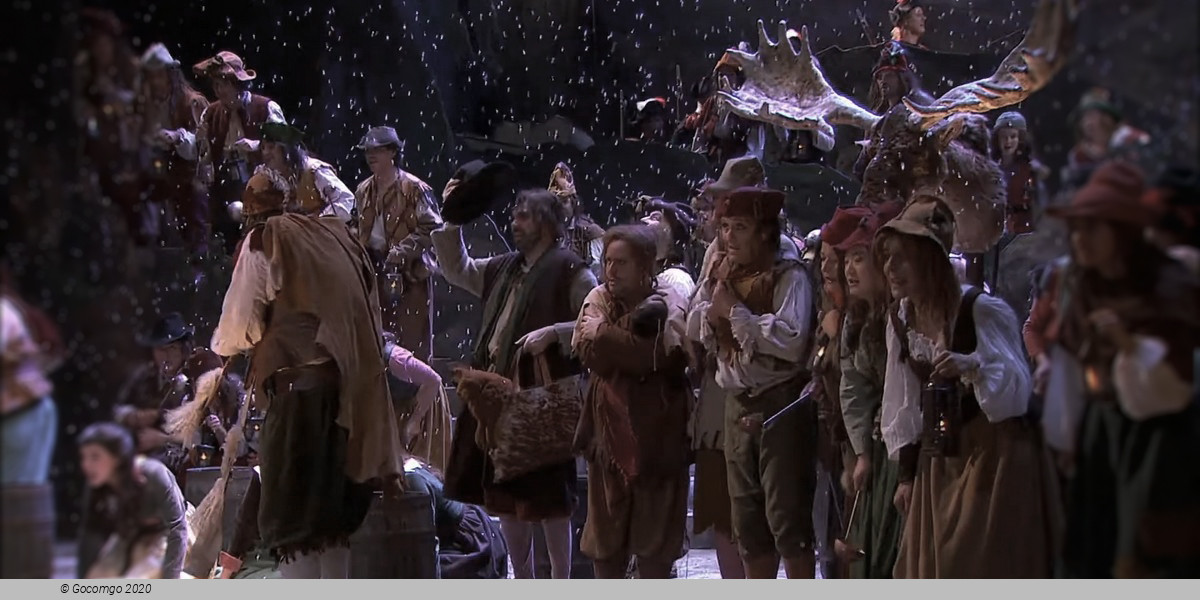
Oper Frankfurt 15 March 2024 - The Bandits | GoComGo.com

The Bandits

Oper Frankfurt, Opera House, Frankfurt am Main, Germany
All photos (4)
Select date and time
7:30 PM

E-tickets: Print at home or at the box office of the event if so specified. You will find more information in your booking confirmation email.

You can only select the category, and not the exact seats.
If you order 2 or 3 tickets: your seats will be next to each other.
If you order 4 or more tickets: your seats will be next to each other, or, if this is not possible, we will provide a combination of groups of seats (at least in pairs, for example 2+2 or 2+3).

Important Info
Type: Opera
City: Frankfurt am Main, Germany
Starts at: 19:30
Acts: 3
Intervals: 1
Duration: 2h 30min
Sung in: German
Titles in: German,English

E-tickets: Print at home or at the box office of the event if so specified. You will find more information in your booking confirmation email.

You can only select the category, and not the exact seats.
If you order 2 or 3 tickets: your seats will be next to each other.
If you order 4 or more tickets: your seats will be next to each other, or, if this is not possible, we will provide a combination of groups of seats (at least in pairs, for example 2+2 or 2+3).

Overview

Jacques Offenbach, the master of satirical-biting wit and virtuosic situation comedy, proves he’s still at the top of his game with his operetta about robbers, always a popular theme.

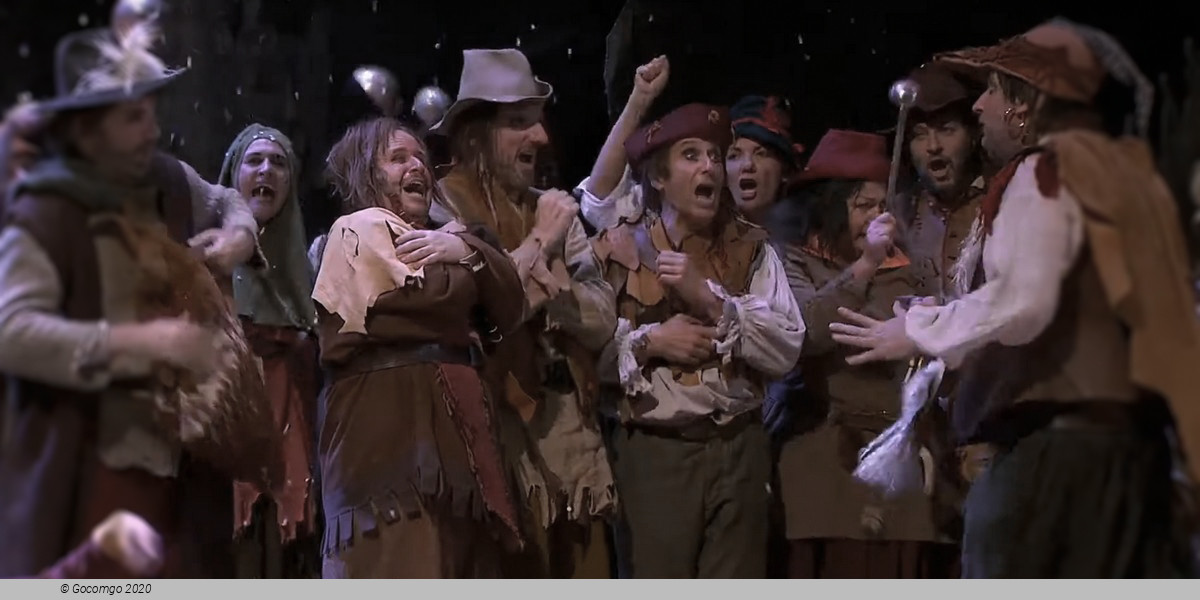
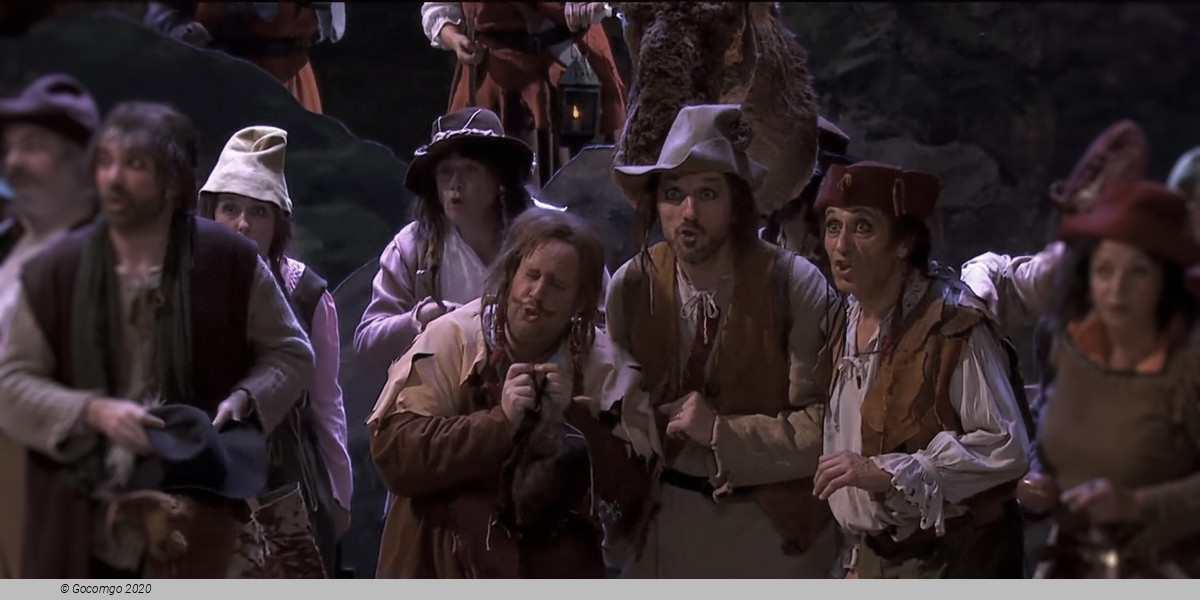
Life as a bandit ain’t what it used to be. Robber chief Falsacappa’s having trouble keeping his men happy: Recent forays raked in next to nothing.

When they raided farmer Fragoletto's place he fell in love with Falsacappa’s daughter Fiorella, and she with him. So he wants to be a bandit too. Fragoletto makes an interesting catch: a government messenger. From papers in his possession they discover that the Princess of Granada’s on her way to marry the Prince of Mantua. Most of her dowry consists of money the Mantuans owe Spain. The rest – 3 million – is to be given to the delegation from Granada when they arrive. Falsacappa draws up a plan: to beat the Spanish to it and get his hands on the money himself. To this end the robbers, disguised as pilgrims, attack the inn "on the border between Italy and Spain", where the Spanish are expected,  and pose as landlord Pipo and his staff in the kitchen. Once they’ve caught the delegation from Granada they swap roles with them. At the court of Mantua, however, it turns out that the treasurer has long since frittered the money away on private affairs: they’re broke. State authorities are obviously more criminal than bandits – but the carabinieri can’t do much about it, turning up too late in their heavy boots once again.

History
Premiere of this production: 10 December 1869, Théâtre des Variétés, Paris

Les brigands (The Bandits) is an opéra bouffe, or operetta, by Jacques Offenbach to a French libretto by Henri Meilhac and Ludovic Halévy. Meilhac and Halévy's libretto lampoons both serious (Schiller's play set to music by Verdi) and light theatre (Fra Diavolo and Les diamants de la couronne by Auber). The plot is cheerfully amoral in its presentation of theft as a basic principle of society rather than as an aberration. As Falsacappa, the brigand chieftain, notes: "Everybody steals according to their position in society". The piece premiered in Paris in 1869 and has received periodic revivals in France and elsewhere, both in French and in translation.

Synopsis

Act 1
A wild rocky place
The brigands assemble at dawn, but some of them complain to Falsacappa that they cannot live properly on the rewards of their work. He promises an imminent and profitable venture. The marriage of the Princess of Grenade with the Duc de Mantoue has been announced, and the band will be there.

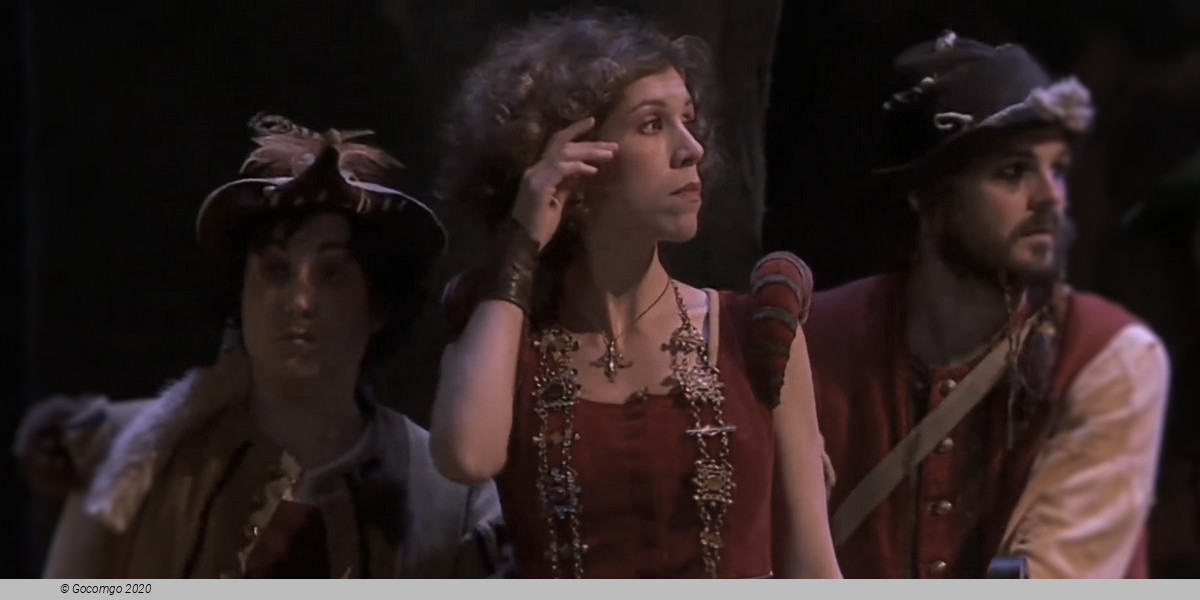
His daughter Fiorella has fallen for the young farmer Fragoletto, whose farm the gang recently raided, and she is beginning to have doubts about their calling. She shows Piétro, the second-in-command a small portrait she has had painted of herself. Fragoletto is brought in by some of the brigands, not unwillingly, as he asks for Fiorella's hand, and to join the band. Falsacappa agrees on condition that Fragoletto prove himself.

Fiorella is left with Piétro, and a handsome stranger enters. He – fascinated by her – has lost his way. When Piétro goes to find help, she decides to warn him – in fact the Duke of Mantua – to flee. Fragoletto arrives with an intercepted message about the union of the Duke and the Princess of Granada, setting out the promise to the Spaniards of a large dowry instead of the debt owed to them. Falsacappa frees the messenger, replacing the princess's portrait in the briefcase with that of his daughter. Fragoletto has earned his place in the band; as the gang celebrate their new member they hear the sound of the boots of the carabinieri approaching, but they pass by without noticing the gang, and the brigands resume their celebration of their plans.

Act 2
An inn on the frontier
The Mantuan delegation is heading for Pipo's inn on the border of Italy and Spain on the road from Granada to Mantua. Posing as beggars the bandits come to the inn; they quickly overwhelm the hotel staff horrified to be victims of the infamous Falsacappa.

The band plan to disguise themselves as cooks and waiters; then, when the Mantuans arrive, they will capture them in turn and re-disguise themselves as Mantuans, so that when the Granadans arrive they will surprise them, don their clothes and hasten to the Mantuan court to present Fiorella as the princess whose associate (Pietro in disguise) is worth three millions. Fiorella claims her reward: Fragolettos’s hand and the disguising begins.

When the Mantuan party arrive, led by the Baron de Campotasso and accompanied by the carabinieri they fall into the trap, but the brigands have little time to switch clothes again before the Granadan delegation reaches the inn. After a Spanish dance, the Granadans are greeted by Falsacappa as the captain of the carabinieri and Piétro as the Baron de Campotasso. Gloria-Cassis asks about the three million payment but then Fragoletto and Fiorella (as the innkeeper and his lover) enter. The Granadans become confused when told to retire to bed (at two in the afternoon) but do as they are told. Once out of their clothes, the brigands go for them for the next disguise. However the innkeeper escapes his bonds and cries for help, but the brigands prevail over the carabinieri who, locked in the cellars, have helped themselves to the wine. The brigands head off towards Mantua.

Act 3
A great hall at the court of Mantua
The Duke is taking advantage of his last hours before marriage bidding farewell to his mistresses. The portrait he has received of his bride reminds him of the peasant girl who assisted him in the mountains (and for whom he has been searching ever since). The Duke is also keen to pay off his debt of three million little knowing that his treasurer Antonio has been spending the ducal money on women of his own.

When the fake Granadan delegation arrives led by Falsacappa, the Duke is delighted to see Fiorella again, and she recognizes him as the stranger lost in the mountains. Fiorella, playing the princess of Grenade introduces Fragoletto as her page.

When Falsacappa asks for the money it emerges that the treasurer has squandered the dowry. Falsacappa is furious, but just then the Mantuans, swiftly followed by the Granadans abandoned at the inn, arrive, along with the carabineri. The real princess introduces herself. The brigands admit who they are but when Fiorella enters in her costume from Act 1 and reminds the Duke that she saved him from the brigands, he agrees to an amnesty and they swear to lead good lives from then on.

Venue Info

Oper Frankfurt - Frankfurt am Main
Location   Untermainanlage 11

The Oper Frankfurt (Frankfurt Opera) is one of the leading opera companies in Europe, and voted best "Opera house of the year" several times since 1996.

Opera in Frankfurt am Main has a long tradition, with many world premieres such as Franz Schreker's Der ferne Klang in 1912, Fennimore und Gerda by Frederick Delius in 1919, and Carl Orff's Carmina Burana in 1937. Frankfurt's international recognition began in the Gielen Era, 1977 to 1987, when Michael Gielen and stage directors such as Ruth Berghaus collaborated.

A historic opera house from 1880 was destroyed in World War II, and reconstructed as a concert hall, Alte Oper. The present opera house, built in 1963, is under one roof with the stage for drama. The opera orchestra is called Frankfurter Opern- und Museumsorchester. Today's venue for Baroque and contemporary opera is the Bockenheimer Depot, a former tram depot.

Oper Frankfurt is part of the Städtische Bühnen Frankfurt.

Frankfurt's first opera was Johann Theile's Adam und Eva, performed in 1698 by Johann Velten's touring company. The young Goethe's first operas in his home town of Frankfurt were productions by Theobald Marchand's company.

1782 – 1880
Opened in 1782, the Comoedienhaus was the first permanent venue of the Frankfurt Theater (drama and opera). In 1878 German violinist Willy Hess took up the leadership of the Oper Frankfurt. He resigned from that post in 1886 to take up a professorship in the Rotterdam Conservatorium voor Muziek.

1880 – 1944
The first representative opera house of the city was inaugurated in Frankfurt in 1880 at Opernplatz. Under the direction of the first Intendant Emil Claar and the first Kapellmeister Felix Otto Dessoff, the house was opened with Mozart's opera Don Giovanni.

During the 1920s, the opera in Frankfurt had more prominent Jewish singers than any other company in Germany, including the tenor Hermann Schramm, bass Hans Erl (the first King in Schreker's Der Schatzgräber), baritone Richard Breitenfeld and contralto Magda Spiegel, who also toured with Frankfurt Opera performing Wagner in the Netherlands. These singers were forced to leave the opera in June 1933. Orff's Carmina Burana was premiered at Oper Frankfurt in 1937. Jewish members of the opera company among those rounded up at 9 November 1938 at the Festhalle Frankfurt, where Erl sang In diesen Heilgen Hallen, from the Magic Flute for the deportees. Members of Frankfurt Opera were sent to Auschwitz and other camps where they perished.

1945 – 1970s
The opera house was damaged in an air raid in January 1944, and then almost completely destroyed in March. A new house for opera and play was built, completed in 1963 at the Theaterplatz (now Willy-Brandt-Platz). In 1952, Georg Solti became Generalmusikdirektor (GMD) and Intendant of the Oper Frankfurt, where he remained in charge for nine years.

The Gielen Era
From 1977 to 1987, Frankfurt Opera was led by Michael Gielen. This decade became known as the "Gielen Era", notable for the music of a conductor who was also a composer, and directors including Ruth Berghaus and Hans Neuenfels, whose productions of standard works such as Verdi's Aida and Wagner's Ring Cycle were thought-provoking. Operas which received their world premieres at the house were also performed again, including Franz Schreker's Die Gezeichneten.

1987 – present
The stage of the opera house was destroyed by a fire in November 1987. The opera house was rebuilt and opened in April 1991. Many famous singers started their career with the company, including Franz Völker, Edda Moser, Cheryl Studer and Diana Damrau, and many established artists have been engaged there in recent seasons including Christian Gerhaher, whose roles here have included Monteverdi's L'Orfeo and his first Wolfram in Wagner's Tannhäuser, Piotr Beczała in Massenet's Werther and Jan-Hendrik Rootering in Wagner's Parsifal.

Since 2002, Bernd Loebe has served as Intendant of the company. The company's current GMD is Sebastian Weigle, since 2008. Weigle has made commercial recordings of opera with the company for the OEHMS Classics label. He is scheduled to stand down as GMD of Oper Frankfurt at the close of the 2022–2023 season. In October 2021, the company announced the appointment of Thomas Guggeis as the next GMD of the company, effective with the 2023–2024 season, with an initial contract of 5 years.

Oper Frankfurt was voted 1996, 2003, 2015, 2018 and 2020 "Opera House of the Year" by the magazine Opernwelt.

Important Info
Type: Opera
City: Frankfurt am Main, Germany
Starts at: 19:30
Acts: 3
Intervals: 1
Duration: 2h 30min
Sung in: German
Titles in: German,English
Top of page