


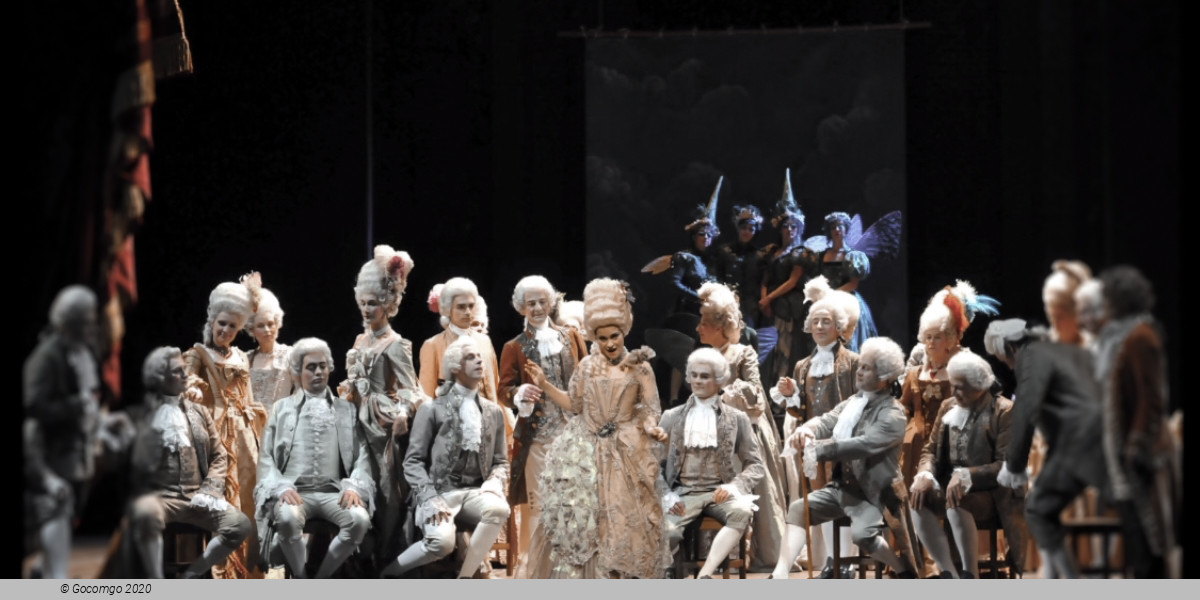
Oper Frankfurt 19 April 2020 - Mignon | GoComGo.com

Mignon

Oper Frankfurt, Opera House, Frankfurt am Main, Germany
All photos (1)
Select date and time
6 PM
Request for Tickets
Important Info
Type: Opera
City: Frankfurt am Main, Germany
Starts at: 18:00
Duration: 2h 30min
Sung in: French
Titles in: English,German

E-tickets: Print at home or at the box office of the event if so specified. You will find more information in your booking confirmation email.

You can only select the category, and not the exact seats.
If you order 2 or 3 tickets: your seats will be next to each other.
If you order 4 or more tickets: your seats will be next to each other, or, if this is not possible, we will provide a combination of groups of seats (at least in pairs, for example 2+2 or 2+3).

Overview

Introductory talks, in German, in the Holzfoyer 30 minutes before performances begin.

History
Premiere of this production: 17 November 1866, Opéra-Comique, Paris

Mignon is an opéra comique (or opera in its second version) in three acts by Ambroise Thomas. The original French libretto was by Jules Barbier and Michel Carré, based on Goethe's novel Wilhelm Meisters Lehrjahre. The Italian version was translated by Giuseppe Zaffira. The opera is mentioned in James Joyce's "The Dead" (Dubliners) and Willa Cather's The Professor's House. Thomas's goddaughter Mignon Nevada was named after the main character.

Synopsis

,Neither young girl, boy or woman – Mignon is an enigma, almost not of this world: for some an "angelic child", for others a dark-demonic freak of nature. This mysterious figure from one of Goethe's Wilhelm Meister novels inspired generations of composers. The successful team of Barbier and Carré's libretto, upon which the libretto for Gounod's Faust was based, in Goethe mad France, turned Goethe's educational journey into a real adventure of the heart. A passionate triangle emerges between the yearning creature Mignon and the seductive actress Philine. Ambroise Thomas, one of the most productive 19th century Parisian operatic composers, found world fame with his Mignon – not Hamlet. In the first thirty years after the world premiere in 1866 it was performed a thousand times at the Opéra-Comique alone. It was staged regularly for nearly a hundred years. The first Mignon was the French star mezzo-soprano Célestine Galli-Marié, who wrote operatic history nearly a decade later as the first Carmen. Thomas contrasts Mignon's dark timbre with a high coloratura for easy-going Philine. Romantic-lyric sentiment, temperament and elegant vocal lines are the ingredients for one of the most successful Opéra comiques.

Time: End of the 18th century.
Place: Germany and Italy.

Act 1
In the courtyard of an inn in a small German town, the wandering minstrel Lothario sings and the Gypsies dance while the townspeople watch and drink. Jarno threatens Mignon with a stick when she refuses to dance, but Lothario and Wilhelm Meister come to her aid. She thanks them and divides her bouquet of wild flowers between them. Wilhelm and Laerte have a drink together. Philine and Laerte leave, after he gives her his flowers from Mignon. Mignon tells Wilhelm she was captured by Gypsies as a child. Wilhelm decides to purchase Mignon’s freedom. Lothario comes to say goodbye to Mignon. Lothario wants Mignon to travel with him, but she stays with Wilhelm. Frédéric lovingly follows Philine in, but she also wants Wilhelm. The acting troupe is about to set off for a baron's castle after receiving an invitation to perform there. Mignon is deeply in love with Wilhelm, but upset to see the flowers that she gave him in the hands of Philine.

Act 2

In Philine’s room in the baron's castle, Philine is elated, living in the luxury and charming the baron. Laerte is heard outside, praising Philine. Wilhelm and Mignon enter. She pretends to sleep while Wilhelm and Philine sing. When the couple leave, Mignon tries on Philine’s costumes and make-up. She is jealous and exits. Frédéric enters. When Wilhelm returns for Mignon he is confronted by Frédéric. Mignon rushes in to break up their impending fight. Wilhelm decides that he cannot stay with Mignon and says goodbye to her. He leaves arm-in-arm with a jubilant Philine. Later, in the courtyard of the castle, Mignon is consumed by a jealous rage, when she hears Lothario playing the harp. He comforts the girl. Philine's portrayal of Titania in A Midsummer Night's Dream is applauded in the conservatory. Mignon, in jealousy, shouts that she wishes the building would catch fire and runs out. Lothario hears her and moves toward the conservatory. After Mignon returns, Wilhelm receives her so warmly that Philine, now jealous, sends her to fetch the wild flowers in the conservatory. Wilhelm rushes to save Mignon from the fire that Lothario had set to please her, carrying her unconscious body out of the conservatory with the singed flowers still in her hand.

Act 3

Wilhelm has brought Mignon and Lothario to a castle in Italy which he considers buying. There an old man watches over Mignon and prays for her recovery. Antonio relates how the castle’s previous owner had gone mad after his wife had died of grief over the loss of their young daughter. Wilhelm decides to buy the castle for Mignon because it has so speeded her recovery. Mignon awakens and confesses to Wilhelm of her love for this strangely familiar place. He finally realizes that he loves her deeply and resists Philine’s attempts to win him back. Lothario re-enters and informs the couple that he is the owner of the castle and that returning here has restored his sanity. After reading a prayer found in a book in the house, Mignon realizes that she is his daughter Sperata. The three embrace happily.

Venue Info

Oper Frankfurt - Frankfurt am Main
Location   Untermainanlage 11

The Oper Frankfurt (Frankfurt Opera) is one of the leading opera companies in Europe, and voted best "Opera house of the year" several times since 1996.

Opera in Frankfurt am Main has a long tradition, with many world premieres such as Franz Schreker's Der ferne Klang in 1912, Fennimore und Gerda by Frederick Delius in 1919, and Carl Orff's Carmina Burana in 1937. Frankfurt's international recognition began in the Gielen Era, 1977 to 1987, when Michael Gielen and stage directors such as Ruth Berghaus collaborated.

A historic opera house from 1880 was destroyed in World War II, and reconstructed as a concert hall, Alte Oper. The present opera house, built in 1963, is under one roof with the stage for drama. The opera orchestra is called Frankfurter Opern- und Museumsorchester. Today's venue for Baroque and contemporary opera is the Bockenheimer Depot, a former tram depot.

Oper Frankfurt is part of the Städtische Bühnen Frankfurt.

Frankfurt's first opera was Johann Theile's Adam und Eva, performed in 1698 by Johann Velten's touring company. The young Goethe's first operas in his home town of Frankfurt were productions by Theobald Marchand's company.

1782 – 1880
Opened in 1782, the Comoedienhaus was the first permanent venue of the Frankfurt Theater (drama and opera). In 1878 German violinist Willy Hess took up the leadership of the Oper Frankfurt. He resigned from that post in 1886 to take up a professorship in the Rotterdam Conservatorium voor Muziek.

1880 – 1944
The first representative opera house of the city was inaugurated in Frankfurt in 1880 at Opernplatz. Under the direction of the first Intendant Emil Claar and the first Kapellmeister Felix Otto Dessoff, the house was opened with Mozart's opera Don Giovanni.

During the 1920s, the opera in Frankfurt had more prominent Jewish singers than any other company in Germany, including the tenor Hermann Schramm, bass Hans Erl (the first King in Schreker's Der Schatzgräber), baritone Richard Breitenfeld and contralto Magda Spiegel, who also toured with Frankfurt Opera performing Wagner in the Netherlands. These singers were forced to leave the opera in June 1933. Orff's Carmina Burana was premiered at Oper Frankfurt in 1937. Jewish members of the opera company among those rounded up at 9 November 1938 at the Festhalle Frankfurt, where Erl sang In diesen Heilgen Hallen, from the Magic Flute for the deportees. Members of Frankfurt Opera were sent to Auschwitz and other camps where they perished.

1945 – 1970s
The opera house was damaged in an air raid in January 1944, and then almost completely destroyed in March. A new house for opera and play was built, completed in 1963 at the Theaterplatz (now Willy-Brandt-Platz). In 1952, Georg Solti became Generalmusikdirektor (GMD) and Intendant of the Oper Frankfurt, where he remained in charge for nine years.

The Gielen Era
From 1977 to 1987, Frankfurt Opera was led by Michael Gielen. This decade became known as the "Gielen Era", notable for the music of a conductor who was also a composer, and directors including Ruth Berghaus and Hans Neuenfels, whose productions of standard works such as Verdi's Aida and Wagner's Ring Cycle were thought-provoking. Operas which received their world premieres at the house were also performed again, including Franz Schreker's Die Gezeichneten.

1987 – present
The stage of the opera house was destroyed by a fire in November 1987. The opera house was rebuilt and opened in April 1991. Many famous singers started their career with the company, including Franz Völker, Edda Moser, Cheryl Studer and Diana Damrau, and many established artists have been engaged there in recent seasons including Christian Gerhaher, whose roles here have included Monteverdi's L'Orfeo and his first Wolfram in Wagner's Tannhäuser, Piotr Beczała in Massenet's Werther and Jan-Hendrik Rootering in Wagner's Parsifal.

Since 2002, Bernd Loebe has served as Intendant of the company. The company's current GMD is Sebastian Weigle, since 2008. Weigle has made commercial recordings of opera with the company for the OEHMS Classics label. He is scheduled to stand down as GMD of Oper Frankfurt at the close of the 2022–2023 season. In October 2021, the company announced the appointment of Thomas Guggeis as the next GMD of the company, effective with the 2023–2024 season, with an initial contract of 5 years.

Oper Frankfurt was voted 1996, 2003, 2015, 2018 and 2020 "Opera House of the Year" by the magazine Opernwelt.

Important Info
Type: Opera
City: Frankfurt am Main, Germany
Starts at: 18:00
Duration: 2h 30min
Sung in: French
Titles in: English,German
Top of page