


Kabukiza Theatre 24 September 2023 - September Program at the Kabukiza Theatre | GoComGo.com

September Program at the Kabukiza Theatre

Kabukiza Theatre, Tokyo, Japan
All photos (1)
Select date and time
4:30 PM

E-tickets: Print at home or at the box office of the event if so specified. You will find more information in your booking confirmation email.

You can only select the category, and not the exact seats.
If you order 2 or 3 tickets: your seats will be next to each other.
If you order 4 or more tickets: your seats will be next to each other, or, if this is not possible, we will provide a combination of groups of seats (at least in pairs, for example 2+2 or 2+3).

Important Info
Type: Show
City: Tokyo, Japan
Starts at: 16:30
Acts: 2
Intervals: 1

E-tickets: Print at home or at the box office of the event if so specified. You will find more information in your booking confirmation email.

You can only select the category, and not the exact seats.
If you order 2 or 3 tickets: your seats will be next to each other.
If you order 4 or more tickets: your seats will be next to each other, or, if this is not possible, we will provide a combination of groups of seats (at least in pairs, for example 2+2 or 2+3).

Overview

This month's program is titled 'Shūzan-sai' (the Shūzan Festival). Shūzan was the pen name of Nakamura Kichiemon I, and the 'Shūzan-sai' will be held to honor his outstanding artistry and talent, as well as to commemorate the third anniversary of the death of his adopted son Nakamura Kichiemon II. Various works including historical plays, dances and a 'New Kabuki' play from 'The Ten Best Plays of Nakamura Kichiemon I' (a collection of the actor's most successful roles) will be performed by actors associated with them.

September's program will consist of two parts. Between parts there will be an intermission.

Part 1: 11:00 AM

Part 2: 04:30 PM

Part 1:

GION SAIREI SHINKŌKI
Kinkakuji
['The Golden Pavilion' from 'The Gion Festival Chronicle of Faith']

This is a 'jidaimono', a history play portraying the life of warriors in the 16th century. Matsunaga Daizen has defeated the shogun and has set up base at the Golden Pavilion. The beautiful Yukihime is being held prisoner there by Daizen. The brilliant strategist Hisayoshi, disguised as a disgruntled retainer named Tōkichi, pretends to enter Daizen's employ to try to sabotage his plans from within. In a famous highlight of the play, Yukihime is bound to a cherry tree, but when she draws a mouse in the tree's petals the mouse miraculously comes to life and chews the ropes that bind her. The role of Yukihime is considered to be one of the most difficult 'princess' roles in kabuki.

TSUCHIGUMO
['The Earth Spider']

This dance drama was adapted from a play in the classical Nō repertoire. In legend, the samurai lord Minamoto no Raikō is famous for destroying demons. In this work, Raikō is ill in bed. Distinguished priests visit him to pray for his recovery but they do no good. Then, another priest appears mysteriously at night also claiming to pray for his health. However, suspicious of the strange shadow the priest casts, Raikō cuts at him with his heirloom sword named 'Hizamaru'. The priest turns out to be the spirit of the Great Earth Spider that has the ambition to rule the country. In the end, the spider's plan to kill Raikō is thwarted and it is defeated by his retainers in an exciting fight.

NIJŌ-JŌ NO KIYOMASA
['Kiyomasa at Nijō Castle']

This play was written by Yoshida Genjirō for Nakamura Kichiemon I, and first performed in 1933. The plot concerns true historical characters during a time of great political tension and instability. The year is 1611, and Tokugawa Ieyasu is visiting Kyoto. Though now supreme ruler of the country, there is still great antagonism between Ieyasu's stronghold in the east and the city of Osaka where Toyotomi Hideyori resides. Ieyasu has invited Hideyori to come and visit him at Kyoto's Nijō Castle and, against the wishes of his mother and others, the young man has agreed. With him is the wise commander Katō Kiyomasa who, despite his current illness, insists on accompanying him.

Part 2:

SUGAWARA DENJU TENARAI KAGAMI
Kurumabiki
['Pulling the Carriage Apart' from 'Sugawara's Secrets of Calligraphy']

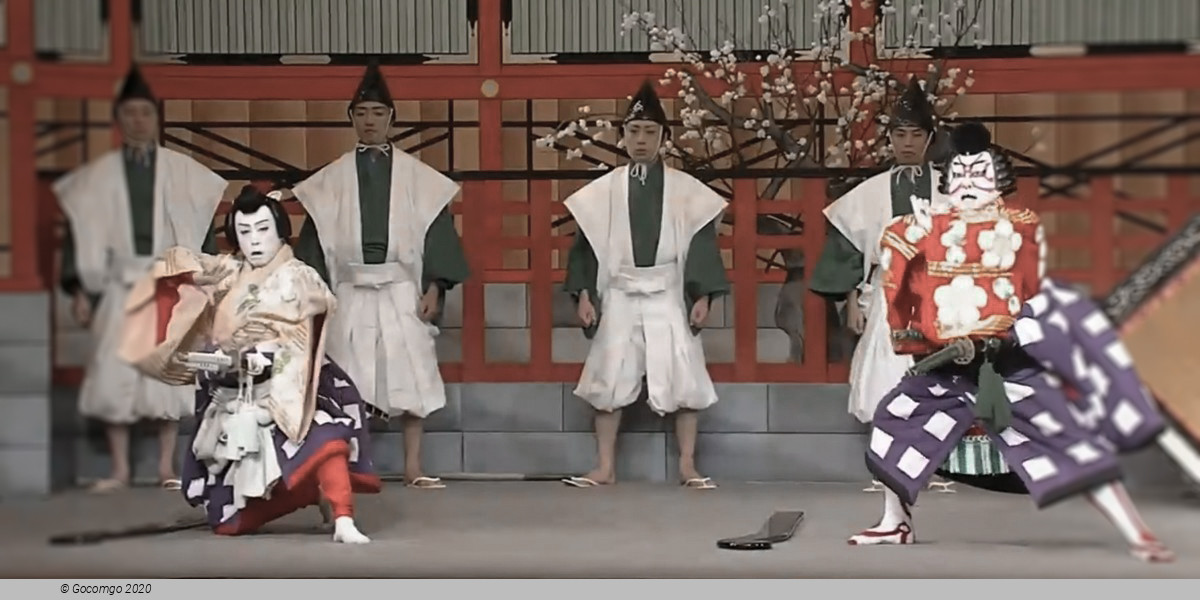
Umeōmaru and his triplet brother, Sakuramaru, try to get revenge on Fujiwara no Shihei who falsely accused Umeōmaru's lord, Kan Shōjō of treason. However, they are confronted by their other brother, Matsuōmaru, who is one of Shihei's retainers. The energetic performance of Umeōmaru is a showcase for the bombastic 'aragoto' style of acting.

RENJISHI
['Parent and Child Lion Dance']

A dance adapted from a tale featuring the legendary 'shishi', a mythical lion-like beast. It is based on the belief that a 'shishi' will push its cubs over a steep cliff as a test of their strength, only nurturing those cubs strong enough to climb up by themselves. Two entertainers dance the tale of the legendary 'shishi' that live at the foot of a holy Buddhist mountain. The dance portrays a parent 'shishi' forcing its cub to undergo harsh training in order to grow up strong. In the finale, the 'shishi' themselves appear and perform their dance with the wild shaking of their long manes.

IPPON GATANA DOHYŌ IRI
['The Wrestling Ring and the Sword']

First performed in 1931, this is a so-called 'New Kabuki' ('Shin Kabuki') play by Hasegawa Shin. The protagonist Komagata Mohē is a starving, would-be sumō wrestler. He encounters a courtesan named Otsuta who takes pity on him. She gives him her purse and hair ornaments, making him promise to become a champion sumō wrestler. In turn, she promises to go to see him make his ceremonial entry into the ring. But ten years later, Mohē has become a gangster instead. Now a powerful fighter, he rescues Otsuta and her family. Ironically, this shameful form that his entry into the ring has taken is the only way that he can repay her kindness.


A kabuki program is usually made up of several different plays and dances, but at the Kabukiza Theatre, 'Single Act Seats' are available so that you can watch just one of the acts.

Single Act Tickets will be sold on the day of the performance (they cannot be reserved or purchased in advance). Reserved seats for Part 1 are sold out on the 8th (Thu), 9th (Fri), 13th (Tue), 14th (Wed) and 15th (Thu).

Tea will not be offered at the Box Seats. Please refrain from eating at seats as well.

Venue Info

Kabukiza Theatre - Tokyo
Location   4 Chome-12-15 Ginza, Chuo City

Kabuki-za in Ginza is the principal theater in Tokyo for the traditional kabuki drama form.

The Kabuki-za was originally opened by a Meiji era journalist, Fukuchi Gen'ichirō. Fukuchi wrote kabuki dramas in which Ichikawa Danjūrō IX and others starred; upon Danjūrō's death in 1903, Fukuchi retired from the management of the theater. 

The original Kabuki-za was a wooden structure, built in 1889 on land which had been either the Tokyo residence of the Hosokawa clan of Kumamoto, or that of Matsudaira clan of Izu.

The building was destroyed on October 30, 1921, by an electrical fire. The reconstruction, which commenced in 1922, was designed to "be fireproof, yet carry traditional Japanese architectural styles", while using Western building materials and lighting equipment. Reconstruction had not been completed when it again burned down during the 1923 Great Kantō earthquake. Rebuilding was finally completed in 1924.

The theater was destroyed once again by Allied bombing during World War II. It was restored in 1950 preserving the style of 1924 reconstruction, and was until recently one of Tokyo's more dramatic and traditional buildings.

The 1950 structure was demolished in the spring of 2010, and rebuilt over the ensuing three years. Reasons cited for the reconstruction include concerns over the building's ability to survive earthquakes, as well as accessibility issues. A series of farewell performances, entitled Kabuki-za Sayonara Kōen 
 were held from January through April 2010, after which kabuki performances took place at the nearby Shinbashi Enbujō and elsewhere until the opening of the new theatre complex, which took place on March 28, 2013.

The style in 1924 was in a baroque Japanese revivalist style, meant to evoke the architectural details of Japanese castles, as well as temples of pre-Edo period. This style was kept after the post-war reconstruction and again after the 2013 reconstruction.

Inside, with the latest reconstruction the theatre was outfitted with four new front curtains called doncho. These are by renowned Japanese artists in the Nihonga style and reflect the different seasons.

Performances are exclusively run by Shochiku, in which the Kabuki-za Theatrical Corporation is the largest shareholder. They are nearly every day, and tickets are sold for individual acts as well as for each play in its entirety. As is the case for most kabuki venues, programs are organized monthly: each month there is a given set of plays and dances that make up the afternoon performance, and a different set comprising the evening show. These are repeated on a nearly daily schedule for three to four weeks, with the new month bringing a new program.

Important Info
Type: Show
City: Tokyo, Japan
Starts at: 16:30
Acts: 2
Intervals: 1
Top of page