

Kabukiza Theatre 20 October 2022 - October Program at the Kabukiza Theatre | GoComGo.com

October Program at the Kabukiza Theatre

Kabukiza Theatre, Tokyo, Japan
All photos (1)
Select date and time
11 AM

E-tickets: Print at home or at the box office of the event if so specified. You will find more information in your booking confirmation email.

You can only select the category, and not the exact seats.
If you order 2 or 3 tickets: your seats will be next to each other.
If you order 4 or more tickets: your seats will be next to each other, or, if this is not possible, we will provide a combination of groups of seats (at least in pairs, for example 2+2 or 2+3).

Important Info
Type: Show
City: Tokyo, Japan
Starts at: 11:00
Acts: 3
Intervals: 1

E-tickets: Print at home or at the box office of the event if so specified. You will find more information in your booking confirmation email.

You can only select the category, and not the exact seats.
If you order 2 or 3 tickets: your seats will be next to each other.
If you order 4 or more tickets: your seats will be next to each other, or, if this is not possible, we will provide a combination of groups of seats (at least in pairs, for example 2+2 or 2+3).

Overview

Part 1: 11:00 AM

Part 2: 2:30 PM

Part 3: 6:15 PM

Each month's program will consist of three parts. Between each part there will be an intermission.

Part 1:

ONI ZOROI MOMIJIGARI ('A Party of Demons Maple-Viewing')

This is a dance drama by Hagiwara Yukio that is adapted from the Nō play 'Momijigari'. It includes a spectacular finale featuring a large group of demons.
While Taira no Koremochi, a warrior of the 10th century, is viewing the scarlet maple leaves on Mt. Togakushi in Shinano Province, he comes across a party of women accompanying the beautiful Princess Sarashina. She invites him to join her party and entertains him with a captivating dance, during which he is given so much saké that he becomes tipsy and dozes off. The Princess and her ladies-in-waiting reveal their true identities as demons.

ARAKAWA JŪDAYŪ ('Arakawa Jūdayū')

The street in front of the Sengakuji Temple is bustling with people who come to celebrate the 7th anniversary of the death of the loyal retainers of Akō domain. Arakawa Jūdayū, a foot guard of the Matsudaira clan in Iyo Province, comes to visit the grave in fine attire which is unsuitable for a warrior of lower rank. Sugita Gozaemon, an inspector of the same clan who happens to be present, rebukes him for assuming a false rank which is a serious crime for a warrior. Later at court, as his lord Matsudaira Oki no kami interrogates him about the reason why he assumed a false rank, he begins to talk about the day when he acted as second for Horibe Yasubē, one of the loyal retainers of Akō domain, as he committed 'seppuku' ritual disembowelment and …

Part 2:

GION KOI ZUKUSHI ('Many Sorts of Love in Gion, Kyoto')

On his way back to Edo (today's Tokyo) from a pilgrimage to Ise Shrine, Tomegorō stays at the Ōtsuya in Kyoto, a store selling tea ceremony utensils. It is run by Jirohachi who has invited Tomegorō to stay because he is much indebted to Tomegorō's father, and also because it is just the time of the Gion Festival in Kyoto. Tomegorō falls in love at first sight with Osono, the sister of Jirohachi's wife Otsugi. Otsugi asks him to spy on Jirohachi to see whether he is in love with another woman. Since this spring, Jirohachi has often come home late at night. As Otsugi suspects, Jirohachi is head over heels in love with Someka, a geisha in Gion, but Someka has a patron and dislikes Jirohachi. Meanwhile, Osono asks Tomegorō to take her along to Edo; she is in love with Bunshichi, a clerk of the Ōtsuya. However, Otsugi doesn't know about their relationship and recommends that she marry the son of the Mochimaruya. She asks Tomegorō to help her elope with Bunshichi. In exchange for telling Otsugi the name of the woman Jirohachi loves, Tomegorō asks Otsugi to approve the marriage between Osono and Bunshichi. Hearing this, Jirohachi thinks that Tomegorō has talked them into humiliating him. Bearing a grudge against Tomegorō, they quarrel with each other. They are reconciled at last to hear that Mochimaruya Tahē has given up on getting Osono as his son's bride and approves the marriage between Osono and Bunshichi.

TSURI ONNA ('Fishing for Wives')

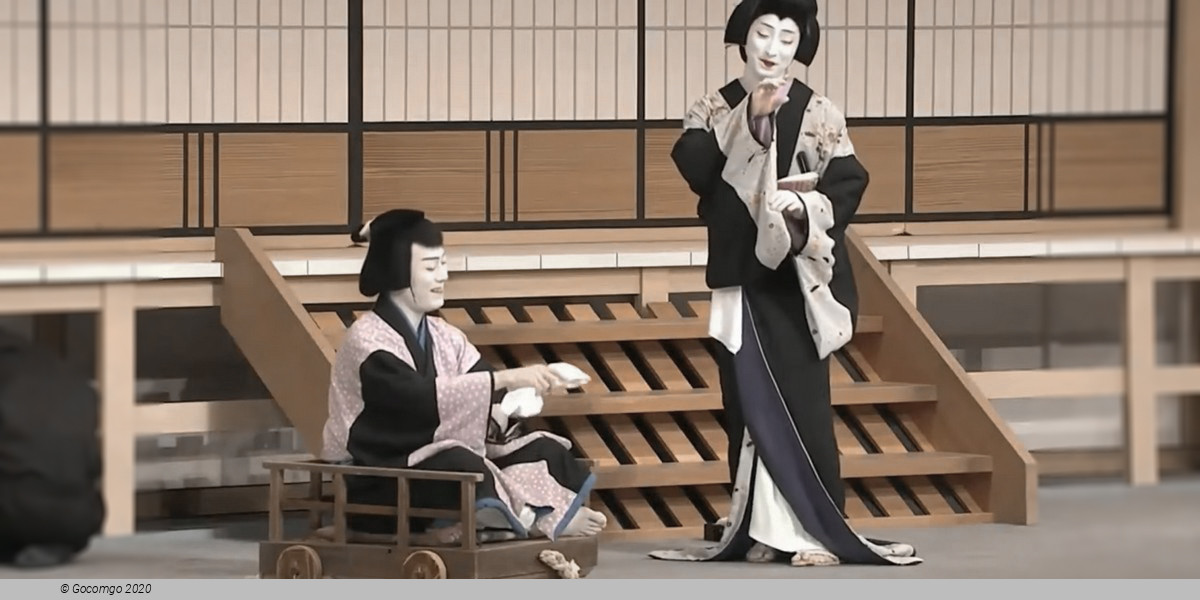
This is a dance drama based on a classical Kyōgen farce. A master longs for a wife and is told by the gods in a dream to go fishing for one. When he does so, he is united with a beautiful princess. His servant Tarōkaja wants a wife as well, but when he goes fishing, he gets stuck with a very surprising companion. This woman is played by an actor who specialises in male roles here playing a rare, humorous, female role.

Part 3:

GENJI MONOGATARI. Yūgao no Maki ('Yūgao' chapter from 'The Tale of Genji')

Hikaru Genji cannot get accustomed to his lawful wife Lady Aoi and finds peace of mind with other women. One day, while visiting the concubine of the Emperor's elder brother who lives in Rokujō, he becomes attracted to a woman who lives quietly in a house, on the fence of which a moonflower is in bloom. On the night of 15th August when a beautiful moon appears, he at last calls on her, led there by his follower Koremitsu. While he enjoys a moon-viewing party and dances with her, another suspicious woman thrusts herself between them and …

KAGATOBI ('The Firemen of Kaga')

The masseur Takegaki Dōgen kills the farmer Tajiemon at the embankment of Ochanomizu and steals the money he possessed. Matsuzō, who happened to be passing by, picks up a tobacco pouch which Dōgen dropped. Dōgen hears that his niece Oasa received money from the Iseya pawn shop where she is an apprentice, and thinks of extortion. He visits Iseya with his lover Okane, a masseuse, and tries to extort 100 gold coins. But Matsuzō shows the tobacco pouch to Dōgen and they scuttle off. Finally, his evil deeds are discovered and pursuers are sent after him. In the end he is arrested before the front gate of the mansion of the Kaga Domain.

A kabuki program is usually made up of several different plays and dances, but at the Kabukiza Theatre, 'Single Act Seats' are available so that you can watch just one of the acts.

Single Act Tickets will be sold on the day of the performance (they cannot be reserved or purchased in advance).

Tea will not be offered at the Box Seats. Please refrain from eating at seats as well.

Venue Info

Kabukiza Theatre - Tokyo
Location   4 Chome-12-15 Ginza, Chuo City

Kabuki-za in Ginza is the principal theater in Tokyo for the traditional kabuki drama form.

The Kabuki-za was originally opened by a Meiji era journalist, Fukuchi Gen'ichirō. Fukuchi wrote kabuki dramas in which Ichikawa Danjūrō IX and others starred; upon Danjūrō's death in 1903, Fukuchi retired from the management of the theater. 

The original Kabuki-za was a wooden structure, built in 1889 on land which had been either the Tokyo residence of the Hosokawa clan of Kumamoto, or that of Matsudaira clan of Izu.

The building was destroyed on October 30, 1921, by an electrical fire. The reconstruction, which commenced in 1922, was designed to "be fireproof, yet carry traditional Japanese architectural styles", while using Western building materials and lighting equipment. Reconstruction had not been completed when it again burned down during the 1923 Great Kantō earthquake. Rebuilding was finally completed in 1924.

The theater was destroyed once again by Allied bombing during World War II. It was restored in 1950 preserving the style of 1924 reconstruction, and was until recently one of Tokyo's more dramatic and traditional buildings.

The 1950 structure was demolished in the spring of 2010, and rebuilt over the ensuing three years. Reasons cited for the reconstruction include concerns over the building's ability to survive earthquakes, as well as accessibility issues. A series of farewell performances, entitled Kabuki-za Sayonara Kōen 
 were held from January through April 2010, after which kabuki performances took place at the nearby Shinbashi Enbujō and elsewhere until the opening of the new theatre complex, which took place on March 28, 2013.

The style in 1924 was in a baroque Japanese revivalist style, meant to evoke the architectural details of Japanese castles, as well as temples of pre-Edo period. This style was kept after the post-war reconstruction and again after the 2013 reconstruction.

Inside, with the latest reconstruction the theatre was outfitted with four new front curtains called doncho. These are by renowned Japanese artists in the Nihonga style and reflect the different seasons.

Performances are exclusively run by Shochiku, in which the Kabuki-za Theatrical Corporation is the largest shareholder. They are nearly every day, and tickets are sold for individual acts as well as for each play in its entirety. As is the case for most kabuki venues, programs are organized monthly: each month there is a given set of plays and dances that make up the afternoon performance, and a different set comprising the evening show. These are repeated on a nearly daily schedule for three to four weeks, with the new month bringing a new program.

Important Info
Type: Show
City: Tokyo, Japan
Starts at: 11:00
Acts: 3
Intervals: 1
Top of page