
Kabukiza Theatre 9 October 2023 - October Program at the Kabukiza | GoComGo.com

October Program at the Kabukiza

Kabukiza Theatre, Tokyo, Japan
All photos (1)
Select date and time
4:30 PM

E-tickets: Print at home or at the box office of the event if so specified. You will find more information in your booking confirmation email.

You can only select the category, and not the exact seats.
If you order 2 or 3 tickets: your seats will be next to each other.
If you order 4 or more tickets: your seats will be next to each other, or, if this is not possible, we will provide a combination of groups of seats (at least in pairs, for example 2+2 or 2+3).

Important Info
Type: Show
City: Tokyo, Japan
Starts at: 16:30
Acts: 2
Intervals: 1

E-tickets: Print at home or at the box office of the event if so specified. You will find more information in your booking confirmation email.

You can only select the category, and not the exact seats.
If you order 2 or 3 tickets: your seats will be next to each other.
If you order 4 or more tickets: your seats will be next to each other, or, if this is not possible, we will provide a combination of groups of seats (at least in pairs, for example 2+2 or 2+3).

Overview

Part 1: 11:00 AM

Part 2: 04:30 PM

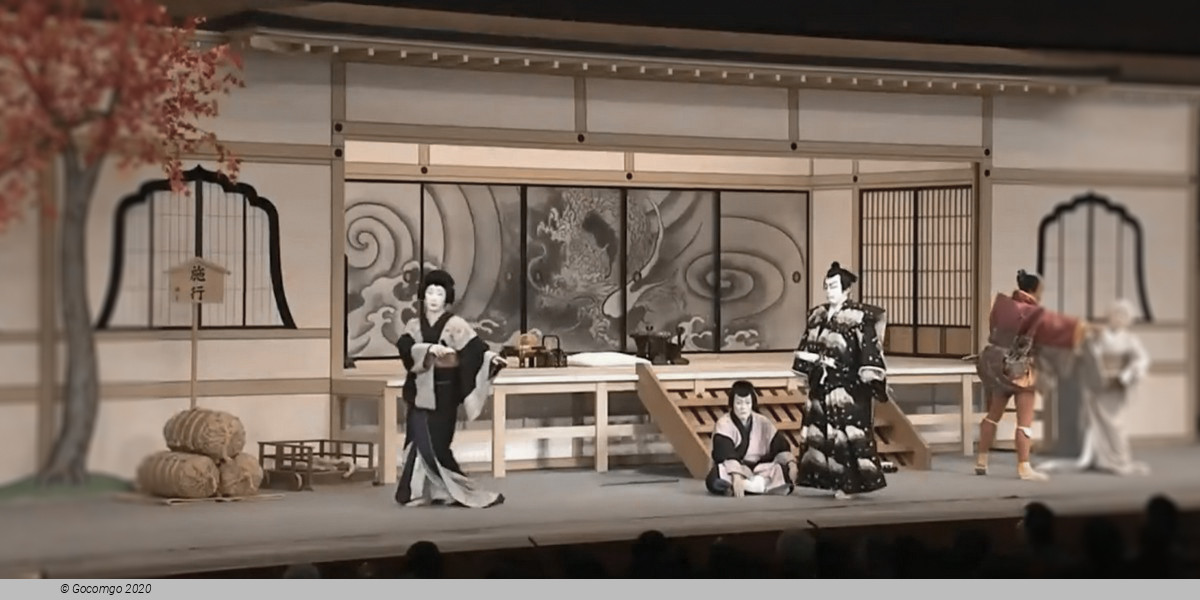
In the Matinee, please enjoy a history play by Tsuruya Nanboku IV with a fantastic story and spectacular stage tricks, plus a popular domestic play directed by one of today's leading Japanese movie directors.
In the Evening Show, you will see a domestic play portraying the sense of duty in the Edo period as seen through the eyes of a popular sumō wrestler, a dance featuring the beautiful spirits of chrysanthemums and a story about an old man well known to modern Japanese.

Part 1

TENJIKU TOKUBĒ IKOKU BANASHI
['Tenjiku Tokubē's Adventures in Foreign Countries']

This is a 'jidaimono' history play set in the Muromachi period (approx. 1336-1573). It is a play on a grand scale about Tenjiku Tokubē, a man who plans to overthrow Japan with the help of toad sorcery. The play was written by Tsuruya Nanboku IV, and includes many spectacular effects such as a giant toad, collapsible stage sets, quick changes, a flight through the air, and so on. In the story, Sasaki Katsuranosuke goes to the mansion of his retainer Yoshioka Sōkan in search of an heirloom sword named 'Namikirimaru' which has been stolen. A boatman named Tokubē who has been to India appears and entertains Katsuranosuke for a while with his adventures. When he hears that the envoy of the shogun has come, he conceals himself. Sōkan commits ritual suicide by disembowelment to atone for the escape of his lord Katsuranosuke. He discloses to Tokubē that he is, in reality, Mokusokan, who plans to restore the Ming dynasty....

BUNSHICHI MOTTOI MONOGATARI
['The Tale of the Bunshichi Paper Cord']

Adapted from a classical Rakugo story by San'yūtei Enchō, this play shows the gallant spirit of the commoners of Edo. Chōbē spends his days and nights gambling, but finally realizes that his family is in dire straits when his daughter takes a job in the pleasure quarters. Having received the money for her contract, he reveals his good heart when, on the way home, he saves Bunshichi who is about to commit suicide. Chōbē feels sorry for Bunshichi and finally gives him the money. After arriving home, nobody believes Chōbē, thinking instead that he has gambled the money away. Then, Bunshichi and his master Uhē come to Chōbē's home, and reveal the truth.

Part 2

FUTATSU CHŌCHŌ KURUWA NIKKI
Sumō Ba
['The Sumō Match' from 'Two Butterflies in the Pleasure Quarters']

This is a sewamono play portraying in a realistic way the lives of ordinary people in the Edo period (1603-1868). The words in the title 'Futatsu Chōchō' mean 'two butterflies', and this reflects the fact that the names of the two sumō wrestlers who play important roles in the play both begin with "chō": Chōkichi and Chōgorō. Nuregami Chōgorō throws a match in the hopes that the younger wrestler Hanaregoma Chōkichi will persuade his patron Gōzaemon to give up the beautiful courtesan, Azuma. This is because Yogorō, Chōgorō's patron, and Azuma love each other, and Yogorō wants to redeem her from her contract. However, Chōkichi loses his temper at the fact that Chōgorō purposely lost the fight and the two begin quarreling, performing a series of magnificent mie poses as they compete in a test of pride.

KIKU
['Chrysanthemum']

The spirits of chrysanthemums appear in a garden where chrysanthemum flowers are in full bloom. The spirits dance beautifully to music and lyrics that praise chrysanthemums, as they portray innocent girls and young town maidens who have begun to dream of romance. This is a dance perfectly suited to the autumn.

MITO KŌMON
Sanuki Manyū Hen
['Mito Kōmon']

Mito Mitsukuni (commonly known as Mito Kōmon), the former Middle Councillor and the retired lord of Mito domain, is traveling incognito around Japan. He is now in Sanuki domain, and is accompanied by his attendants Sasaki Sukesaburō (Suke san) and Atsumi Kakunoshin (Kaku san). Kakunoshin loses sight of Kōmon and encounters the beautiful girl Ochō. Thanks to Sukesaburō's help, Ochō turns out to be a man, who picks Kakunoshin's pocket of a wallet. Mito Kōmon is at an udon noodle shop pretending to be an old farmer, when he hears people of Sanuki domain complain about the lord Matsudaira Yoritsune who is in fact his eldest son. Will Kōmon and his party be able to remove the root of the evil which thrives in the domain, while various people including the kind girl Osode whom he met in the noodle shop get involved?


A kabuki program is usually made up of several different plays and dances, but at the Kabukiza Theatre, 'Single Act Seats' are available so that you can watch just one of the acts.

Single Act Tickets will be sold on the day of the performance (they cannot be reserved or purchased in advance).

Tea will not be offered at the Box Seats. Please refrain from eating at seats as well.

Venue Info

Kabukiza Theatre - Tokyo
Location   4 Chome-12-15 Ginza, Chuo City

Kabuki-za in Ginza is the principal theater in Tokyo for the traditional kabuki drama form.

The Kabuki-za was originally opened by a Meiji era journalist, Fukuchi Gen'ichirō. Fukuchi wrote kabuki dramas in which Ichikawa Danjūrō IX and others starred; upon Danjūrō's death in 1903, Fukuchi retired from the management of the theater. 

The original Kabuki-za was a wooden structure, built in 1889 on land which had been either the Tokyo residence of the Hosokawa clan of Kumamoto, or that of Matsudaira clan of Izu.

The building was destroyed on October 30, 1921, by an electrical fire. The reconstruction, which commenced in 1922, was designed to "be fireproof, yet carry traditional Japanese architectural styles", while using Western building materials and lighting equipment. Reconstruction had not been completed when it again burned down during the 1923 Great Kantō earthquake. Rebuilding was finally completed in 1924.

The theater was destroyed once again by Allied bombing during World War II. It was restored in 1950 preserving the style of 1924 reconstruction, and was until recently one of Tokyo's more dramatic and traditional buildings.

The 1950 structure was demolished in the spring of 2010, and rebuilt over the ensuing three years. Reasons cited for the reconstruction include concerns over the building's ability to survive earthquakes, as well as accessibility issues. A series of farewell performances, entitled Kabuki-za Sayonara Kōen 
 were held from January through April 2010, after which kabuki performances took place at the nearby Shinbashi Enbujō and elsewhere until the opening of the new theatre complex, which took place on March 28, 2013.

The style in 1924 was in a baroque Japanese revivalist style, meant to evoke the architectural details of Japanese castles, as well as temples of pre-Edo period. This style was kept after the post-war reconstruction and again after the 2013 reconstruction.

Inside, with the latest reconstruction the theatre was outfitted with four new front curtains called doncho. These are by renowned Japanese artists in the Nihonga style and reflect the different seasons.

Performances are exclusively run by Shochiku, in which the Kabuki-za Theatrical Corporation is the largest shareholder. They are nearly every day, and tickets are sold for individual acts as well as for each play in its entirety. As is the case for most kabuki venues, programs are organized monthly: each month there is a given set of plays and dances that make up the afternoon performance, and a different set comprising the evening show. These are repeated on a nearly daily schedule for three to four weeks, with the new month bringing a new program.

Important Info
Type: Show
City: Tokyo, Japan
Starts at: 16:30
Acts: 2
Intervals: 1
Top of page