
Kabukiza Theatre 24 November 2022 - November Program at the Kabukiza Theatre | GoComGo.com

November Program at the Kabukiza Theatre

Kabukiza Theatre, Tokyo, Japan
All photos (1)
Select date and time
11 AM

E-tickets: Print at home or at the box office of the event if so specified. You will find more information in your booking confirmation email.

You can only select the category, and not the exact seats.
If you order 2 or 3 tickets: your seats will be next to each other.
If you order 4 or more tickets: your seats will be next to each other, or, if this is not possible, we will provide a combination of groups of seats (at least in pairs, for example 2+2 or 2+3).

Important Info
Type: Show
City: Tokyo, Japan
Starts at: 11:00
Acts: 2
Intervals: 1

E-tickets: Print at home or at the box office of the event if so specified. You will find more information in your booking confirmation email.

You can only select the category, and not the exact seats.
If you order 2 or 3 tickets: your seats will be next to each other.
If you order 4 or more tickets: your seats will be next to each other, or, if this is not possible, we will provide a combination of groups of seats (at least in pairs, for example 2+2 or 2+3).

Overview

Matinee: 11:00 AM

Evening Show: 4:00 PM

November's program will consist of two parts. Between each part there will be an intermission.

Part 1:

IWAU NARITA KOBIKI NO NIGIWAI ('In front of the Theatre')

It is festival day in the bustling city of Edo, where the proprietress of a theatre teahouse, chiefs of the fire brigade and geisha all turn out and dance happily. This is a dance accompanied by Tokiwazu music, which grandly opens the performances celebrating the name succession of Ichikawa Danjūrō XIII.

UIRŌ URI ('The Medicine Peddler')

Kudō Suketsune, a senior vassal of Minamoto no Yoritomo, was appointed master of the hunt at the foot of Mt. Fuji. Having finished the preparations for the hunt, Suketsune relaxes at the Ōiso pleasure quarters. An Uirō medicine peddler, a specialty of Odawara, is called in as entertainment at the drinking party. Uirō is a Chinese medicine transmitted to the Uirō family, but this Uirō peddler is, in reality, Soga no Gorō Tokimune who seeks Suketsune's life as his father's murderer... Ichikawa Shinnosuke will try his hand at the famous tongue-twisting dialogue as the Uirō peddler, relating the medicine's origins and explaining its efficacy in a fluent speech.

KANJINCHŌ ('The Subscription Scroll')

Disguised as traveling priests, the fugitive general Yoshitsune and his band of retainers are stopped at a road barrier. The head retainer Benkei claims they are soliciting contributions for the rebuilding of a temple, but the barrier guard Togashi insists that, if so, they must have the temple's book of solicitation. Benkei elaborately improvises the text with an empty scroll. When one-soldier points out that one of the group resembles Yoshitsune, Benkei is forced to strike Yoshitsune with his staff. Togashi is convinced that they are the fugitives but, sympathizing with Benkei's loyalty, he tells them to proceed on their way.

Part 2:

YANONE ('The Arrowhead')

This play is one of the great classics of the bombastic 'aragoto' style of acting. It shows the Soga brothers, Gorō and Jūrō, who suffer in poverty for eighteen years until they can avenge the death of their father. This play combines the antics of the super-strong Gorō with the comic, urbane and witty atmosphere of the kabuki of the Genroku Era. Gorō is sharpening a gigantic arrow when, in a dream, he is alerted to the fact that his brother is in danger. He explodes in a burst of energy and rushes to save him.

Shūmei Hirō KŌJŌ ('Stage Announcement Commemorating the Name Succession')

The actors will appear as themselves to make a stage announcement to commemorate the name succession.

SUKEROKU YUKARI NO EDO ZAKURA ('Sukeroku, the Flower of Edo')

This is a play filled with the leisurely atmosphere of old-style kabuki in its mixture of comedy and romance. 'Sukeroku' is a great showpiece for the top stars in kabuki. The dandy Sukeroku is the most famous patron of the Yoshiwara pleasure quarters, but his reputation as the lover of the highest-ranking courtesan Agemaki is matched by his argumentative nature and his tendency to pick fights. In fact, Sukeroku is the samurai Soga no Gorō in disguise and he uses the fights as an excuse to search for a lost heirloom sword. His quest takes place amidst of the colorful spectacle that is the Yoshiwara, where the processions of beautiful courtesans compete with the splendor of cherry blossoms in full bloom.


A kabuki program is usually made up of several different plays and dances, but at the Kabukiza Theatre, 'Single Act Seats' are available so that you can watch just one of the acts.

Single Act Tickets will be sold on the day of the performance (they cannot be reserved or purchased in advance).

Tea will not be offered at the Box Seats. Please refrain from eating at seats as well.

Venue Info

Kabukiza Theatre - Tokyo
Location   4 Chome-12-15 Ginza, Chuo City

Kabuki-za in Ginza is the principal theater in Tokyo for the traditional kabuki drama form.

The Kabuki-za was originally opened by a Meiji era journalist, Fukuchi Gen'ichirō. Fukuchi wrote kabuki dramas in which Ichikawa Danjūrō IX and others starred; upon Danjūrō's death in 1903, Fukuchi retired from the management of the theater. 

The original Kabuki-za was a wooden structure, built in 1889 on land which had been either the Tokyo residence of the Hosokawa clan of Kumamoto, or that of Matsudaira clan of Izu.

The building was destroyed on October 30, 1921, by an electrical fire. The reconstruction, which commenced in 1922, was designed to "be fireproof, yet carry traditional Japanese architectural styles", while using Western building materials and lighting equipment. Reconstruction had not been completed when it again burned down during the 1923 Great Kantō earthquake. Rebuilding was finally completed in 1924.

The theater was destroyed once again by Allied bombing during World War II. It was restored in 1950 preserving the style of 1924 reconstruction, and was until recently one of Tokyo's more dramatic and traditional buildings.

The 1950 structure was demolished in the spring of 2010, and rebuilt over the ensuing three years. Reasons cited for the reconstruction include concerns over the building's ability to survive earthquakes, as well as accessibility issues. A series of farewell performances, entitled Kabuki-za Sayonara Kōen 
 were held from January through April 2010, after which kabuki performances took place at the nearby Shinbashi Enbujō and elsewhere until the opening of the new theatre complex, which took place on March 28, 2013.

The style in 1924 was in a baroque Japanese revivalist style, meant to evoke the architectural details of Japanese castles, as well as temples of pre-Edo period. This style was kept after the post-war reconstruction and again after the 2013 reconstruction.

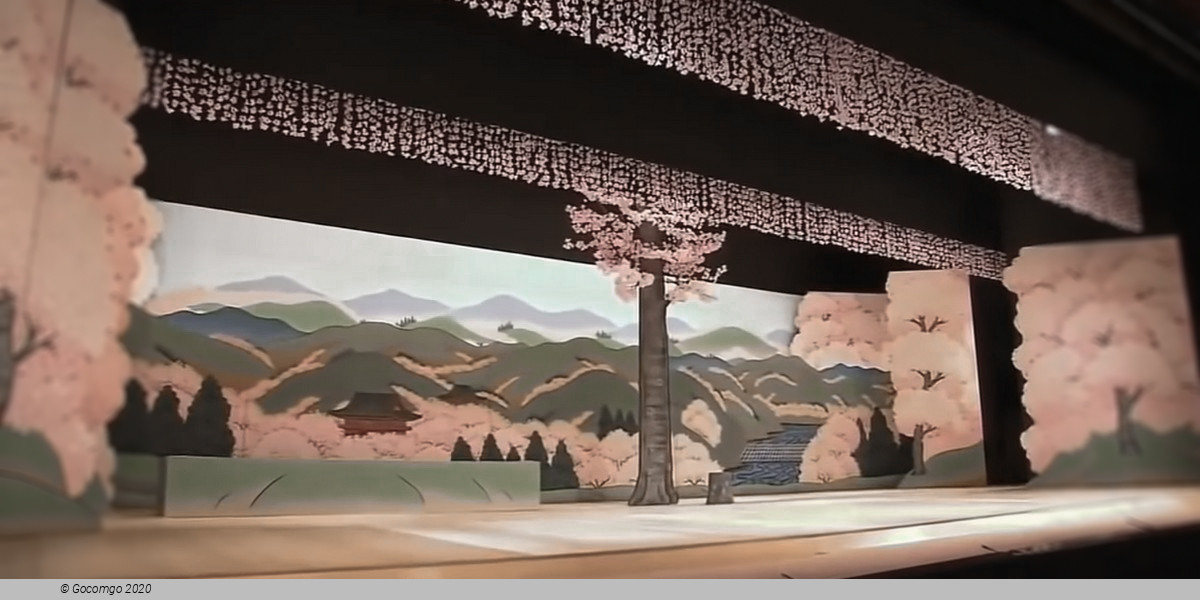
Inside, with the latest reconstruction the theatre was outfitted with four new front curtains called doncho. These are by renowned Japanese artists in the Nihonga style and reflect the different seasons.

Performances are exclusively run by Shochiku, in which the Kabuki-za Theatrical Corporation is the largest shareholder. They are nearly every day, and tickets are sold for individual acts as well as for each play in its entirety. As is the case for most kabuki venues, programs are organized monthly: each month there is a given set of plays and dances that make up the afternoon performance, and a different set comprising the evening show. These are repeated on a nearly daily schedule for three to four weeks, with the new month bringing a new program.

Important Info
Type: Show
City: Tokyo, Japan
Starts at: 11:00
Acts: 2
Intervals: 1
Top of page