In the Matinee, you can enjoy kabuki’s stylish beauty in a fight scene in the gorgeous work ‘The Bustling Kabuki Theatre in the Year of the Horse’, which is perfect for the New Year.
There is also a spectacular fight scene in ‘The Spider's Web and the Catalpa Bow’, which is followed by the serious history play ‘The Tale of Sanemori’, which portrays Sanemori’s pride as a warrior as well as his humanity. In the Evening Show, first you will see ‘A Female “Wait a minute!” ’, in which you will be attracted by the powerful and gorgeous beauty of the aragoto acting style. It is followed by the lighthearted, joyful and rhythmic dance ‘The Dance premiered by Oniji’. Finally, ‘The Woman Killer and the Hell of Oil’, a masterpiece by Chikamatsu Monzaemon, will be performed, portraying the unfathomable depths of the human mind and the life of commoners in a realistic way.
Part 1: 11:00 AM
ATARU UMADOSHI KABUKI NO NIGIWAI
['The Bustling Kabuki Theatre in the Year of the Horse']
STORY :
The New Year Program for the year 2026, the Year of the Horse, begins with three auspicious pieces. ‘The Tug-of-War Over the Armor’ portrays in a splendid, vibrant manner how Kobayashi Asahina boldly seized the skirt of Soga Gorō’s armor to stop him as he charged toward the residence of Kudō Suketsune—his father’s killer. This is followed by a festive ‘Manzai’ dance, said to bring good fortune to the people, performed here by a lineup of accomplished dancers. In ‘Search in the Dark at Kobikichō’ characters connected to the Soga brothers line up and search silently in the dark. This is an acting convention called ‘Danmari’ which is characteristic of kabuki. ‘Kobiki’ in the title refers to Kobikichō, the old name of the town where the Kabukiza is situated. In the city of Edo, modern Tokyo, it was considered auspicious to perform Kabuki works concerning the vendetta of the Soga brothers at New Year’s and this continues today as a theatrical tradition.
KUMO NO ITO AZUSA NO YUMIHARI
['The Spider's Web and the Catalpa Bow']
STORY :
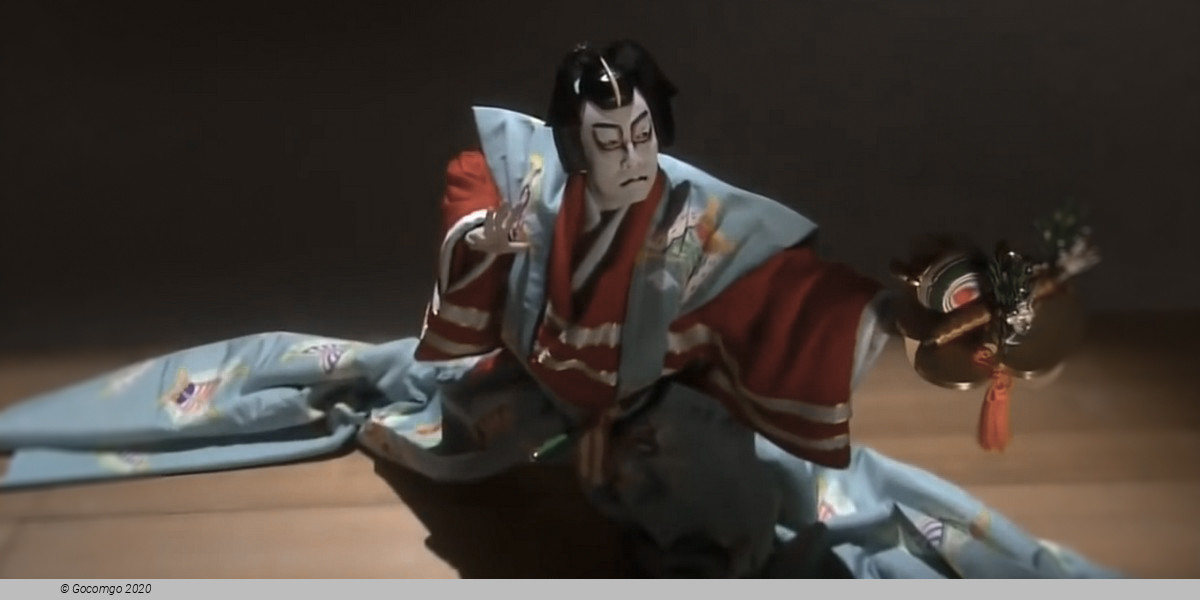
This is one of the oldest dances in the kabuki repertoire related to the legend of a spider that attacked the medieval warrior, Minamoto no Yorimitsu. Yorimitsu is visited by an evil spider with magical powers. The creature appears in various forms, disguised first as a child, second as a jester, third as a blind masseur and finally as a courtesan. After revealing its true nature, the spider throws out its web, trying to trap the warrior.
Genpei Nunobiki no Taki
SANEMORI MONOGATARI
['The Tale of Sanemori']
STORY :
This is a 'jidaimono' history play set at the end of the Heian Period (12th century). The play's subject concerns the early days of the rivalry between the Genji and the Heike military clans. Lady Aoi, widow of the Genji clan's leader Kiso Yoshikata, is pregnant and is in hiding at the house of a man named Kurosuke. Knowing that Lady Aoi is there, Sanemori, a warrior who was once of the Genji clan but has now joined the Heike, comes to Kurosuke's house with the Heike warrior Seno'o. Should Lady Aoi's child be a boy, it could become the future head of the Genji clan, and so Sanemori is ordered to kill the baby if it is indeed male. But to everyone's surprise, the 'baby' turns out to be a woman's severed arm. Seno'o is amazed and does not believe it, but Sanemori (who is concealing something) assures him that there is a similar event in history. The highlight of this play is when Sanemori recounts how he severed the woman's arm. In this section, the actor is accompanied by the Gidayū narrator and shamisen player, leaving him free to use gestures and a fan in his heroic description.
Part 2: 04:15 PM
ONNA SHIBARAKU
['Female “Wait a Minute”']
STORY :
More ceremony than play, “Shibaraku” is one of the oldest pieces in kabuki. Minamoto no Noriyori, who rendered distinguished service in destroying Heike, has the ambition to be the ruler of Japan. A group of loyal retainers remonstrates with Noriyori on his arrogance in wearing the same costume as the Emperor without permission, but he will not listen. Just as the evil villain is about to execute them, a voice calls out for him to wait and a hero appears to save the day. However, this version is a parody of that original, as the hero is played by an ‘onnagata’ female role specialist who mixes the super-human strength of an aragoto hero with the soft gentleness of a kabuki heroine.
ONIJI HYŌSHIMAI
['The Dance Premiered by Oniji']
STORY :
This is a classical dance filled with the stylized beauty of gesture and pose, which also includes an exciting fight scene. Osada no Tarō, a warrior of the Heike clan who is disguised as a woodcutter, encounters a ‘shirabyōshi’ dancer in the mountains of Kyoto. As Osada joins her in dance, she tries to snatch a pipe from him, but ….
ONNA GOROSHI ABURA NO JIGOKU
['The Woman Killer and the Hell of Oil']
STORY :
This play by the great Chikamatsu Monzaemon was virtually ignored at the time it was written, but it has become phenomenally popular in modern times for its realistic sensibility and its sensuous killing scene in which the protagonists slip and struggle through puddles of spilt oil. Yohē, heir to the oil shop Kawachiya, is living a life of debauchery. He starts a fight in town and incurs debts at the pleasure quarters, and even hits his own stepfather and sister. Not being able to take this any longer, his mother finally disowns him. Troubled by this, and needing to pay back his debts, he tries to borrow money from the wife of a neighboring oil merchant. He tries to blackmail her, but when he is rejected, he ends up killing her.
A kabuki program is usually made up of several different plays and dances, but at the Kabukiza Theatre, 'Single Act Seats' are available so that you can watch just one of the acts.
Tickets are sold separately for each performance. They are valid only for the performance starting at the listed time.
Single Act Tickets will be sold on the day of the performance (they cannot be reserved or purchased in advance).
Tea will not be offered at the Box Seats. Please refrain from eating at seats as well.
Each month's program consists of three or two parts. Between parts there will be an intermission.
Program to be announced later.
A kabuki program is usually made up of several different plays and dances, but at the Kabukiza Theatre, 'Single Act Seats' are available so that you can watch just one of the acts.
Tickets are sold separately for each performance. They are valid only for the performance starting at the listed time.
Single Act Tickets will be sold on the day of the performance (they cannot be reserved or purchased in advance).
Tea will not be offered at the Box Seats. Please refrain from eating at seats as well.




 4 Chome-12-15 Ginza, Chuo City