
Kabukiza Theatre 21 February 2023 - February Program at the Kabukiza Theatre | GoComGo.com

February Program at the Kabukiza Theatre

Kabukiza Theatre, Tokyo, Japan
All photos (1)
Select date and time
11 AM

E-tickets: Print at home or at the box office of the event if so specified. You will find more information in your booking confirmation email.

You can only select the category, and not the exact seats.
If you order 2 or 3 tickets: your seats will be next to each other.
If you order 4 or more tickets: your seats will be next to each other, or, if this is not possible, we will provide a combination of groups of seats (at least in pairs, for example 2+2 or 2+3).

Important Info
Type: Show
City: Tokyo, Japan
Starts at: 11:00
Acts: 3
Intervals: 4
Duration: 9h 50min

E-tickets: Print at home or at the box office of the event if so specified. You will find more information in your booking confirmation email.

You can only select the category, and not the exact seats.
If you order 2 or 3 tickets: your seats will be next to each other.
If you order 4 or more tickets: your seats will be next to each other, or, if this is not possible, we will provide a combination of groups of seats (at least in pairs, for example 2+2 or 2+3).

Overview

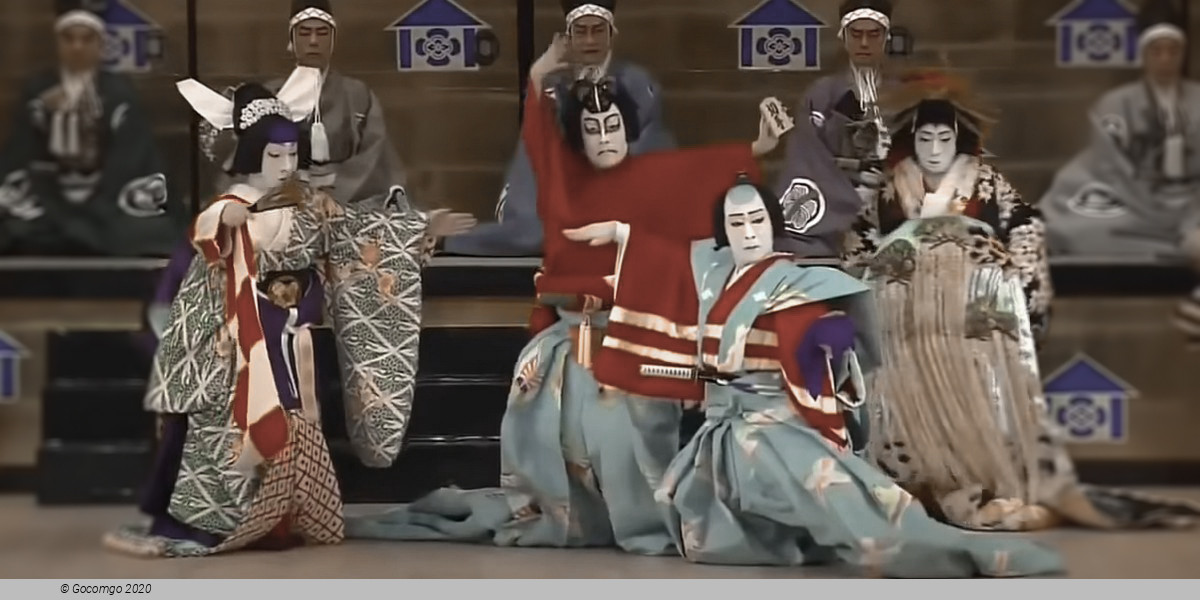
Masterpieces of kabuki feature in the February program.

Part 1: 11:00 AM

Part 2: 2:30 PM

Part 3: 5:30 PM

In Part 1, Theatre presents you a popular domestic play by Kawatake Mokuami concerning three thieves.
In Part 2, you will see a gorgeous dance by female role specialists, plus a dance play commemorating the 13th anniversary of the death of Nakamura Tomijūrō V, in which his son performs one of his most successful roles.
In Part 3, a masterpiece by Tsuruya Nanboku portraying a grand revenge that took place over time will be performed, featuring one of today's greatest actors.

Part 1:

SANNIN KICHISA TOMOE NO SHIRANAMI ['Three Thieves Named Kichisa']

Ojō Kichisa, a thief disguised as a girl, steals 100 gold pieces. Another thief Obō Kichisa happens to witness this act and they struggle for the money. A third thief, Oshō Kichisa, mediates between them. The three become sworn brothers and the money passes into Oshō's hands. Denkichi's son Oshō comes home to give him the money, but he throws it away and it passes into Kamaya Buhē's hands. Obō Kichisa robs it from Buhē and kills Denkichi, unaware that he is Oshō's father. After committing one crime after another, the three thieves are pursued by the police and all the gates in the town are locked. Oshō kills his sister Otose and his brother Jūzaburō who have committed incest, as scapegoats for Ojō and Obō. Ojō pounds the drum that hangs in the fire watch tower to open the town gates and the three thieves meet again under the heavy snow.

Part 2:

ONNA KURUMABIKI ['Women Pulling the Carriage Apart']

A loyal farmer named Shiratayū who served Sugawara no Michizane (Kan Shōjō) has three sons: Matsuōmaru who serves Fujiwara no Shihei, Umeōmaru who serves Kan Shōjō, and Sakuramaru who serves the Emperor's brother. Slandered by Shihei, Shōjō is exiled to Tsukushi and the three brothers fall out. Their respective wives, Chiyo, Haru and Yae, meet together in front of the Yoshida Shrine in Kyoto. They describe in dance how they pull a cart in footmen's costume and how they cook to celebrate their father-in-law's 70th birthday.

FUNA BENKEI ['Benkei in the Boat']

Minamoto no Yoshitsune and his retainers, Musashibō Benkei and others, are fleeing from the capital to distant Kyūshū, escaping the wrath of Yoshitsune's brother Yoritomo. They arrive at Daimotsu Bay where they decide that Yoshitsune's lover Shizuka should return to the capital. Shizuka dances expressing her sadness at parting from Yoshitsune. As they depart across the bay lead by the boat captain, the spirit of Taira no Tomomori who died in the battle at Dannoura confronts them.

Part 3:

REIGEN KAMEYAMA HOKO. Kameyama no Adauchi ['The Blood Revenge at Kameyama']

Villagers near the Isawa post station in Kai Province discuss the rumours that Ishii Hyōsuke intends to avenge the death of his brother who was killed in a surprise attack by Fujita Mizuemon. In a contemptible manner, Mizuemon kills Hyōsuke by poisoning his drinking water before he has the chance to avenge his brother's death. Ishii Gennojō, the adopted son of Hyōsuke's brother, together with Gennojō's wife Omatsu and the geisha Otsuma who is in love with Gennojō bargain with Mizuemon to dispell Hyōsuke's grudge. However, Mizuemon gets the better of them with wiles and tricks and ...


Single Act Tickets will be sold on the day of the performance (they cannot be reserved or purchased in advance).

Tea will not be offered at the Box Seats. Please refrain from eating at seats as well.

Venue Info

Kabukiza Theatre - Tokyo
Location   4 Chome-12-15 Ginza, Chuo City

Kabuki-za in Ginza is the principal theater in Tokyo for the traditional kabuki drama form.

The Kabuki-za was originally opened by a Meiji era journalist, Fukuchi Gen'ichirō. Fukuchi wrote kabuki dramas in which Ichikawa Danjūrō IX and others starred; upon Danjūrō's death in 1903, Fukuchi retired from the management of the theater. 

The original Kabuki-za was a wooden structure, built in 1889 on land which had been either the Tokyo residence of the Hosokawa clan of Kumamoto, or that of Matsudaira clan of Izu.

The building was destroyed on October 30, 1921, by an electrical fire. The reconstruction, which commenced in 1922, was designed to "be fireproof, yet carry traditional Japanese architectural styles", while using Western building materials and lighting equipment. Reconstruction had not been completed when it again burned down during the 1923 Great Kantō earthquake. Rebuilding was finally completed in 1924.

The theater was destroyed once again by Allied bombing during World War II. It was restored in 1950 preserving the style of 1924 reconstruction, and was until recently one of Tokyo's more dramatic and traditional buildings.

The 1950 structure was demolished in the spring of 2010, and rebuilt over the ensuing three years. Reasons cited for the reconstruction include concerns over the building's ability to survive earthquakes, as well as accessibility issues. A series of farewell performances, entitled Kabuki-za Sayonara Kōen 
 were held from January through April 2010, after which kabuki performances took place at the nearby Shinbashi Enbujō and elsewhere until the opening of the new theatre complex, which took place on March 28, 2013.

The style in 1924 was in a baroque Japanese revivalist style, meant to evoke the architectural details of Japanese castles, as well as temples of pre-Edo period. This style was kept after the post-war reconstruction and again after the 2013 reconstruction.

Inside, with the latest reconstruction the theatre was outfitted with four new front curtains called doncho. These are by renowned Japanese artists in the Nihonga style and reflect the different seasons.

Performances are exclusively run by Shochiku, in which the Kabuki-za Theatrical Corporation is the largest shareholder. They are nearly every day, and tickets are sold for individual acts as well as for each play in its entirety. As is the case for most kabuki venues, programs are organized monthly: each month there is a given set of plays and dances that make up the afternoon performance, and a different set comprising the evening show. These are repeated on a nearly daily schedule for three to four weeks, with the new month bringing a new program.

Important Info
Type: Show
City: Tokyo, Japan
Starts at: 11:00
Acts: 3
Intervals: 4
Duration: 9h 50min
Top of page