Part 1: 11:00 AM
TABI NO UWASA OKAZAKI NO NEKO
['Cat Monster of Okazaki heard in Journey's Rumor']
STORY :
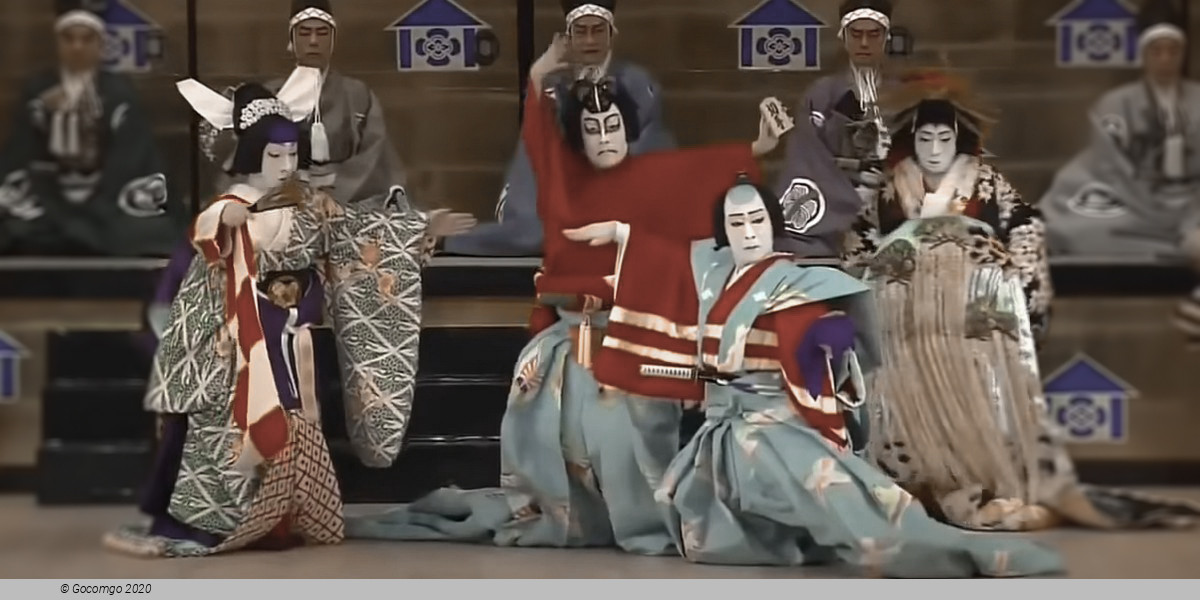
Yui Minbunosuke and Osode have come with their child to the outskirts of Okazaki, a post town on the Tōkaidō Highway. As it has grown dark, the pair asks to be lodged at Muryōji Temple. The old woman Osan who keeps this temple and Osode's mother who died of illness are as alike as two peas in a pod. The old woman, who claims that she has come back to life, is glad to see her first grandchild, but her true identity is that of a terrifying cat monster… This is a popular scene revived by Ichikawa En'ō II from the play 'Traveling Alone Along the Tōkaidō Highway', which was originally written by Tsuruya Nanboku IV.
Cho Kabuki Powered by NTT
HANA KURABE SENBON ZAKURA
['Contest of the Cherry Trees Now and Past']
STORY :
The first scene is set in the Age of the Gods when the sacred cherry tree 'Senbon Zakura' is in full bloom. As the spirit of the Blue Dragon, which plots to rob the world of its light attacks the tree and scatters its blossoms, the world becomes shrouded in darkness. The white fox that protects the sacred tree and Princess Miku barely escape this calamity after much sacrifice. Time passes. A butterfly which flutters forlornly around the withered 'Senbon Zakura' is the temporary reincarnation of Princess Miku who lost her memory and fled. Then, Satō Tadanobu, the reincarnation of the white fox, appears. Tadanobu who still remembers the Age of the Gods rushes to Princess Miku and …. This play, inspired by the masterpiece of classic kabuki "Yoshitsune and the Thousand Cherry Trees", as well as the world of Hatsune Miku's hit tune "One Thousand Cherry Trees", is a monumental work which was first performed as 'Cho Kabuki' in Niconico Chokaigi 2016.
Part 2: 02:45 PM
TSUMEŌ
['The Talons of the King']
STORY :
A falconer is asked by the headman of a nearby village to rid it of a wicked fox that is troubling the people. His falcon Fubuki attacks the fox and there is a furious fight. Fubuki returns to the falconer, defeated and heavily wounded, but alive. When spring comes with its brightly colored blossoms, the falconer has nursed Fubuki back to health and wants it to fight the fox again to become the king of the mountain … This rarely performed and unique dance is based on a children's story about a falconer and his young falcon by Togawa Yukio (1912 - 2004) whose tales are based on a wealth of observation of nature.
TAWARABOSHI GENBA
['Tawaraboshi Genba']
STORY :
The play is set on the 13th of December, 1702, at the training hall of the master spearman Tawaraboshi Genba in Yokoamichō in Edo. Jūsuke, the keeper of a buckwheat noodle shop, visits his customer Genba who is resting for a while drinking his favorite saké again. Jūsuke has come to bid Genba farewell as he has decided to return to his home province the next day. He is in reality, Sugino Jūheiji, one of the masterless samurai of the Akō domain. He has been spying on the mansion of their enemy, Kira, having disguised himself as a noodle shop owner, as part of the plan to avenge his lord's death, but he has never revealed his identity. As Genba drinks with Jūsuke, he tells Jūsuke that he has been asked to serve as a guard at Kira's mansion, for it is rumored that the mansion will soon be attacked by the masterless samurai of the Akō domain... Please enjoy this affecting story which was written in collaboration with Kanda Shōri, a Living National Treasure of Kōdan storytelling.
Part 3: 05:45 PM
SHŌJŌ
['Mythical Saké Loving Spirit']
STORY :
The shōjō is a mythical Chinese saké-loving spirit that lives in rivers. In this dance, a young and honest man has a revelation in a dream in which he is told to open a saké shop. Soon after he does so, he meets a mysterious customer who visits the shop daily, drinking enormous amounts of saké with great satisfaction. As it turns out, the customer is actually a shōjō in disguise. The dance shows two shōjō as they drink and dance joyfully together.
TENSHU MONOGATARI
['Tale of a Castle Keep']
STORY :
The top of Shirasagi Castle in Harima Province is another world inhabited by beautiful and mysterious spirits who keep humans at bay. Their mistress is the beautiful and noble Princess Tomi. Her friend, Princess Kame, who adores her as her sister visits her. Princess Tomi rejoices at their reunion and gives Princess Kame a present: the white falcon which is the prize possession of Takeda, Lord of Harima. That night, Himekawa Zushonosuke, who serves the Lord of Harima as his falconer, comes to the keep in search of the falcon. Impressed by his gallant mien, Princess Tomi gives him the treasured helmet of the castle lord and allows him to return safely. When Zushonosuke descends from the keep and returns to his compatriots, he is suspected of stealing the treasured helmet … This work which weaves together a unique blend of fantasy, is one of the foremost masterpieces of Izumi Kyōka. Please look forward to experiencing the amazing world of beautiful, mysterious spirits who live apart from the human realm.
A kabuki program is usually made up of several different plays and dances, but at the Kabukiza Theatre, 'Single Act Seats' are available so that you can watch just one of the acts.
Single Act Tickets will be sold on the day of the performance (they cannot be reserved or purchased in advance).
Tea will not be offered at the Box Seats. Please refrain from eating at seats as well.





 4 Chome-12-15 Ginza, Chuo City