
Kabukiza Theatre 7 August 2022 - August Program at the Kabukiza Theatre | GoComGo.com

August Program at the Kabukiza Theatre

Kabukiza Theatre, Tokyo, Japan
All photos (1)
Select date and time
11 AM

E-tickets: Print at home or at the box office of the event if so specified. You will find more information in your booking confirmation email.

You can only select the category, and not the exact seats.
If you order 2 or 3 tickets: your seats will be next to each other.
If you order 4 or more tickets: your seats will be next to each other, or, if this is not possible, we will provide a combination of groups of seats (at least in pairs, for example 2+2 or 2+3).

Important Info
Type: Show
City: Tokyo, Japan
Starts at: 11:00
Acts: 3
Intervals: 2
Duration: 9h 50min

E-tickets: Print at home or at the box office of the event if so specified. You will find more information in your booking confirmation email.

You can only select the category, and not the exact seats.
If you order 2 or 3 tickets: your seats will be next to each other.
If you order 4 or more tickets: your seats will be next to each other, or, if this is not possible, we will provide a combination of groups of seats (at least in pairs, for example 2+2 or 2+3).

Overview

Part 1: 11:00 AM

Part 2: 3:00 PM

Part 3: 6:15 PM

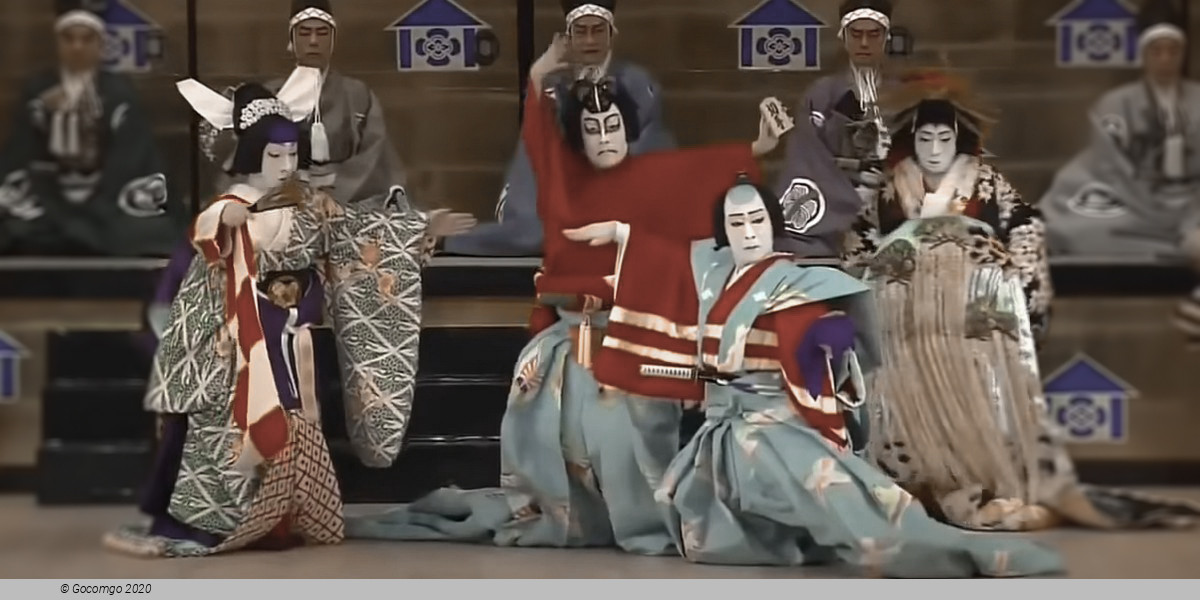
Each month's program will consist of three parts. Between each part there will be an intermission.

Part 1:

SHINSENGUMI ('Shinsengumi')

This is the first kabuki adaptation of the manga series by Tezuka Osamu.
It is set at the end of the Edo period in Kyoto. Fukakusa Kyūjūrō becomes a member of the Shinsengumi, a party of masterless warriors, to avenge his father's death, and gets acquainted with a boy swordsman named Kamagiri Daisaku. Though they have opposite characters, in time they become good friends after sharing moments of relief during their severe training. One day, Kyūjūrō is forced to slay a man while fighting as a member of the Shinsengumi and now his own life is sought to avenge that man's death...

YAMINOUME HYAKU MONOGATARI ('The Game of One Hundred Ghost Tales')

This is a dance drama based on a traditional popular game in which people would light one hundred lanterns and tell ghost stories. At the conclusion of each story a light was extinguished. When the last remaining lantern was put out, it was believed, a real ghost would appear.

Part 2:

ANSEI KIBUN TSUKUDA NO YOARASHI ('Strange News in the Ansei Era: Night Storm at Tsukuda')

Aoki Teijirō and Kamiya Genzō spend their days doing hard labor in prison on Tsukuda Island in the early winter of 1858. Aoki, who was formerly a samurai in Kōshū province, hopes to avenge his parents who were killed over the buried gold of Takeda Shingen. As Kamiya knows of Aoki's wish, he encourages Aoki to flee from the island together with him. On the night when they carry out their plan, they climb over the fence of the prison and go across the Sumida River to the riverbank at Fukagawa. They commit one crime after another to earn their traveling expenses. Parting from Kamiya, Aoki sets out for Kōshū province and encounters the ferryman Gihē and his family at a ferry on the Fuefuki River and...

FUNA BENKEI ['Benkei in the Boat']

UKIYO BURO ('The Fashionable Bathhouse')

This is a light-hearted dance portraying the attendant Masakichi at a public bath house in the Edo Period. Masakichi goes about his chores stacking up wooden pails neatly and checking the temperature of the bath. At dawn when the cocks crow he rinses the bathers' backs. However, one day a slug in the figure of a woman appears...

Part 3:

Tōkai Dōchū Hizakurige. YAJIKITA RETURNS ('Yajirobē and Kitahachi on the Tōkaidō Highway Returns')

Yajirobē and Kitahachi worked as stagehands at the Kabukiza Theatre in Edo's Kobikichō district. They set out on a pilgrimage to Ise Shrine dreaming of getting rich quick, and caused various kinds of trouble everywhere they went. But they managed to come through every crisis. Three years have passed since then. At the end of the previous play in this series, fireworks at the Ise Shrine blew them high up in the sky, after which they landed on a remote desert island, but they survived somehow. By this means and that, they manage to arrive in Nagasaki where they learn that the Kabukiza Theatre, where they formerly worked, is in trouble. In order to return to the Kabukiza Theatre, they again have an incident-filled journey, getting over many problems which confront them.

A kabuki program is usually made up of several different plays and dances, but at the Kabukiza Theatre, 'Single Act Seats' are available so that you can watch just one of the acts.

Single Act Tickets will be sold on the day of the performance (they cannot be reserved or purchased in advance).

Tea will not be offered at the Box Seats. Please refrain from eating at seats as well.

Venue Info

Kabukiza Theatre - Tokyo
Location   4 Chome-12-15 Ginza, Chuo City

Kabuki-za in Ginza is the principal theater in Tokyo for the traditional kabuki drama form.

The Kabuki-za was originally opened by a Meiji era journalist, Fukuchi Gen'ichirō. Fukuchi wrote kabuki dramas in which Ichikawa Danjūrō IX and others starred; upon Danjūrō's death in 1903, Fukuchi retired from the management of the theater. 

The original Kabuki-za was a wooden structure, built in 1889 on land which had been either the Tokyo residence of the Hosokawa clan of Kumamoto, or that of Matsudaira clan of Izu.

The building was destroyed on October 30, 1921, by an electrical fire. The reconstruction, which commenced in 1922, was designed to "be fireproof, yet carry traditional Japanese architectural styles", while using Western building materials and lighting equipment. Reconstruction had not been completed when it again burned down during the 1923 Great Kantō earthquake. Rebuilding was finally completed in 1924.

The theater was destroyed once again by Allied bombing during World War II. It was restored in 1950 preserving the style of 1924 reconstruction, and was until recently one of Tokyo's more dramatic and traditional buildings.

The 1950 structure was demolished in the spring of 2010, and rebuilt over the ensuing three years. Reasons cited for the reconstruction include concerns over the building's ability to survive earthquakes, as well as accessibility issues. A series of farewell performances, entitled Kabuki-za Sayonara Kōen 
 were held from January through April 2010, after which kabuki performances took place at the nearby Shinbashi Enbujō and elsewhere until the opening of the new theatre complex, which took place on March 28, 2013.

The style in 1924 was in a baroque Japanese revivalist style, meant to evoke the architectural details of Japanese castles, as well as temples of pre-Edo period. This style was kept after the post-war reconstruction and again after the 2013 reconstruction.

Inside, with the latest reconstruction the theatre was outfitted with four new front curtains called doncho. These are by renowned Japanese artists in the Nihonga style and reflect the different seasons.

Performances are exclusively run by Shochiku, in which the Kabuki-za Theatrical Corporation is the largest shareholder. They are nearly every day, and tickets are sold for individual acts as well as for each play in its entirety. As is the case for most kabuki venues, programs are organized monthly: each month there is a given set of plays and dances that make up the afternoon performance, and a different set comprising the evening show. These are repeated on a nearly daily schedule for three to four weeks, with the new month bringing a new program.

Important Info
Type: Show
City: Tokyo, Japan
Starts at: 11:00
Acts: 3
Intervals: 2
Duration: 9h 50min
Top of page