
Dutch National Opera 23 January 2020 - Rodelinda | GoComGo.com

Rodelinda

Dutch National Opera, Amsterdam, Netherlands
All photos (1)
Select date and time
7 PM
Request for Tickets
Important Info
Type: Opera
City: Amsterdam, Netherlands
Starts at: 19:00
Acts: 3
Intervals: 1
Sung in: Italian
Titles in: Dutch,English

E-tickets: Print at home or at the box office of the event if so specified. You will find more information in your booking confirmation email.

You can only select the category, and not the exact seats.
If you order 2 or 3 tickets: your seats will be next to each other.
If you order 4 or more tickets: your seats will be next to each other, or, if this is not possible, we will provide a combination of groups of seats (at least in pairs, for example 2+2 or 2+3).

Overview

What makes Handel’s opera Rodelinda such a popular favourite? In arias suffused with grief, bitter yearning and joy, her story speaks to our imaginations and draws us into her dilemma. What would you do, faced with a choice between loyalty and power?


PLOT

The plot of Rodelinda is fuelled by the intrigues surrounding the supposed death of King Bertarido and the resulting love and power vacuum. Beset on all sides, his wife and widow Rodelinda must choose whether to risk remaining loyal to her dead husband, or to save herself by siding with her enemy Grimaldo. In the end, she chooses loyalty, even at the cost of her son’s life.

NO ESCAPE

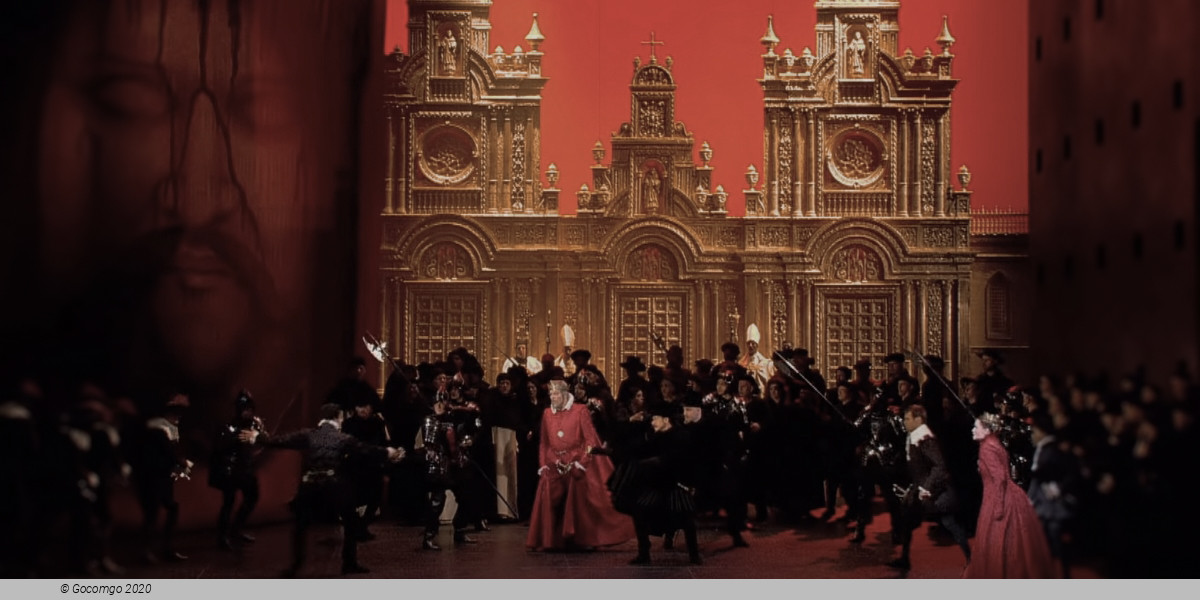
In German director Claus Guth’s staging of Rodelinda, the family tragedy unfolds in a vast house, a black box with white stairways going up and down. In this oppressive setting, with no means of escape, the intrigue and power games become almost unbearable. Masks and projected drawings influence the characters’ emotional state and heighten the sinister mood.

BAROQUE OPERA

Handel’s works have become fixtures of the opera repertoire, Rodelinda being one of his greatest triumphs. Like the two other pinnacles of his oeuvre from the same period, Giulio Cesare and Tamerlano, it was composed for the Royal Academy of Music, of which Handel was the artistic director. Rodelinda is the DNO’s only Baroque opera this season.

History
Premiere of this production: 13 February 1725, the King`s Theatre in the Haymarket, London,

Rodelinda, regina de' Longobardi is an opera seria in three acts composed for the first Royal Academy of Music by George Frideric Handel. The libretto is by Nicola Francesco Haym, based on an earlier libretto by Antonio Salvi. Rodelinda has long been regarded as one of Handel's greatest works.

Synopsis

The argument
Prior to the opening of the opera, Grimoaldo has defeated Bertarido, King of Lombardy, in battle and has usurped the throne of Milan. Bertarido has fled, leaving his wife Rodelinda and his son Flavio prisoners of the usurper in the royal palace. Failing to secure support to recover his crown, Bertarido has caused it to be reported that he has died in exile, a ruse to be used in an attempt to rescue his wife and son.

Act 1

Rodelinda's apartments
Alone in the palace, Rodelinda mourns the loss of her husband Bertarido. The usurper Grimoaldo enters, declaring a long-hidden passion for her. He proposes marriage and offers her back the throne that is rightfully hers. She angrily rejects him (Aria:"L'empio rigor del fato"). Eduige arrives at the apartment looking for Grimoaldo. Grimoaldo, having previously been betrothed to Bertarido's sister Eduige, now tells her that as she once spurned him, he shall spurn her. After Grimoaldo leaves, the scheming Garibaldo, his counsellor, professes love for Eduige. She promises to return his love once she has had revenge on Grimoaldo (Aria:"Lo farò, diro: spietato"). Alone, Garibaldo reveals that his love for Eduige is feigned, and is part of a plan to gain the throne for himself (Aria: "Di cupido impiego i vanni").

A cypress-grove
Bertarido, in hiding nearby, reads the inscription on his own memorial and longs for his beloved wife Rodelinda (Aria:"Dove sei, amato bene?"). Along with his friend and counsellor Unulfo, he secretly watches as Rodelinda and Flavio, her son, arrive to lay flowers at his memorial. She weeps at her husband's fate. Garibaldo enters with an ultimatum for Rodelinda: either she agrees to marry Grimoaldo, or her son will be put to death. Rodelinda consents but also vows to demand Garibaldo's death when she returns to the throne. Bertarido, still watching, is aghast and takes Rodelinda's decision as an act of personal betrayal.

Act 2

A great hall
Garibaldo taunts Eduige, telling her that now, since she has lost Grimoaldo, she has missed her chance to become queen. Eduige satirically congratulates Rodelinda, noting her sudden decision to betray her husband's memory and marry his usurper. Rodelinda reminds Eduige of who is queen. Eduige vows vengeance on Grimoaldo. Eduige departs and Grimoaldo enters. Rodelinda sets out her terms for marrying Grimoaldo: he must kill Flavio with his own hands in front of her. Grimoaldo, horrified, refuses. After Rodelinda leaves, Garibaldo encourages Grimoaldo to carry out the murder and take Rodelinda as his wife, but Grimoaldo rejects the advice. He says that Rodelinda's act of courage and determination has made him love her all the more, though he has now lost hope of ever winning her. When the two advisors are alone, Unulfo asks Garibaldo how he could give a king such advice, and Garibaldo expounds his tyrannical perspective on the use of power (Aria: “Tirannia gliel diede il regno”).

A delightful prospect
Bertarido approaches the palace grounds in disguise, where his sister Eduige recognizes his voice. Unolfo brings word of Rodelinda's fidelity - also gratifying for Eduige - and Eduige agrees to help Bertarido rescue his wife and son. Unolfo promises to pass a message to Rodelinda that her husband is still alive. Bertarido rejoices at the prospect of reunion.

A gallery in Rodelinda's apartment
Rodelinda and Bertarido meet in secret, and are discovered in an embrace by Grimoaldo who fails to recognise her husband. Grimoaldo is outraged, believing that Rodelinda has taken a lover. To save her honour, Bertarido reveals his identity but Grimoaldo vows to kill him anyway, whoever he may be. The spouses bid each other a last farewell (Duet: "Io t'abbraccio").

Act 3

A gallery
Unulfo and Eduige make a plan to release Bertarido from prison: they will smuggle to him a sword and the key to a secret passage that runs under the palace. Garibaldo advises Grimoaldo to put the unknown man - whether Bertarido or not - to death. Grimoaldo is racked by jealousy, passion and fear.

A very dark prison
Languishing in prison, Bertarido receives the sword, the key and a written note. When Unulfo comes to release him, Bertarido mistakes the visitor in the darkness for the executioner and wounds him with the sword. Unulfo shrugs the injury off, and the two leave. Eduige guides Rodelinda into the cell. Finding it empty and with blood on the floor, they fear that Bertarido is dead.

A royal garden
Grimoaldo is tormented by remorse and flees to the palace garden, hoping to find a peaceful spot where he can seek solace in sleep (Aria:"Pastorello d'un povero armento"). Garibaldo, finding him unprotected, decides to kill him. Bertarido appears and kills the intended assassin; Grimoaldo, however, he spares (Aria:"Vivi, tiranno!"). Grimoaldo renounces his claim to the throne of Milan, and pledges himself once again to Eduige. He offers the throne back to Bertarido who accepts it once he is assured that his wife and son will be returned to him. There is general rejoicing.

Venue Info

Dutch National Opera - Amsterdam
Location   Amstel 3

The Dutch National Opera is the largest theatre production house in the Netherlands. Situated in the heart of Amsterdam, the iconic theatre of Dutch National Opera & Ballet offers a magnificent view of the River Amstel and the famous Magere Brug (Skinny Bridge). The various spaces form an inspiring backdrop for a whole range of special events.

Dutch National Opera & Ballet is a young theatre with a long history. The plans for building a new theatre ran parallel to the plans for a new city hall. The first discussions held by the Amsterdam city council about building a new city hall and opera house go back to 1915. At that time, the plans were specifically for an opera house, since ballet was a relatively unknown art form back then.

Ideas for the site of the new city hall and opera house were continually changing, and the idea that both buildings could form a single complex only emerged much later. Sites considered for the new city hall were initially the Dam, followed by the Frederiksplein, and finally the Waterlooplein.

In 1955, the city council commissioned the firm of architects Berghoef and Vegter to draft a design for a city hall on the Waterlooplein. The draft was approved, but in 1964 the council ended the association with the architects, as the final design was nothing like the original plans they had been shown. In 1967, a competition was held for a new design, with the Viennese architect Wilhelm Holzbauer emerging as the winner. Amsterdam's financial problems, however, meant that the plans for the new city hall were put on hold for several years.

DNO has its own choir of sixty singers and technical staff of 260. DNO historically has not had its own resident orchestra, and so various orchestras of the Netherlands, including the Netherlands Philharmonic Orchestra (NPO), the Netherlands Chamber Orchestra (NKO), the Royal Concertgebouw Orchestra, the Rotterdam Philharmonic Orchestra, the Radio Filharmonisch Orkest and the Asko/Schönberg ensemble have provided the orchestral forces for DNO productions.

DNO produces on average eleven productions per year. While most performances are in the Dutch National Opera & Ballet building, the company has also performed in the Stadsschouwburg, at the Carré Theatre, and on the Westergasfabriek industrial site in Amsterdam. For many years, the June production has been organized as part of the Holland Festival and includes the participation of the Royal Concertgebouw Orchestra. DNO has lent its productions to foreign companies, such as the Metropolitan Opera, the Brooklyn Academy of Music, the Lincoln Center Festival in New York, as well as the Adelaide Festival in Australia.

Since 1988, the French-Lebanese theatre director Pierre Audi has been the artistic director of DNO. Audi is scheduled to conclude his DNO tenure in 2018. In April 2017, DNO announced the appointment of Sophie de Lint as the company's next artistic director, effective 1 September 2018.

Hartmut Haenchen was chief conductor from 1986 to 1999, in parallel with holding the title of chief conductor of the NPO. He subsequently held the title of principal guest conductor with DNO. Subsequent chief conductors have been Edo de Waart (1999-2004) and Ingo Metzmacher (2005-2008). In March 2009, DNO announced the appointment of Marc Albrecht as the orchestra's next chief conductor, with the 2011-2012 season, for an initial contract of four years. This return to a single chief conductor at both DNO and the NPO/NKO allows for the NPO to become the principal opera orchestra for DNO. Albrecht is scheduled to stand down as chief conductor of DNO at the end of the 2019-2020 season.

Important Info
Type: Opera
City: Amsterdam, Netherlands
Starts at: 19:00
Acts: 3
Intervals: 1
Sung in: Italian
Titles in: Dutch,English
Top of page