Act 1
Scene 1: A desolate no-man's land
A truck breaks down. Three fugitives from justice get out and find themselves in the city of Mahagonny: Fatty the Bookkeeper, Trinity Moses, and Leocadia Begbick. Because the federal agents pursuing them will not search this far north, and they are in a good location to attract ships coming south from the Alaskan gold fields, Begbick decides that they can profit by staying where they are and founding a pleasure city, where men can have fun, because there is nothing else in the world to rely on.
Scene 2
The news of Mahagonny spreads quickly, and sharks from all over flock to the bait, including the whore Jenny Smith, who is seen, with six other girls, singing the "Alabama Song", in which she waves goodbye to her home and sets out in pursuit of whiskey, dollars and pretty boys.
Scene 3
In the big cities, where men lead boring, purposeless lives, Fatty and Moses spread the gospel of Mahagonny, city of gold, among the disillusioned.
Scene 4
Four Alaskan Lumberjacks who have shared hard times together in the timberlands and made their fortunes set off together for Mahagonny. Jimmy Mahoney and his three friends – Jacob Schmidt, Bank Account Billy, and Alaska Wolf Joe – sing of the pleasures awaiting them in "Off to Mahagonny", and look forward to the peace and pleasure they will find there.
Scene 5
The four friends arrive in Mahagonny, only to find other disappointed travelers already leaving. Begbick, well-informed about their personal tastes, marks down her prices, but for the penurious Billy they still seem too high. Jimmy impatiently calls for the girls of Mahagonny to show themselves, so he can make a choice. Begbick suggests Jenny as the right girl for Jack, who finds her rates too high. She pleads with Jack to reconsider ("Havana Song"), which arouses Jim's interest, and he chooses her. Jenny and the girls sing a tribute to "the Jimmys from Alaska."
Scene 6
Jimmy and Jenny get to know one another as she asks him to define the terms of their contact: Does he wish her to wear her hair up or down, to wear fancy underwear or none at all? "What is your wish?" asks Jim, but Jenny evades answering.
Scene 7
Begbick, Fatty and Moses meet to discuss the pleasure city's financial crisis: People are leaving in droves, and the price of whiskey is sinking rapidly. Begbick suggests going back to civilization, but Fatty reminds her that the federal agents have been inquiring for her in nearby Pensacola. Money would solve everything, declares Begbick, and she decides to soak the four new arrivals for all they've got.
Scene 8
Jimmy, restless, attempts to leave Mahagonny, because he misses the wife he left in Alaska.
Scene 9
In front of the Rich Man's Hotel, Jimmy and the others sit lazily as a pianist plays Tekla Bądarzewska's "A Maiden's Prayer". With growing anger, Jimmy sings of how his hard work and suffering in Alaska have led only to this. Drawing a knife, he shouts for Begbick, while his friends try to disarm him and the other men call to have him thrown out. Calm again, he tells Begbick that Mahagonny can never make people happy: it has too much peace and quiet.
Scene 10
As if in answer to Jimmy's complaint, the city is threatened by a typhoon. Everyone sings in horror of the destruction awaiting them.
Scene 11
Tensely, people watch for the hurricane's arrival. The men sing a hymn-like admonition not to be afraid. Jim meditatively compares Nature's savagery to the far greater destructiveness of Man. Why do we build, he asks, if not for the pleasure of destroying? Since Man can outdo any hurricane, fear makes no sense. For the sake of human satisfaction, nothing should be forbidden: If you want another man's money, his house or his wife, knock him down and take it; do what you please. As Begbick and the men ponder Jimmy's philosophy, Fatty and Moses rush in with news: The hurricane has unexpectedly struck Pensacola, destroying Begbick’s enemies, the federal agents. Begbick and her cohorts take it as a sign that Jimmy is right; they join him, Jenny, and his three friends in singing a new, defiant song: If someone walks over someone else, then it's me, and if someone gets walked on, then it's you. In the background, the men continue to chant their hymn as the hurricane draws nearer.
Act 2
Scene 12
Magically, the hurricane bypasses Mahagonny, and the people sing in awe of their miraculous rescue. This confirms Begbick's belief in the philosophy of "Do what you want," and she proceeds to put it into effect.
Scene 13 At the renovated "Do It" tavern.
The men sing of the four pleasures of life: Eating, Lovemaking, Fighting and Drinking. First comes eating: To kitschy cafe music, Jimmy's friend Jacob gorges until he keels over and dies. The men sing a chorale over his body, saluting "a man without fear".
Scene 14: Loving.
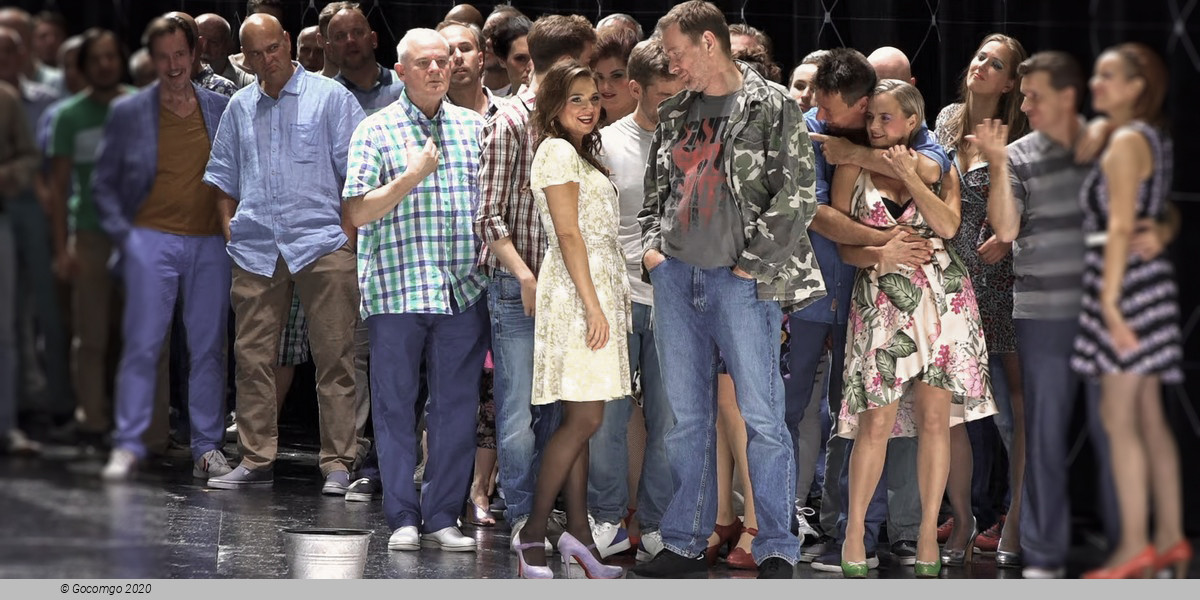
While Begbick collects money and issues tips on behavior, Moses placates the impatient men queuing to make love to Jenny and the other whores. The men sing the "Mandalay Song", warning that love does not last forever, and urging those ahead of them to make it snappy.
Scene 15: Fighting.
The men flock to see a boxing match between Trinity Moses and Jim's friend Alaska Wolf Joe. While most of the men, including the ever-cautious Billy, bet on the burly Moses, Jim, out of friendship, bets heavily on Joe. The match is manifestly unfair; Moses not only wins but kills Joe in knocking him out.
Scene 16: Drinking.
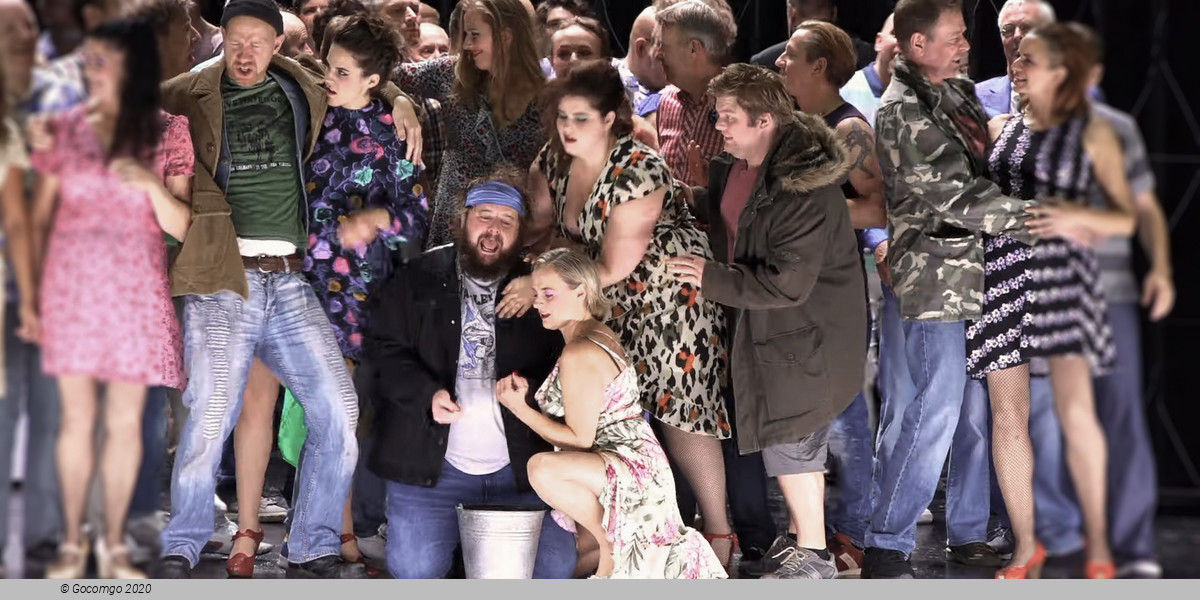
In an effort to shake off the gloom of Joe's death, Jimmy invites everyone to have a drink on him. The men sing "Life in Mahagonny", describing how one could live in the city for only five dollars a day, but those who wanted to have fun always needed more. Jim, increasingly drunk, dreams of sailing back to Alaska. He takes down a curtain rod for a mast and climbs on the pool table, pretending it is a ship; Jenny and Billy play along. Jimmy is abruptly sobered up when Begbick demands payment for the whiskey as well as for the damage to her property. Totally broke, he turns in a panic to Jenny, who explains her refusal to help him out in the song "Make your own bed" – an adaptation of the ideas he proclaimed at the end of act 1. Jim is led off in chains as the chorus, singing another stanza of "Life in Mahagonny", returns to its pastimes. Trinity Moses assures the crowd that Jimmy will pay for his crimes with his life.
Scene 17
At night, Jim alone and chained to a lamppost, sings a plea for the sun not to rise on the day of his impending trial.
Act 3
Scene 18: In the courtroom
Moses, like a carnival barker, sells tickets to the trials. He serves as prosecutor, Fatty as defense attorney, Begbick as judge. First comes the case of Toby Higgins, accused of premeditated murder for the purpose of testing an old revolver. Fatty invites the injured party to rise, but no one does so, since the dead do not speak. Toby bribes all three, and as a result, Begbick dismisses the case. Next Jimmy's case is called. Chained, he is led in by Billy, from whom he tries to borrow money; Billy of course refuses, despite Jim's plea to remember their time together in Alaska. In virtually the same speech he used to attack Higgins, Moses excoriates him for not paying his bills, for seducing Jenny (who presents herself as a plaintiff) to commit a "carnal act" with him for money, and for inciting the crowd with "an illegal joyous song" on the night of the typhoon. Billy, with the chorus's support, counters that, in committing the latter act, Jimmy discovered the laws by which Mahagonny lives. Moses argues that Jim hastened his friend Joe's death in a prizefight by betting on him, and Billy counters by asking who actually killed Joe. Moses does not reply. But there is no answer for the main count against him. Jim gets short sentences for his lesser crimes, but for having no money, he is sentenced to death. Begbick, Fatty and Moses, rising to identify themselves as the injured parties, proclaim "in the whole human race / there is no greater criminal / than a man without money". As Jim is led off to await execution, everyone sings the "Benares Song", in which they long for that exotic city "where the sun is shining." But Benares has been destroyed by an earthquake. "Where shall we go?" they ask.
Scene 19: At the gallows
Jim says a tender goodbye to Jenny, who, dressed in white, declares herself his widow. He surrenders her to Billy, his last remaining companion from Alaska. When he tries to delay the execution by reminding the people of Mahagonny that God exists, they play out for him, under Moses' direction, the story of "God in Mahagonny", in which the Almighty condemns the town and is overthrown by its citizens, who declare that they can not be sent to Hell because they are already in Hell. Jim, chastened, asks only for a glass of water, but is refused even this as Moses gives the signal for the trap to be sprung.
Scene 20
A caption advises that, after Jim's death, increasing hostility among the city's various factions has caused the destruction of Mahagonny. To a potpourri of themes from earlier in the opera, groups of protesters are seen on the march, in conflict with one another, while the city burns in the background. Jenny and the whores carry Jim's clothing and accessories like sacred relics; Billy and several men carry his coffin. In a new theme, they and the others declare, "Nothing you can do will help a dead man". Begbick, Fatty and Moses appear with placards of their own, joining the entire company in its march and declaring "Nothing will help him or us or you now," as the opera ends in chaos.



 Amstel 3