Dutch National Opera 17 March 2020 - Das Jagdgewehr | GoComGo.com

Das Jagdgewehr

Dutch National Opera, Amsterdam, Netherlands
All photos (1)
Select date and time
8 PM
Request for Tickets
Important Info
Type: Opera
City: Amsterdam, Netherlands
Starts at: 20:00
Duration:

E-tickets: Print at home or at the box office of the event if so specified. You will find more information in your booking confirmation email.

You can only select the category, and not the exact seats.
If you order 2 or 3 tickets: your seats will be next to each other.
If you order 4 or more tickets: your seats will be next to each other, or, if this is not possible, we will provide a combination of groups of seats (at least in pairs, for example 2+2 or 2+3).

Overview

Das Jagdgewehr is a production of the Bregenzer Festival in collaboration with Ensemble Modern. Composition assignment of the Bregenzer Festival.

Das Jagdgewehr is based on the Japanese writer Yashushi Inoue’s ‘eponymous’ debut novel of 1949. The tragic and meticulously told love story about three women is framed around their letters, which tell a tale of romance, secrets and betrayal.


TEAM AND CAST

Japanese aesthetic
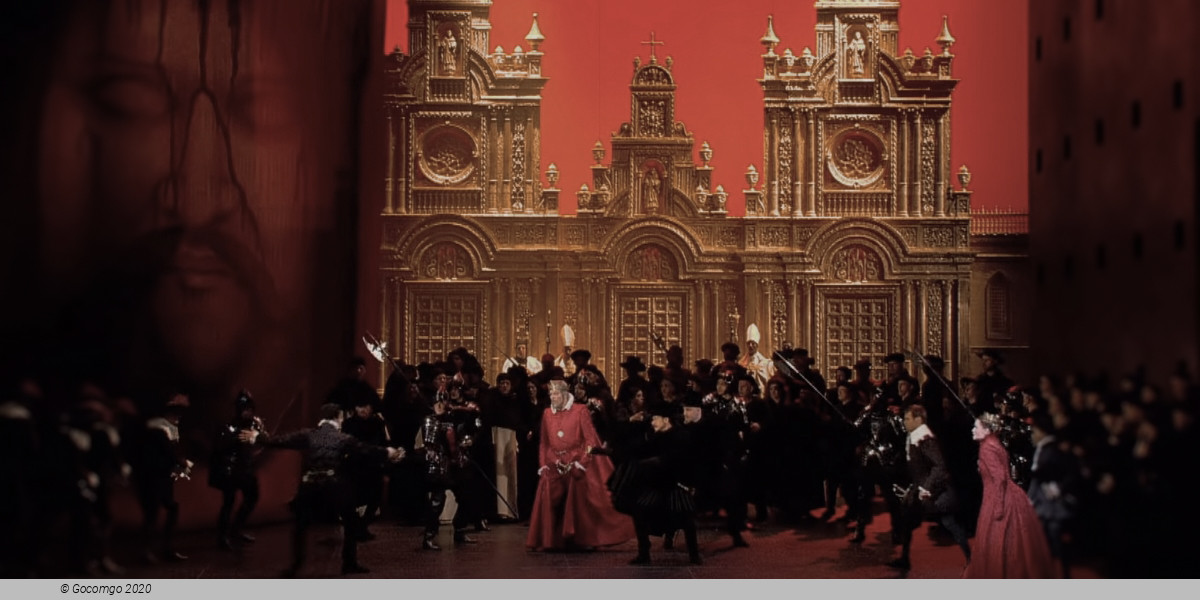
Director Karl Markovics and designer Katharina Woppermann create a world inspired by the Japanese aesthetic, brought to life in bright yellow, peacock blue and vibrant red. Thomas Larcher's evocative and richly hued score opens with mysterious percussive susurration underlaid by the chorus.

Composer Thomas Larcher:
When I first read the story of Das Jagdgewehr, I was instantly captivated by its timelessness. It centres on the illusions we cultivate in almost every relationship and the ultimate profound loneliness inherent in being human. () The music is a counterpoint to the storys superficial serenity, subtly reflecting the characters’ turbulent emotions. Like many Japanese texts, Das Jagdgewehr has a ritual aspect. The chorus of seven voices spatially amplifies the solo instruments.

Ensemble Modern
Ensemble Modern is a leading contemporary music ensemble formed in Frankfurt in 1980. It performs a programme of some 70 new works each season, including 20 world premières, working closely with the original composers.

History
Premiere of this production: 15 August 2018, Bregenzer Festspiele

Thomas Larcher's opera "The Hunting Rifle" after Yasushi Inoue premieres at the Bregenz Festival in 2018. Directed by Karl Markovics.

The libretto was written by Fryderike Gösweiner according to a letter from the Japanese author Yasushi Inoue from 1949: framed by a narrative, three women in letters tell a story of secret love.

Synopsis

The three main characters of Das Jagdgewehr are Midori, the betrayed wife; Saiko, her husband’s mistress; and Saiko’s daughter Shoko, who learns of the affair shortly before her mother’s death.

Shoko writes: ‘() How could I have imagined a love that stretches deep beneath the earth, a love like a subterranean river of which no one knows where it begins or ends.

Each letter adds a new facet to the tale of an impossible love. The title’s hunter, Josuke Misugi, is the lover and bearer of the letters, who tells the story of love, death and loneliness in carefully chosen words.

Can you also talk about the development of your vocal works: from small ensembles to ensembles and orchestral works to opera?

Thomas Larcher: There is a continuous expansion of things, but this does not affect the instrumental composition - Ensemble Modern plays in the “hunting rifle” with 17 instrumentalists - but the extension to another aspect: there is a choir, which is the main reinforcement of the soloist and the sound connection between them and the ensemble.

The text also presents a particular problem: although the libretto is very short, however, it is much larger and differs from the text in past plays. So far I have set poems or even fragments to music. On the contrary, the text of the opera is not so charged in every syllable. It was more about adding everyday messages to a message or mood, which is required to shed light on the content and make it flexible. It was not always easy.

Was this emotional level the reason that you, as a composer, chose to stage a novel by Yasushi Inoue? Is this text also different from the others you have set for music so far?

Thomas Larcher: In verses or fragments of earlier works, the text addressed me first of all at the level of words, in “hunting rifles” it was just a story that is very complicated. It is a lot about loneliness, a lot about silence, but also about the power of writing. The text touches on many of the topics that each of us knows: a change of realities, this network of relationships, abandonment and abandonment, as well as Potemkin facades. This is what is considered as an example in this text. Despite the strict form of the novel - it consists of three letters, a prologue and an epilogue - it also carries high explosiveness.

The task of music is to find time to light microscopically, dig it all up and bring it to the surface. Thus, the composition strictly follows the style of the text and its expressive content. It is elongated in only a few places or covered by tools. It often happens that music later comments on what is said in the text. This makes it easier to understand the content. There is also a statement that a person understands sung texts.

The libretto retains the narrative frame, three letters intertwined. An important role is played by the figure of the poet, the protagonist of the narrative frame.

Thomas Larcher: Initially, this figure was supposed to be even more presented, telling parts of the story throughout the process, but it changed in the course of work. Despite the fact that he appears only at the beginning and at the end, the poet, nevertheless, is the core of the whole plot: thanks to his poem, which he and the choir read together at the beginning, the story unfolds, and he experiences as soon as the whole story, it absorbs and returns them in a transformed way to light. It is almost a burning glass, the focus of everything.

There is a place that needs additional description, this is about the bombing in Tokyo. This description is given by the choir. In addition, the choir acts as a musical reinforcement for the soloists.

Have you also selected other singers?

Yes, it was not as simple as it was very brief. But now we have found some great singers. I already worked with Sarah Aristide, who sings Shoko. Other singers are also excellent. Andre Schuen, who plays the role of Yosuke Misugi, I know well and think it's great that he does it. He is a big future star and sings a lot of new things.

Director Karl Markovich for the first time in the opera. Why did you bring this to him?

Because of his film “Breath,” which I really like because of the time and the way of dialogue.

His idea for The Hunting Gun is to show people in a large landscape, to which the room is also very inviting. The workshop stage has a very large width and depth, it has almost the same area as the floating stage. Deep gradation maintains the isolation of people in history, but large space is also problematic and requires amplification. Rehearsals in the coming weeks will show how this is best done.

You said in an interview about your intimacy with nature: “Nature is basically very similar in most parts of the world - just like people are very similar. I consider things more universal, they cannot be tied to the region in which I was born by chance. " Do you also see The Hunting Gun as a universal text, or is it - and therefore your opera - located very much in Japan?

No, the performance is not very Japanese. I also think that the story is not very Japanese. It is universal and concerns issues that affect us all.

Venue Info

Dutch National Opera - Amsterdam
Location   Amstel 3

The Dutch National Opera is the largest theatre production house in the Netherlands. Situated in the heart of Amsterdam, the iconic theatre of Dutch National Opera & Ballet offers a magnificent view of the River Amstel and the famous Magere Brug (Skinny Bridge). The various spaces form an inspiring backdrop for a whole range of special events.

Dutch National Opera & Ballet is a young theatre with a long history. The plans for building a new theatre ran parallel to the plans for a new city hall. The first discussions held by the Amsterdam city council about building a new city hall and opera house go back to 1915. At that time, the plans were specifically for an opera house, since ballet was a relatively unknown art form back then.

Ideas for the site of the new city hall and opera house were continually changing, and the idea that both buildings could form a single complex only emerged much later. Sites considered for the new city hall were initially the Dam, followed by the Frederiksplein, and finally the Waterlooplein.

In 1955, the city council commissioned the firm of architects Berghoef and Vegter to draft a design for a city hall on the Waterlooplein. The draft was approved, but in 1964 the council ended the association with the architects, as the final design was nothing like the original plans they had been shown. In 1967, a competition was held for a new design, with the Viennese architect Wilhelm Holzbauer emerging as the winner. Amsterdam's financial problems, however, meant that the plans for the new city hall were put on hold for several years.

DNO has its own choir of sixty singers and technical staff of 260. DNO historically has not had its own resident orchestra, and so various orchestras of the Netherlands, including the Netherlands Philharmonic Orchestra (NPO), the Netherlands Chamber Orchestra (NKO), the Royal Concertgebouw Orchestra, the Rotterdam Philharmonic Orchestra, the Radio Filharmonisch Orkest and the Asko/Schönberg ensemble have provided the orchestral forces for DNO productions.

DNO produces on average eleven productions per year. While most performances are in the Dutch National Opera & Ballet building, the company has also performed in the Stadsschouwburg, at the Carré Theatre, and on the Westergasfabriek industrial site in Amsterdam. For many years, the June production has been organized as part of the Holland Festival and includes the participation of the Royal Concertgebouw Orchestra. DNO has lent its productions to foreign companies, such as the Metropolitan Opera, the Brooklyn Academy of Music, the Lincoln Center Festival in New York, as well as the Adelaide Festival in Australia.

Since 1988, the French-Lebanese theatre director Pierre Audi has been the artistic director of DNO. Audi is scheduled to conclude his DNO tenure in 2018. In April 2017, DNO announced the appointment of Sophie de Lint as the company's next artistic director, effective 1 September 2018.

Hartmut Haenchen was chief conductor from 1986 to 1999, in parallel with holding the title of chief conductor of the NPO. He subsequently held the title of principal guest conductor with DNO. Subsequent chief conductors have been Edo de Waart (1999-2004) and Ingo Metzmacher (2005-2008). In March 2009, DNO announced the appointment of Marc Albrecht as the orchestra's next chief conductor, with the 2011-2012 season, for an initial contract of four years. This return to a single chief conductor at both DNO and the NPO/NKO allows for the NPO to become the principal opera orchestra for DNO. Albrecht is scheduled to stand down as chief conductor of DNO at the end of the 2019-2020 season.

Important Info
Type: Opera
City: Amsterdam, Netherlands
Starts at: 20:00
Duration:
Top of page