
Deutsche Oper Berlin 4 December 2022 - Don Quichotte | GoComGo.com

Don Quichotte

Deutsche Oper Berlin, Main Stage, Berlin, Germany
All photos (7)
Select date and time
6 PM

E-tickets: Print at home or at the box office of the event if so specified. You will find more information in your booking confirmation email.

You can only select the category, and not the exact seats.
If you order 2 or 3 tickets: your seats will be next to each other.
If you order 4 or more tickets: your seats will be next to each other, or, if this is not possible, we will provide a combination of groups of seats (at least in pairs, for example 2+2 or 2+3).

Important Info
Type: Opera
City: Berlin, Germany
Starts at: 18:00
Acts: 5
Intervals: 1
Duration: 2h 15min
Sung in: French
Titles in: German,English

E-tickets: Print at home or at the box office of the event if so specified. You will find more information in your booking confirmation email.

You can only select the category, and not the exact seats.
If you order 2 or 3 tickets: your seats will be next to each other.
If you order 4 or more tickets: your seats will be next to each other, or, if this is not possible, we will provide a combination of groups of seats (at least in pairs, for example 2+2 or 2+3).

Overview

DON QUICHOTTE is staged by director, performer, magician and Amsterdam resident Jakop Ahlbom, who is known and celebrated across Europe for his unique approach to theatre. His productions are a peculiar combination of pantomime, dance, music and illusion bursting with magical, surrealistic, nightmarish images, as evinced in VIELFALT [2006], INNENSCHAU [2010], LEBENSRAUM [2012] and, most recently, HORROR.

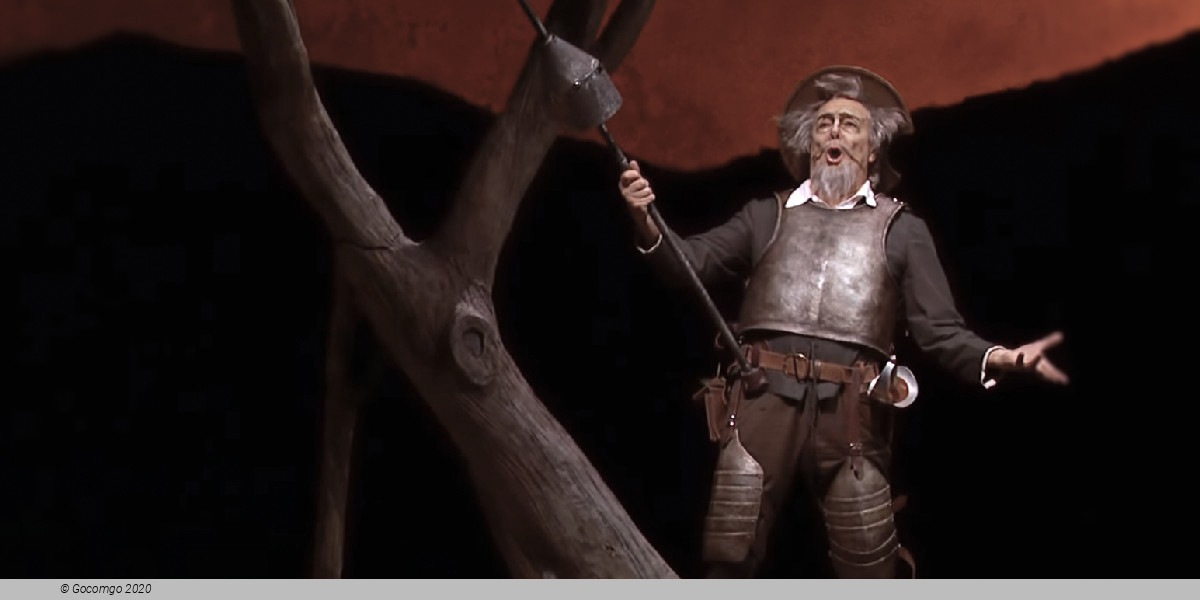
DON QUICHOTTE was Jules Massenet’s musical homage on the opera stage to a classic of world literature. In the eponymous hero’s world everything is possible: windmill sails become the arms of giants, he battles a horde of bandits and his love for the fair Dulcinea is requited. Yet the “knight of the sorrowful countenance” is forced to accept that his dreams have no place in other people’s reality. First performed in 1910 in Monte Carlo, the “comédie héroique” DON QUICHOTTE was Massenet’s penultimate work of musical theatre and in some respects a reflection on death and the ageing process. The 68-year-old composer was himself marked by illness and wrote the score in his sickbed. It is not only Don Quixote, dying of a broken heart, who is asking in the twilight of his years how we might succeed in making our dreams of achieving happiness come true. Through the ambivalent character of Dulcinea he narrates how the façade of a supposedly pure lust for life conceals a fear of its transitory nature.

History
Premiere of this production: 19 February 1910, Opéra de Monte-Carlo

Don Quichotte (Don Quixote) is an opera in five acts by Jules Massenet to a French libretto by Henri Caïn. It was first performed on 19 February 1910 at the Opéra de Monte-Carlo.

Synopsis

Act 1
A square in front of Dulcinée's house

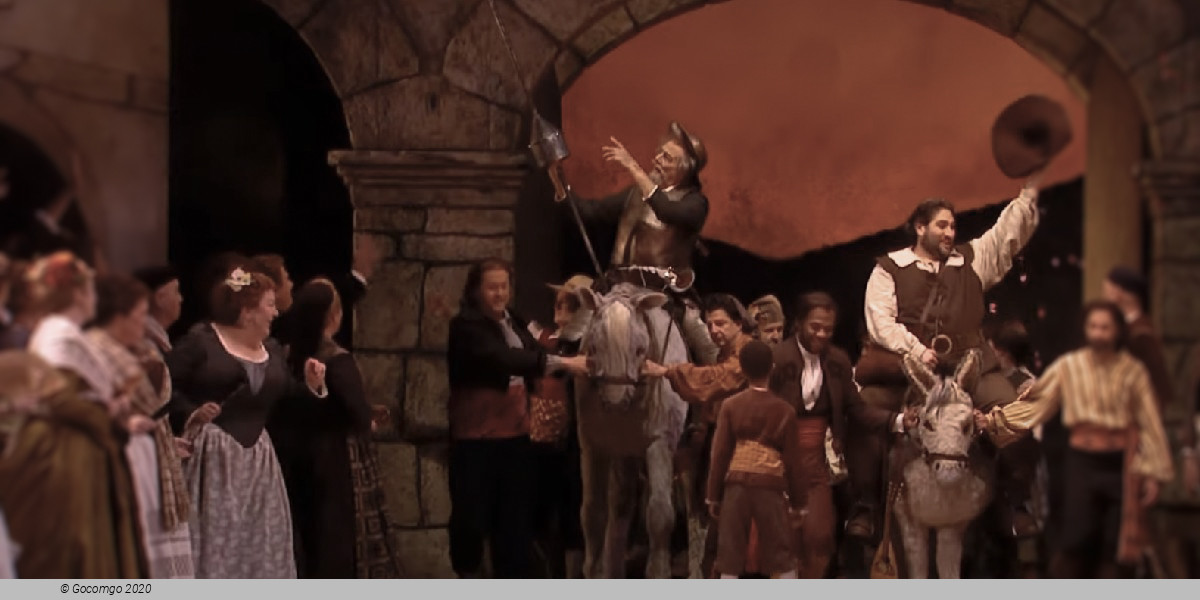
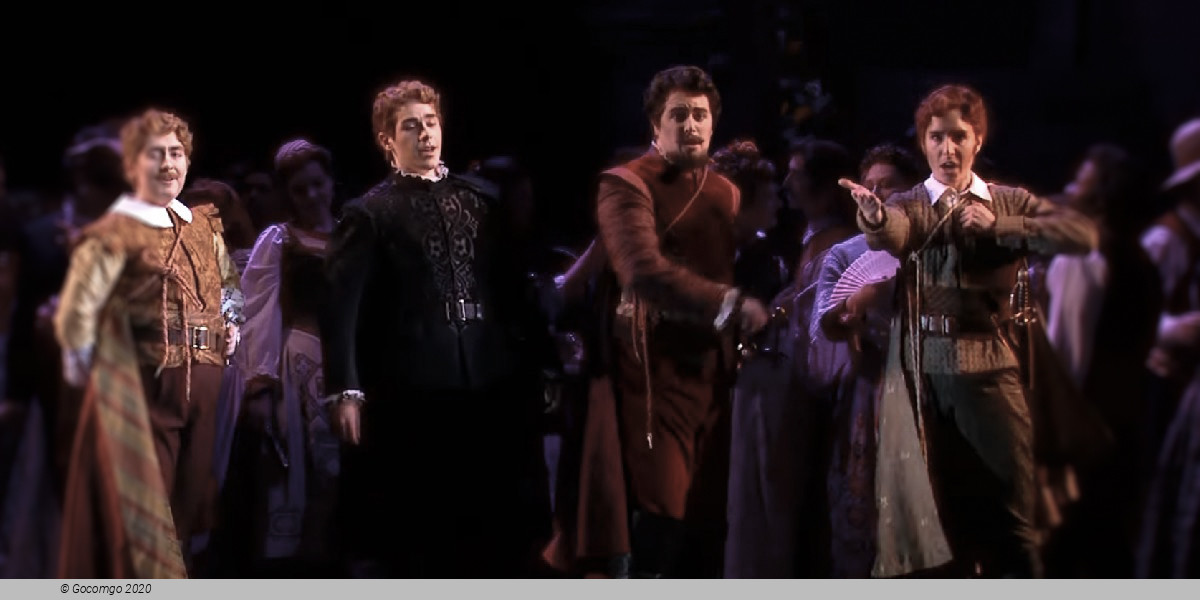
A festival is being celebrated. Four hopeful admirers of Dulcinée serenade her from the street. Dulcinée appears and explains philosophically that being adored is not enough, 'Quand la femme a vingt ans' ('When a woman is twenty'). She withdraws and a crowd, largely of beggars, acclaim the arrival of the eccentric knight Don Quichotte (riding on his horse Rossinante) and his comic squire Sancho Panza (on a donkey). Delighted by their attention, Don Quichotte tells a reluctant Sancho to throw them money. After the crowd disperse, Don Quichotte himself serenades Dulcinée, 'Quand apparaissent les étoiles' ('When the stars begin to shine') but he is stopped by Juan, a jealous admirer of the local beauty. A sword fight follows, interrupted by Dulcinée herself. She is charmed by Don Quichotte's antique attentions, chides Juan for his jealousy and sends him away. The old man offers her his devotion and a castle. She suggests instead that he might retrieve a pearl necklace of hers stolen by Ténébrun, the bandit chief. He undertakes to do so, and Dulcinée quickly rejoins her men friends.

Act 2
In the countryside

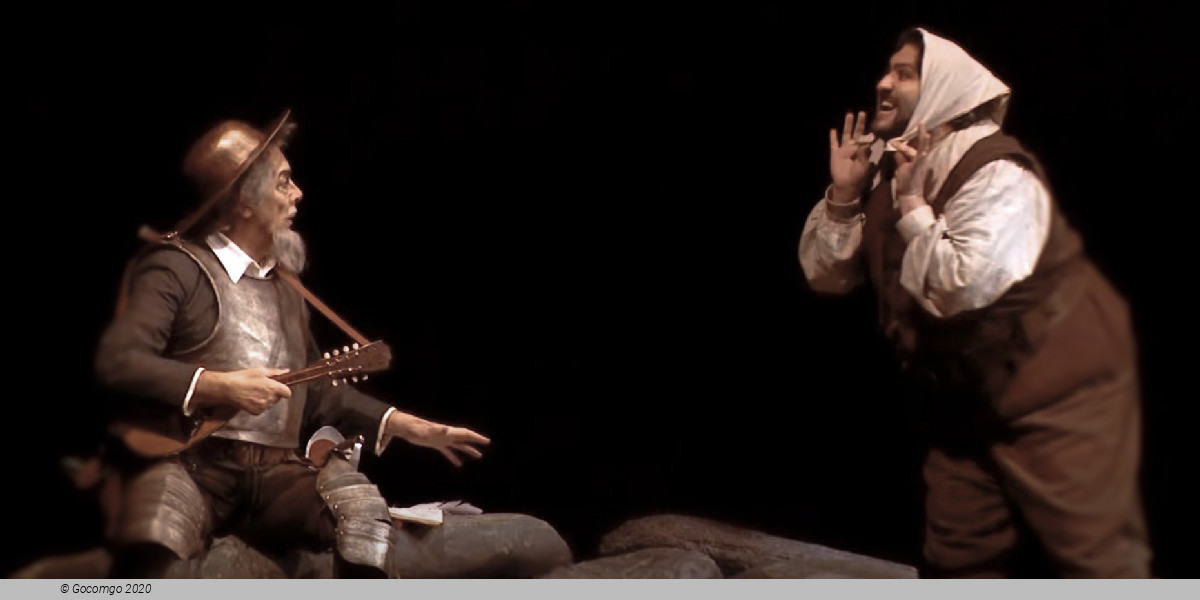
A misty morning, Don Quichotte and Sancho enter with Rossinante and the donkey. Don Quichotte is composing a love poem. Sancho delivers a grand tirade against their expedition, against Dulcinée, and against women in general. 'Comment peut-on penser du bien de ces coquines' ('How can anyone think anything good of those hussies'). The mists disperse revealing a line of windmills that Don Quichotte takes for a group of giants. To Sancho's horror, Don Quichotte attacks the first one, only to be caught up in one of the sails and hoisted up in the air.

Act 3
In the mountains

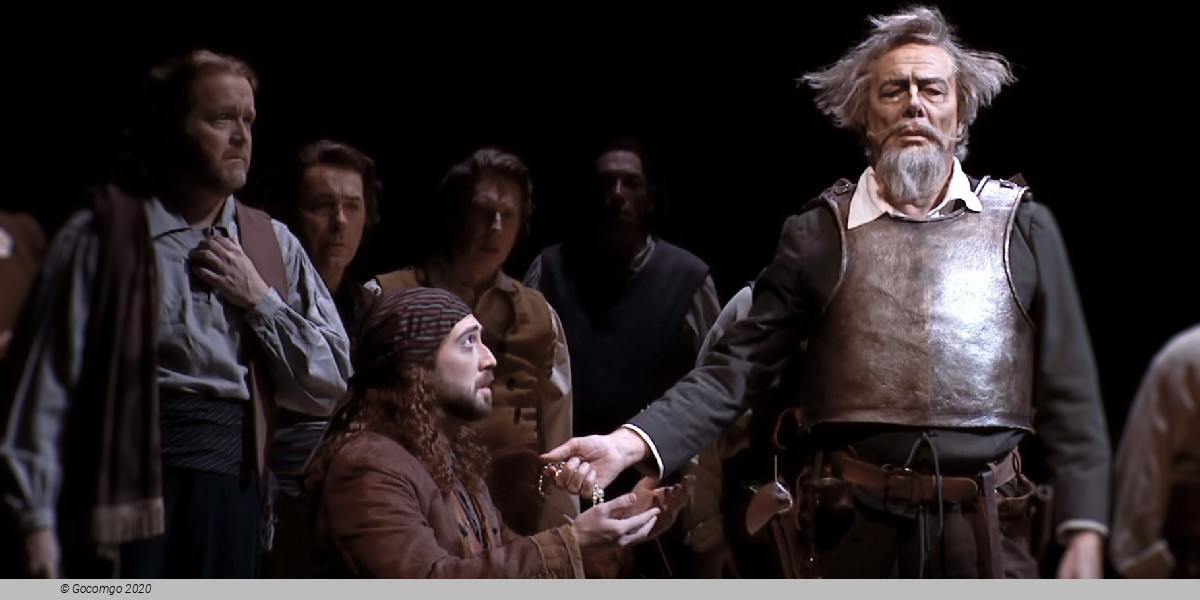
Dusk, Don Quichotte believes they are getting close to the bandits. Sancho goes to sleep while Don Quichotte stands guard. The bandits suddenly appear and after a brief fight take the knight prisoner. Sancho escapes. Surprised by the defiance of the old man, the bandits give him a beating and intend to kill him, however Don Quichotte's prayer 'Seigneur, reçois mon âme, elle n'est pas méchante' ('Lord receive my soul, it is not evil') moves Ténébrun, the bandit chief, to mercy. Don Quichotte explains his mission 'Je suis le chevalier errant' ('I am the Knight-errant'), and the necklace is returned to him. The bandits ask for the blessing of the noble knight before he leaves.

Act 4
The garden of Dulcinée's House

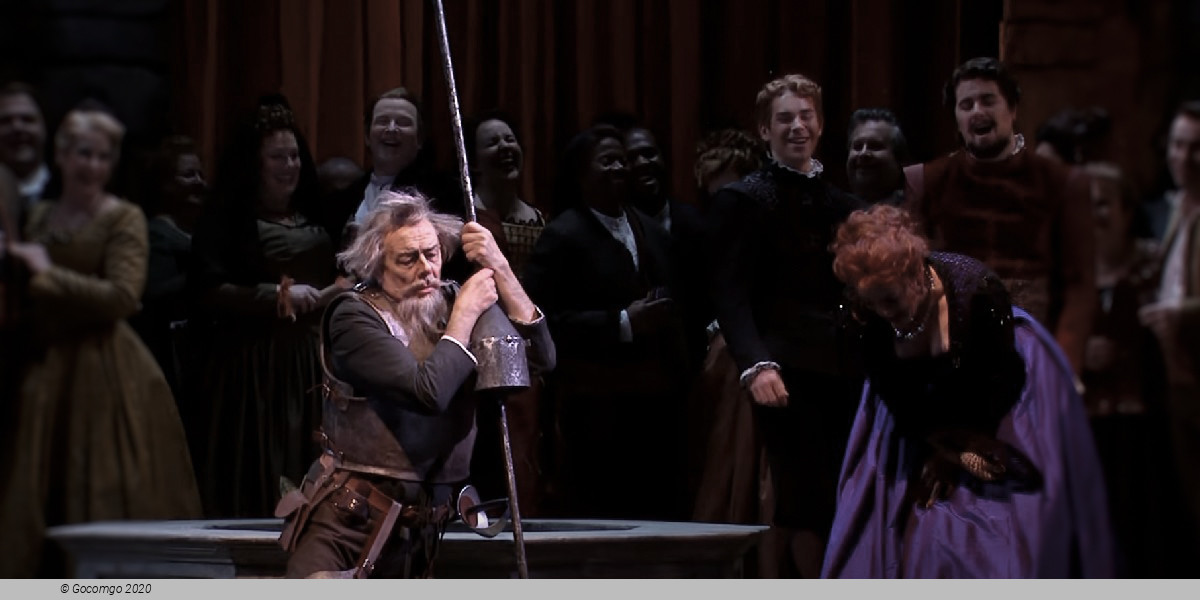
Music and dancing, a party is in progress, but Dulcinée is melancholy, 'Lorsque le temps d'amour a fui' ('When the time of love has gone'). Rousing herself, she snatches a guitar and sings 'Ne pensons qu'au plaisir d'aimer' ('Think just of the pleasures of love'). All retire to dinner. Sancho and Don Quichotte arrive. While waiting for Dulcinée, Sancho asks for his reward to which Don Quichotte responds with vague promises of an island, a castle, riches. Dulcinée and her party greet the knight and he returns the necklace to universal acclaim. However, when he asks her to marry him he is greeted with hysterical laughter. Taking pity, Dulcinée tells the others to leave, apologizes 'Oui, je souffre votre tristesse, et j'ai vraiment chagrin à vous désemparer' ('I share your sorrow and am truly sorry') but explains that her destiny, her way of life, is different from his. She kisses him on the forehead and leaves. But the company return to make fun of the old man. Sancho vigorously upbraids them, 'Riez, allez, riez du pauvre idéologue' ('Laugh, laugh at this poor idealist') and takes his master away.

Act 5
A mountain pass in an ancient forest

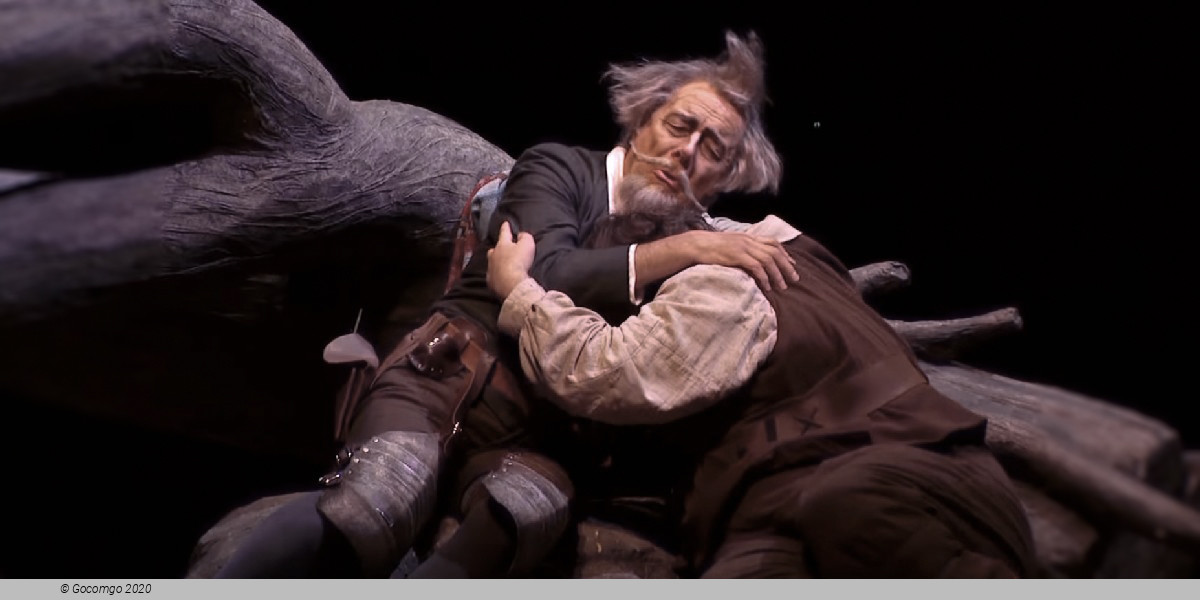
A clear starry night, Don Quichotte is dying. He remembers once promising Sancho an island as his reward, and offers him an isle of dreams, 'Prends cette île' ('Take that isle'). Nearing death, Don Quichotte looks up at a star shining brightly above and hears the voice of Dulcinée calling him to another world. Then he collapses as Sancho weeps over his body.

Venue Info

Deutsche Oper Berlin - Berlin
Location   Bismarckstraße 35

Venue's Capacity: 1698

The Deutsche Oper Berlin is an opera company located in the Charlottenburg district of Berlin, Germany. The resident building is the country's second-largest opera house and also home to the Berlin State Ballet. Since 2004 the Deutsche Oper Berlin, like the Staatsoper Unter den Linden (Berlin State Opera), the Komische Oper Berlin, the Berlin State Ballet, and the Bühnenservice Berlin (Stage and Costume Design), has been a member of the Berlin Opera Foundation.

The company's history goes back to the Deutsches Opernhaus built by the then independent city of Charlottenburg—the "richest town of Prussia"—according to plans designed by Heinrich Seeling from 1911. It opened on November 7, 1912 with a performance of Beethoven's Fidelio, conducted by Ignatz Waghalter. In 1925, after the incorporation of Charlottenburg by the 1920 Greater Berlin Act, the name of the resident building was changed to Städtische Oper (Municipal Opera).

With the Nazi seizure of power in 1933, the opera was under control of the Reich Ministry of Public Enlightenment and Propaganda. Minister Joseph Goebbels had the name changed back to Deutsches Opernhaus, competing with the Berlin State Opera in Mitte controlled by his rival, the Prussian minister-president Hermann Göring. In 1935, the building was remodeled by Paul Baumgarten and the seating reduced from 2300 to 2098. Carl Ebert, the pre-World War II general manager, chose to emigrate from Germany rather than endorse the Nazi view of music, and went on to co-found the Glyndebourne opera festival in England. He was replaced by Max von Schillings, who acceded to enact works of "unalloyed German character". Several artists, like the conductor Fritz Stiedry and the singer Alexander Kipnis, followed Ebert into emigration. The opera house was destroyed by a RAF air raid on 23 November 1943. Performances continued at the Admiralspalast in Mitte until 1945. Ebert returned as general manager after the war.

After the war, in what was now West Berlin, the company, again called Städtische Oper, used the nearby Theater des Westens; its opening production was Fidelio, on 4 September 1945. Its home was finally rebuilt in 1961 but to a much-changed, sober design by Fritz Bornemann. The opening production of the newly named Deutsche Oper, on 24 September, was Mozart's Don Giovanni.

Past Generalmusikdirektoren (GMD, general music directors) have included Bruno Walter, Kurt Adler, Ferenc Fricsay, Lorin Maazel, Gerd Albrecht, Jesús López-Cobos, and Christian Thielemann. In October 2005, the Italian conductor Renato Palumbo was appointed GMD as of the 2006/2007 season. In October 2007, the Deutsche Oper announced the appointment of Donald Runnicles as their next Generalmusikdirektor, effective August 2009, for an initial contract of five years. Simultaneously, Palumbo and the Deutsche Oper mutually agreed to terminate his contract, effective November 2007.

On the evening of 2 June 1967, Benno Ohnesorg, a student taking part in the German student movement, was shot in the streets around the opera house. He had been protesting against the visit to Germany by the Shah of Iran, who was attending a performance of Mozart's The Magic Flute.

In 1986 the American Berlin Opera Foundation was founded.

In April 2001, the Italian conductor Giuseppe Sinopoli died at the podium while conducting Verdi's Aida, at age 54.

In September 2006, the Deutsche Oper's Intendantin (general manager) Kirsten Harms drew criticism after she cancelled the production of Mozart's opera Idomeneo by Hans Neuenfels, because of fears that a scene in it featuring the severed heads of Jesus, Buddha and Muhammad would offend Muslims, and that the opera house's security might come under threat if violent protests took place. Critics of the decision include German Ministers and the German Chancellor Angela Merkel. The reaction from Muslims has been mixed — the leader of Germany's Islamic Council welcomed the decision, whilst a leader of Germany's Turkish community, criticising the decision, said:

This is about art, not about politics ... We should not make art dependent on religion — then we are back in the Middle Ages.

At the end of October 2006, the opera house announced that performances of Mozart's opera Idomeneo would then proceed. Kirsten Harms, after announcing in 2009 that she would not renew her contract beyond 2011, was bid farewell in July of that year.

Important Info
Type: Opera
City: Berlin, Germany
Starts at: 18:00
Acts: 5
Intervals: 1
Duration: 2h 15min
Sung in: French
Titles in: German,English
Top of page